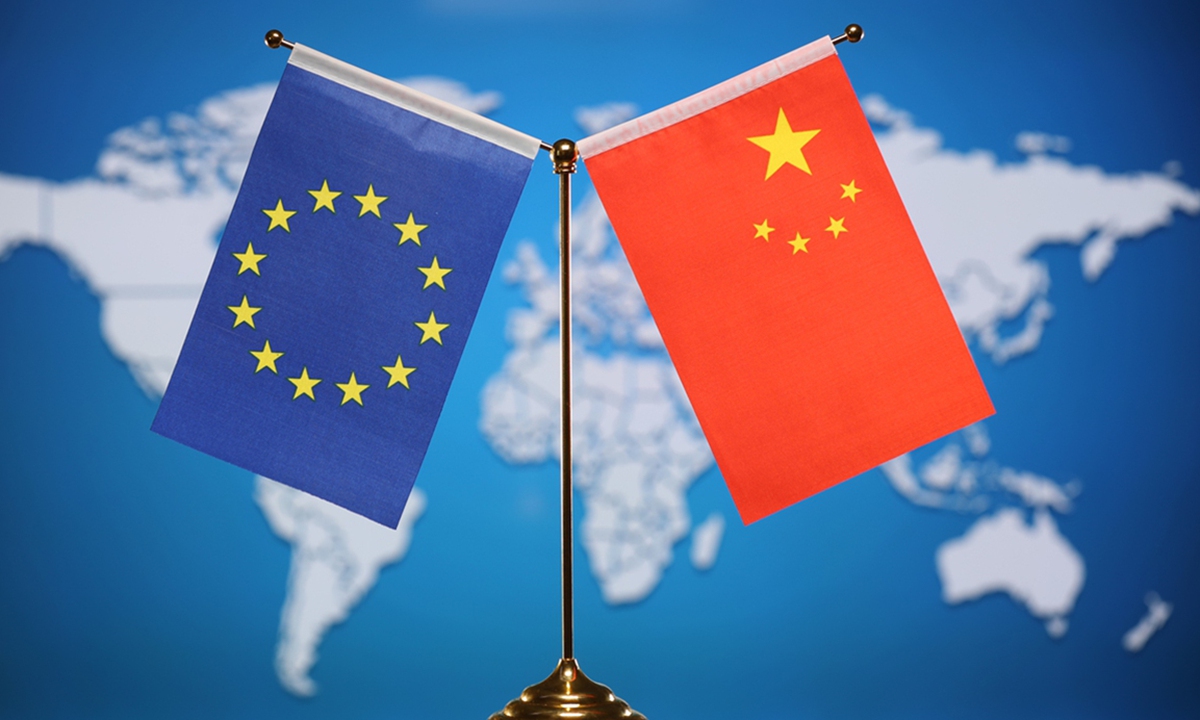
China EU Photo:VCG
Europe has increasingly adopted a dual-track approach in its economic and trade negotiations with China, talking while applying pressure. On the one hand, there is dialogue. In early October, the second meeting of the China-EU trade and investment consultation mechanism was held in Beijing, with the two sides reaching agreement on a list of 16 specific points of consensus. More recently, French President's Diplomatic Adviser Emmanuel Bonne, German President Frank-Walter Steinmeier, and Bernd Lange, Chair of the European Parliament's Committee on International Trade, have each led delegations to China. The European side has continued to signal its reluctance to engage in a trade war with China and its willingness to resolve trade and economic differences through dialogue and consultation.
On the other hand, there is pressuring. At its autumn summit, the EU placed a proposed "kill switch" instrument, jointly put forward by France and Germany, high on its agenda. The mechanism would allow the bloc to shut its market to external parties when deemed necessary. The EU also intends to replicate its trade arrangement on Chinese hybrid vehicles in more sectors, including chemicals and machinery. Media reports have revealed that the bloc plans to impose further import caps or tariffs on Chinese products in which China has a competitive advantage, potentially as early as the first quarter of 2027. Meanwhile, calls within Europe for invoking the EU's "Anti-Coercion Instrument" (ACI) against China continue to grow louder.
The EU's strategy brings to mind a rather telling image: One hand extends a business card across the negotiating table, while the other sharpens a knife underneath it. Brussels says it does not want a trade war, yet its toolbox of trade restrictions continues to expand. For the EU today, however, this is less a case of walking on two legs than of tripping over its own feet. The fundamental contradiction in its dual-track strategy stems from three major miscalculations.
First, China will not accept pressure as a means of extracting concessions. European Commission President Ursula von der Leyen has repeatedly invoked the narrative that the EU's trade deficit with China reaches 1 billion euros ($1.12 billion) a day. Leaving aside the considerable distortions and one-sidedness in this figure, China has nevertheless taken full account of the difficulties facing Europe and reached pragmatic arrangements with the European side to address bilateral trade and economic differences, on the basis of equality and mutual benefit and in accordance with WTO rules. China's willingness to do so has absolutely nothing to do with any fear of the Franco-German "kill switch" or the EU's ACI. In fact, China has never yielded to a strategy of maximum pressure, as its economic and trade negotiations with the US have made abundantly clear. The Chinese government has also made its position explicit: Europe should not expect to extract benefits through pressure, nor should it underestimate China's resolve and ability to safeguard its own interests.
The prerequisite for dialogue to produce substantive results is, ultimately, that both sides believe commitments made at the negotiating table are credible. The EU's practice of negotiating while applying pressure sends precisely the opposite signal: Agreements reached through dialogue do not necessarily constrain either side from taking unilateral action. If the outcomes of negotiations can be overturned at any moment, or subjected to additional conditions and renegotiated terms, what is the point of dialogue in the first place? As the EU's list of pressure tactics continues to grow while the outcomes of negotiations remain slow to materialize, mutual trust between China and Europe will gradually erode. This could well become the greatest risk facing their economic and trade relations in the years ahead.
Second, the EU mistakes China's economic resilience for a vulnerability rooted in dependence on Europe. Some in Europe believe that China's insufficient domestic demand and alleged industrial overcapacity make it dependent on the European market. The facts and figures tell a very different story. Consumption has long been the main engine of China's economic growth, with domestic demand serving as a key pillar. In 2025, the contribution rate of final consumption expenditure to economic growth stood at 52 percent. China's total retail sales of consumer goods exceeded 50 trillion yuan ($7.15 trillion), making it the world's second-largest consumer market and the world's second-largest importer. In the first three quarters of 2026, domestic demand accounted for as much as 74.8 percent of China's economic growth.
The picture is equally clear when it comes to industrial capacity. China's capacity utilization rate of industrial enterprises above the designated size nationwide was 74.4 percent in 2025, reflecting an overall balance between industrial supply and demand. The capacity utilization is even higher in high-tech manufacturing and strategic emerging industries. The temporarily lower capacity utilization in some traditional industries represents a localized and dynamic adjustment in the course of industrial upgrading, and is part of China's own strategic choice to foster new quality productive forces. If the European side assumes that China cannot sell its products and will therefore soften its position at the negotiating table, it is misjudging not only China's determination to defend its interests, but also the formidable resilience and confidence underpinning China's high-quality development.
Third, expanding trade restrictions against China will ultimately backfire on Europe itself. Most of the Chinese products that the EU plans to subject to further import restrictions are intermediate goods essential to European industrial production. These high-quality, competitively priced products account for approximately half of China's total exports to Europe. At a time when energy prices and labor costs in Europe continue to rise, they play a crucial role in reducing production costs and enhancing the competitiveness of European exports.
The EU regards its quota for China-EU hybrid vehicle trade as an example of successful pressure on China, and plans to replicate this approach in sectors such as chemicals and machinery. This wishful thinking overlooks a fundamental distinction: Automobiles are finished consumer goods, for which import quotas may indeed narrow trade imbalances in the short term. Chemicals and machinery, by contrast, are largely inputs for production and indispensable to the normal operation of European manufacturing. Economically speaking, simply copying and pasting the quota-based restrictions used for finished consumer goods into the intermediate goods sector makes little sense. If implemented, such measures would hit downstream industries across Europe first and hardest, pushing up their production costs and directly undermining the EU's own goal of protecting industrial competitiveness.
Europe's own economic circumstances simply cannot sustain a strategy of applying pressure on China. Estimates by the European Central Bank and other institutions indicate that decoupling from China could add approximately 200 billion euros (approximately $224.4 billion) in costs annually. If Chinese suppliers were excluded from 10 key sectors, the EU could lose 840 billion euros ($942.4 billion) over the next five years. European politicians would do well to run these numbers for themselves.
Recent large-scale protests in several European countries have largely reflected domestic concerns, including soaring energy prices, sluggish economic growth and inadequate public spending on people's livelihoods. These grievances share some underlying causes with what lies behind the so-called China-EU trade imbalance. Blaming China for Europe's problems is misguided to begin with; prescribing protectionism as the cure is even more misguided, amounting to a desperate attempt to treat the symptoms while ignoring the disease. China's position is equally clear: China is not the source of Europe's problems, but a partner in addressing them.
The author is an international affairs observer. opinion@globaltimes.com.cn
RELATED ARTICLES