A five-euro ‘toll’: Europe shouldn’t be penny-wise and pound-foolish: Global Times editorial
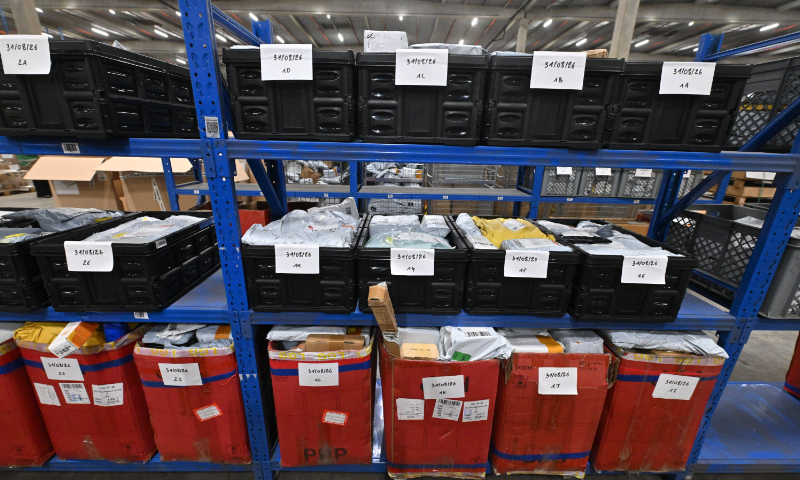
Photo taken on September 3, 2026 shows e-commerce parcels stored at a warehouse near Liege Airport in Grace-Hollogne, Belgium. Photo: VCG
The five-euro charge needs to be viewed in the context of the overall scale of China-EU trade. The nature of this policy is even more worthy of deep consideration. Such a penny-wise, pound-foolish approach may appear to bolster government coffers in the short term, but it comes at the expense of Europe's long-term economic vitality. It will also create unnecessary friction in the mutually beneficial economic and trade relationship between China and the EU, ultimately harming Europe's own development interests.
The European Union (EU) has imposed a so-called two-euro "handling fee" on packages from outside the bloc to European consumers since Sunday. Combined with the three-euro charge introduced in July on small packages worth less than 150 euros, this new revenue-grabbing levy brings the fixed customs-clearance costs on a low-value parcel to five euros. What's more, the handling fee will be levied separately for each category of goods in the same parcel. For example, if a parcel contains three categories of goods, the handling fee will amount to six euros, regardless of how many items fall into each category. Given that approximately 93 percent of cheap packages that entered the EU came from China, the move is widely seen as being clearly targeted at Chinese goods.
The five-euro charge needs to be viewed in the context of the overall scale of China-EU trade. More importantly, the nature of this policy is even more worthy of deep consideration. The figures tell a revealing story: 5.9 billion parcels annually, a fixed charge of three to five euros per package, and an annual revenue boost of six billion euros for the EU budget. Combined with the rule allowing fees to accumulate across different product categories, this measure has gone well beyond the traditional role of tariffs in regulating trade. It effectively amounts to an "entry tax" imposed on consumers even before they complete their purchases. Europe once built its identity on free trade. Yet it is now turning into an economy that charges tolls at its own doorstep, parcel by parcel. The more lucrative this toll-collecting business becomes, the further Europe drifts from its original principles.
The money may flow into EU coffers, but ordinary European consumers will bear the costs. The EU claims that the new fee will be paid by platforms and sellers. However, e-commerce platform AliExpress has explicitly warned that the charges would hurt low-income households in Europe and "exacerbate the cost-of-living crisis." The European Consumer Organisation (BEUC) has also expressed concern that some platforms may try to pass these new costs onto consumers at the final stages of the purchase. A three-euro trinket subject to an additional five euros in charges would end up costing more in taxes than the product itself. It is clear whom this kind of measure is really "protecting."
A new wave of protests is currently spreading across Europe. Although the specific demands vary, protesters share common concerns over inadequate public investment and the rising cost of living. The EU's decision to introduce a "toll" on small parcels is, in essence, an attempt to shift its fiscal anxieties onto ordinary citizens through administrative measures. Imposing additional charges on low-value parcels amid high inflation will hit European consumers even harder, and will exacerbate mounting tensions over people's livelihoods and further inflame already strained public sentiment. At a deeper level, such a short-sighted policy choice exposes Europe's strategic confusion amid profound changes in the global economic and trade landscape.
Faced with the rapid growth of cross-border e-commerce and the competitive advantages brought about by China's industrial upgrading, Europe has chosen not to address these challenges by strengthening its own industrial competitiveness and improving the efficiency of its internal market. Instead, it has reverted to the old path of trade protectionism, using administrative barriers to fragment global supply chains. This approach not only runs counter to the free trade principles Europe has long championed but also undermines its credibility in shaping global economic and trade rules. Such a penny-wise, pound-foolish approach may appear to bolster government coffers in the short term, but it comes at the expense of Europe's long-term economic vitality. It will also create unnecessary friction in the mutually beneficial economic and trade relationship between China and the EU, ultimately harming Europe's own development interests.
Tariff barriers cannot resolve Europe's structural problems. The price advantages of Chinese e-commerce stem from the efficiency of its industrial and supply chains, rather than merely from a tax exemption policy. The EU may be able to keep goods out of its market, but it cannot make its domestic supply chains equally efficient overnight. Some European business representatives have put the calculation more bluntly: US tariff hikes have already pushed up the price of European wines in North America by 15 to 25 percent compared with three years ago. Now, with procurement costs from China rising as well, some European buyers are turning to US platforms instead. "Who is the ultimate winner? American companies."
In stark contrast to this wall-building approach lies another path to development. China-EU trade and investment consultations have yielded multiple results, BYD's factory in Hungary is set to begin mass production, the China-Switzerland free trade agreement has been upgraded, and China's hybrid car exports to the EU surged by more than 200 percent year on year in September. On the same continent, two different choices are producing two different outcomes: those building walls are reaping anxiety, while those embracing openness are securing orders.
The small-parcel levy is just one of several restrictive measures introduced by the EU this year. Europe was once among the champions of free trade, yet it is now "closing" its doors through measures that amount to squeezing every last penny out of consumers. Genuine competitiveness is forged through market competition. Translating anxiety into tax rates will only cause Europe to fall further behind amid the technological revolution, while forcing ordinary households to foot the bill for political maneuvering. China and the EU are important economic and trade partners. And China maintains that an open and inclusive international trading environment serves the common interests of all parties. Whether Europe chooses to narrow that door further or open it again is a question whose answer is already clear.
RELATED ARTICLES