China's first commercial-grade solar-powered UAV completes maiden flight
By Du Qiongfang and Published: Nov 11, 2026 08:07 PM

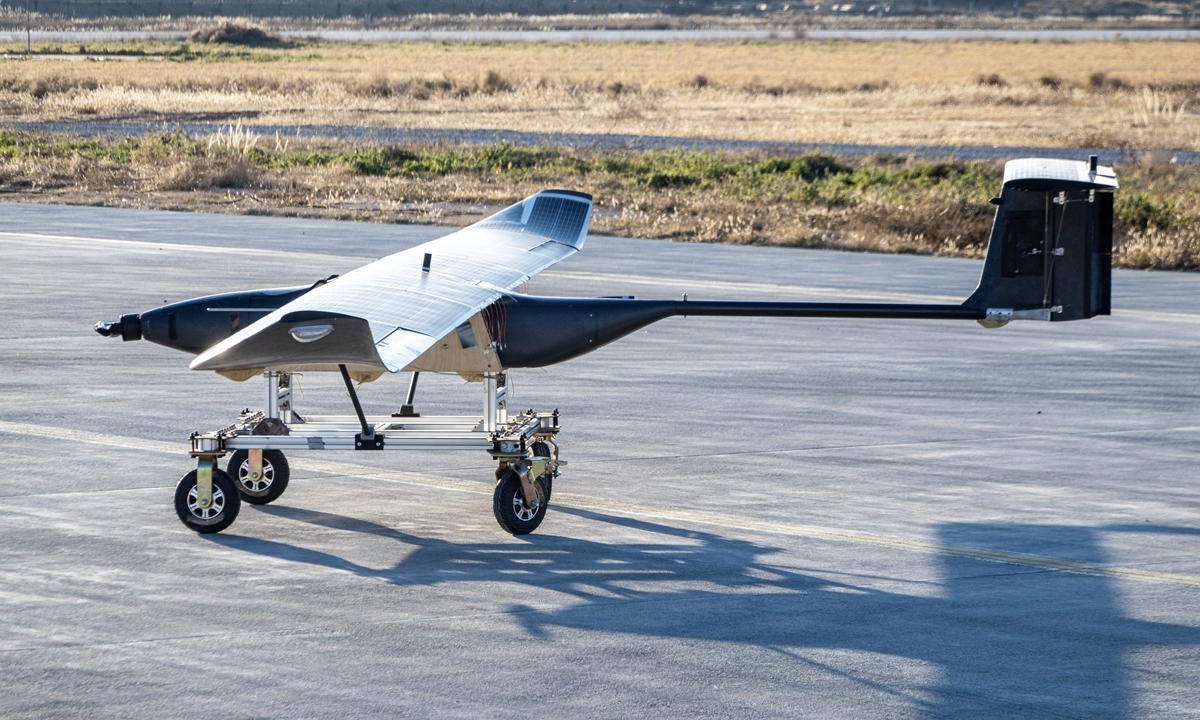
Photo: Courtesy of China Aerospace Science and Technology Corporation
The Light Cavalry, a fully solar-powered unmanned aerial vehicle (UAV) developed by China Aerospace Science and Technology Corporation's 11th Research Institute, successfully completed its maiden flight in Northwest China, marking the transition of solar-powered UAV technology from the laboratory to the market, and paving the way for the commercial application of solar-powered low-altitude aircraft in China, the Global Times learned from the developer on Wednesday.
The UAV successfully completed its maiden flight sequence, from takeoff and climbing to circling and landing, while passing key tests of its flight control, avionics, energy storage systems, as well as its stability and handling. It landed safely in good condition, with all systems functioning normally.
Powered entirely by solar energy, the UAV boasts long endurance, rapid deployment and easy maintenance.
The UAV measures 3.2 meters in length, 8 meters in wingspan, and has a maximum design endurance of 30 hours, a 45-kilogram takeoff weight and a 7,000-meter service ceiling, with a payload capacity exceeding 5 kilograms.
The UAV can be quickly fitted with various types of commercial mission payloads, including electro-optical, communications and detection equipment.
With a vehicle-mounted, runway-independent takeoff system and a ground preparation time of just 20 minutes, the UAV can be rapidly deployed in remote and challenging environments, including mountains, coastlines and wilderness areas, without relying on fixed airfields.
Low-cost, long-endurance solar-powered UAVs represent an emerging global trend in aviation. However, development to date has focused mainly on large and ultra-large solar-powered UAVs. These UAVs serve mainly as research platforms or high-altitude pseudo-satellites.
Small and medium-sized solar-powered UAVs have a wider range of potential applications, but they also face greater technological challenges.
Smaller UAVs leave less room for solar panels, while structural, avionics and energy storage components remain relatively heavy, creating a mismatch between energy generation and overall power demands. Advances in materials, motors and energy storage technologies are needed to overcome these constraints.
The developer expects the new UAV to fill a market gap for long-endurance, low-altitude aircraft while addressing conventional UAVs' limited endurance, high operational carbon emissions and insufficient capacity for sustained operations over large areas, the Science and Technology Daily reported.
The UAV is suited to a wide range of applications, including infrastructure inspections, water conservancy monitoring, land surveying, ecological observation, disaster assessment and large-scale surveillance of coastlines and ports.
RELATED ARTICLES