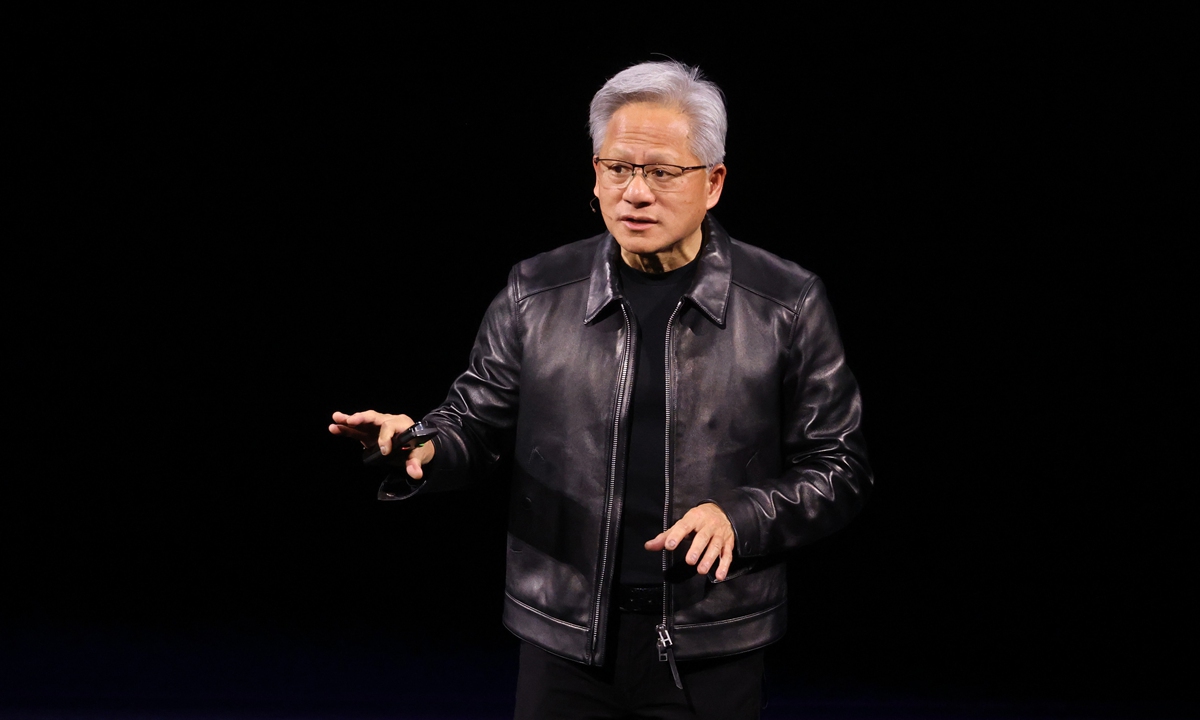
Jensen Huang. Photo: VCG
Jensen Huang's extramarital affair has sent some people in the US into a frenzy of anti-China "witch-hunting." Since The New York Times published the paparazzi-style article that ignited the controversy on October 29, it has followed up with several more pieces within a week, persistently trying to drag China into the mud. Just as these allegations were struggling to gain traction due to a lack of hard evidence, Bloomberg came along with a supposedly "timely" revelation that China's Moonshot AI had rented Nvidia GPUs for its Kimi K3 model.
And that is not all. On November 4, a day after the US midterm elections officially began, three House committee chairs jointly sent a letter to Huang, demanding that he attend a closed-door briefing. On November 7, a US lawmaker said efforts were underway to launch an investigation. One day later, Huang acknowledged the alleged affair. On November 9, lawmakers from both parties jointly called for Congress to take immediate action. On November 10 - the same day Bloomberg published its Kimi report - Senate Democratic Leader Chuck Schumer urged Congress to pass three bills tightening restrictions on chip exports to China. Nvidia, for its part, is the biggest opponent of the Chip Security Act and the AI Overwatch Act. Meanwhile, US media outlets have widely reported that US President Donald Trump is expected to travel to Shenzhen, China, to attend the APEC Economic Leaders' Meeting.
The sheer number of these "coincidences" is enough to raise some reasonable questions: Who is driving, who is amplifying, and who stands to benefit from these coincidences? Linking Huang's private affairs to China is purely unsubstantiated and aimed at smearing China. The Chinese side has already made its position clear on multiple occasions. China has no reason to repeatedly prove its innocence in what is essentially an internal political game in the US. But when a story pieced together entirely from "rumors" and "suspicions" is used as a pretext to push substantive measures aimed at containing China and disrupting the stability of China-US relations, the nature of the matter completely changes.
In recent years, from the "balloon incident" to the Huang affair, whenever China-US relations have shown hard-won signs of easing, certain China-related "coincidences" have invariably emerged in Washington, tightening an atmosphere that had only just begun to thaw. More often than not, congressional bills are already lined up before any serious investigation has even begun; the narrative of a "China threat" is already complete before the relevant evidence has been established.
If the calendars of certain people in Washington always move faster than the investigations, it can only mean one thing: Those so-called "coincidences" are never coincidences in the first place.
RELATED ARTICLES