APEC offers major multilateral platform to take China-Australia ties to next stage
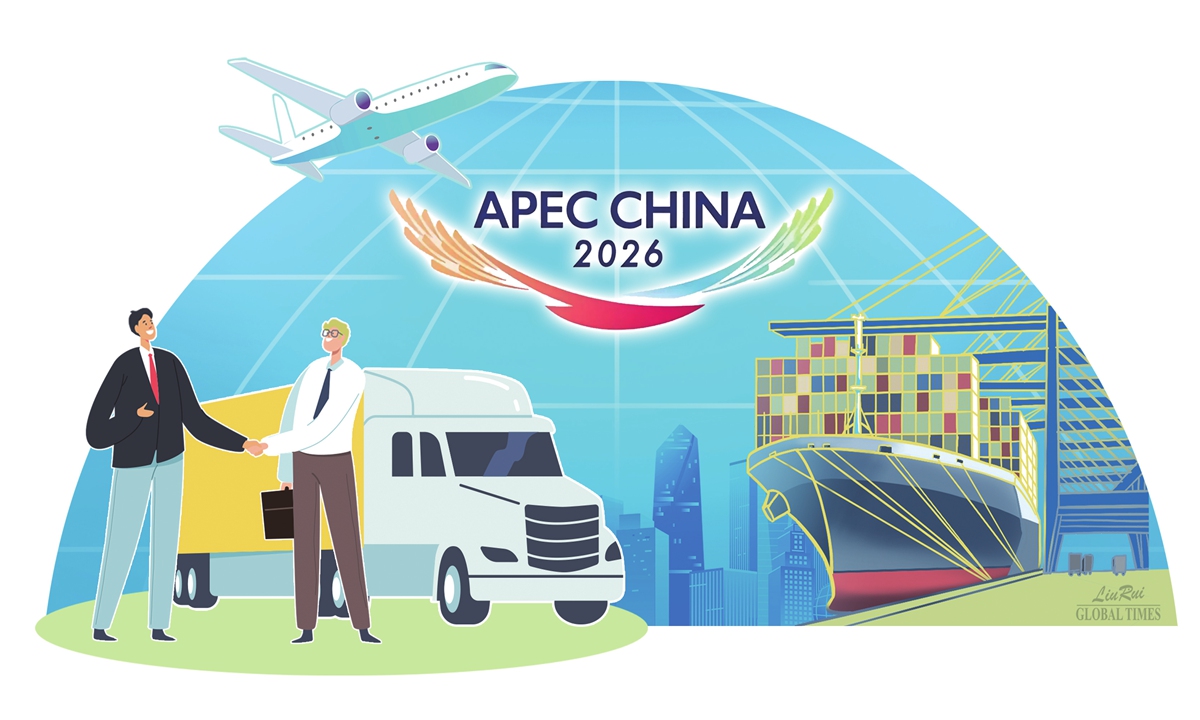
APEC Illustration: Liu Rui/GT
The APEC Economic Leaders' Meeting will take place on November18-19 in Shenzhen, South China's Guangdong Province. Building an Asia-Pacific Community to Prosper Together — this year's overarching APEC theme — means, above all, defending the global multilateral system on which the region's prosperity depends, in a period when global protectionism is on a dangerous rise.
APEC's strength lies in its commitment to openness and inclusiveness, not just as a principle in the conduct of economic policy but in political dealings. That's the core principle of treatment of others on the basis of equality. Those principles have been critical to the region's economic success, and they're also key to political civility and stability - serving as the anchor to building a viable Asia-Pacific Community.
This will be the third time that China has hosted APEC — first in Shanghai in 2001, then in Beijing in 2014. This time, China can show in concrete ways how openness, innovation and cooperation — the priorities of this year's APEC agenda — are essential to building a prosperous Asia-Pacific Community.
At Shenzhen, for example, China could launch work on industrial decarbonization strategies to help meet climate goals. Engaging APEC partners in pathfinder initiatives on industrial decarbonization across member economies would build the support needed to advance that agenda most efficiently. APEC could also use its peer-review processes to assess the impact of fossil fuel subsidies.
Within the Asia-Pacific market, there are significant opportunities for more productive patterns of trade and industrial production through deepening specialization across regional supply chains. China can take up these issues in APEC and carry them forward through regional trade arrangements such as RCEP, helping avert protectionist responses to the big transformation of trade that is underway in our region and globally. As a large economy with a major imprint on international trade, China could engage its partners proactively to ease the impact of these changes.
Bilateral relations
Australian Prime Minister Anthony Albanese said at a press conference in Gyeongju, South Korea in November 2025 that he looked forward to attending the APEC gathering in Shenzhen. This sequence shows how the regional and bilateral tracks of the China-Australia relationship reinforce each other.
In recent years, China-Australia relations have been on a path of stabilization and improvement. At the heart of that progress is our deep complementarity — and its scale and importance to both our economies and to the wider region.

Peter Drysdale
China produces more than half of the world's steel, and Australia supplies more than half of the world's iron ore, most of it to China. That is heft we can put to work together to transform the industry in line with our national climate goals. We can lead the way jointly on this agenda — bilaterally, regionally, in APEC, and globally.The APEC framework is the regional embodiment of the core elements of the open, rules-based global order from which both countries have benefited so greatly, not least through the growth of the China-Australia relationship. It offers a major multilateral setting in which to take that bilateral relationship to the next stage, in line with the shared interests of China and Australiain the region and globally.
We already have a substantial bilateral agenda — for example, decarbonizing our currently carbon-intensive trade and industrial ties in the iron and steel industry. Bilateral work on that has begun and will need leaders' attention and top-level support. There will be better progress if we also work through the scope of what is involved with our partners in APEC and elsewhere. An APEC pathfinder on industrial decarbonization, launched at Shenzhen, would be a natural place to start.
That is the APEC way: Bilateral initiatives that are explained to partners first, and kept open to others on a non-discriminatory basis, become building blocks for the region as a whole and opportunities that others can join.
Even more importantly, we are both invested in APEC and its principles. APEC remains among the world's strongest and most important bulwarks against the breakdown of the multilateral system that underpins the global order and continuing prosperity. Among the major economic regions, the Asia-Pacific stands out for its openness and inclusiveness. There is much more we can do together to defend that.
There will also be focus at the Shenzhen summit on the exchanges between China and the US, the world's two largest economies. APEC is a vehicle for managing China-US relations in a multilateral framework. Too much is at stake for the US in our region. APEC is too valuable for managing economic and political relations there, and for American business it remains too useful a channel for engaging counterparts and governments across the region for the United States to step back from APEC. Keeping a strategic focus on the long-term vision of a Free Trade Area of the Asia-Pacific is important to sustained US engagement. A stable relationship between the two biggest economies is a public good for the whole region, and the rest of us have a stake in that and a part to play.
Middle-sized economies such as Australia, Japan, Korea and the ASEAN members contribute to that stability — and to their own growth — through the cooperation they build with one another and with both major powers.
The author is Emeritus Professor of Economics, Head of the East Asian Bureau of Economic Research at the Australian National University and Editor-in-Chief of East Asia Forum. He is widely acknowledged as the intellectual architect of APEC.
RELATED ARTICLES