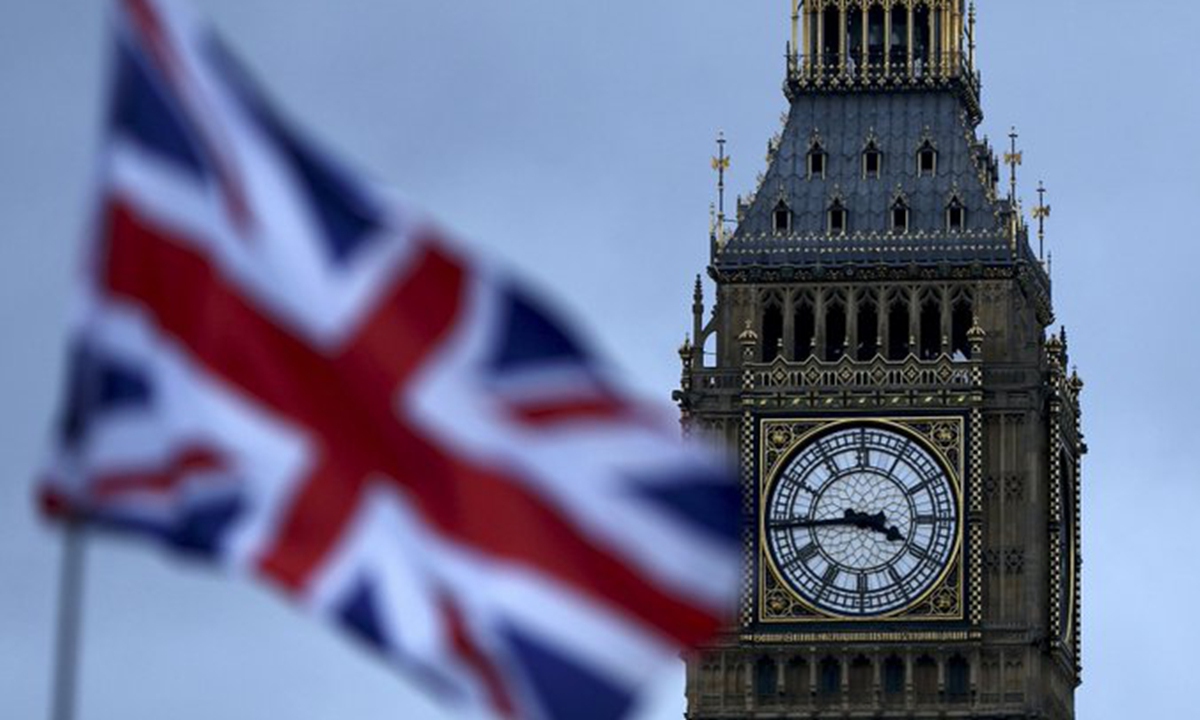
UK Photo: Xinhua
Recently, the Financial Times published an article titled "UK diplomacy suffers exodus of China experts," warning that this trend risks eroding the UK's policy‑making capacity amid geopolitical upheaval. The report noted that several China‑literate diplomats have drifted away from Whitehall's decision‑making circles, warning that a shortage of China specialists is a key vulnerability for the UK.
The turning point in Britain's China perception came under Boris Johnson's administration. In David Cameron's cabinet, China experts - including George Osborne and Jeremy Hunt, former chancellors of the exchequer - played an influential role in the decision-making process. Fueled by Brexit, a populist shift led the ruling establishment to adopt a confrontational posture toward China, gradually sidelining China experts from core decision‑making. Without sufficient analysis, the Johnson administration labeled China a "systemic rival." From that point onward, the UK's China policy amounted to little more than theoretical speculation detached from reality.
Populism has pushed the UK toward narrow-minded nationalism. Once the leadership preemptively labels China a potential "threat," officials who take a rational view of China lose the room to maneuver: Pragmatic voices are either marginalized as dissent, or officials voluntarily distance themselves from the political posturing surrounding China policy to avoid being branded "politically incorrect." The dominance of populist forces in decision-making is the root cause of the UK's growing inability to see China's true nature.
From Boris Johnson to Rishi Sunak, successive British prime ministers suspended high-level exchanges with China. Through this period, rational assessments within the Foreign Office were consistently eclipsed by the "China threat" narrative peddled by security agencies. By the latter part of Sunak's tenure, the Foreign Office was acutely aware of its deficit in China expertise. Yet the British government could not clearly articulate what exactly constituted the threat posed by China.
The Labour government under Keir Starmer, which took office in 2024, pledged in its election manifesto to roll out a long‑term China strategy and set "cooperation" as the central theme of its China policy.
However, the Labour government prioritized domestic issues and focused its diplomatic energy largely on Europe; its China policy was not truly reset but was, in fact, deliberately shelved.
The UK's review of its China policy has been deliberately shrouded in secrecy, driven by two practical dilemmas. For one thing, policymakers themselves lack a clear understanding of China and cannot articulate a coherent position toward the country. For another, the Labour Party is reluctant to challenge the "political correctness" toward China established by the Conservative Party, nor can it identify a viable path to break with the old and forge a new one. British Prime Minister Andy Burnham therefore lacks the resolve and motivation to adjust the country's approach toward China.
Faced with the steady loss of China experts from the decision-making circle, the British Foreign Office has introduced remedial measures. These include allocating 5 million pounds ($6.63 million), and holding multiple one-day training sessions in an effort to boost civil servants' China-related expertise.
However, these measures fail to address the real problem. Far from fostering trainees' objective understanding of China, they risk further distorting their perceptions of reality. When the UK talks about "building up China‑related expertise," its goal may not be pragmatic engagement with China, but rather to find effective tools for confronting it. Many British politicians remain accustomed to drawing parallels with the Cold War-era confrontation with the former Soviet Union, and some even complain that today's pool of China specialists is smaller than the pool of Soviet experts in the early Cold War era.
This is clearly a continuation of Cold War mentality, with the British government preemptively viewing China as a potential "threat" to the UK. On this trajectory, the UK will never cultivate genuine China experts, because it is fundamentally on the wrong path.
China is not the former Soviet Union, nor is today's international community defined by a Cold War structure. Unless the UK changes its mindset, its China policy and the reality of China's development will remain parallel tracks that never converge. No number of so‑called China specialists will bring it any closer to understanding China. This is the crux of the problem - a formidable barrier for Britain that will not be overcome any time soon.
The author is a think tank researcher at the Centre for British Studies, Shanghai Academy of Global Governance and Area Studies, Shanghai International Studies University. opinion@globaltimes.com.cn
RELATED ARTICLES