ARTS / CULTURE & LEISURE
Chinese actress Zhao Liying's lawsuit spotlights AI misuse as experts urge stronger oversight
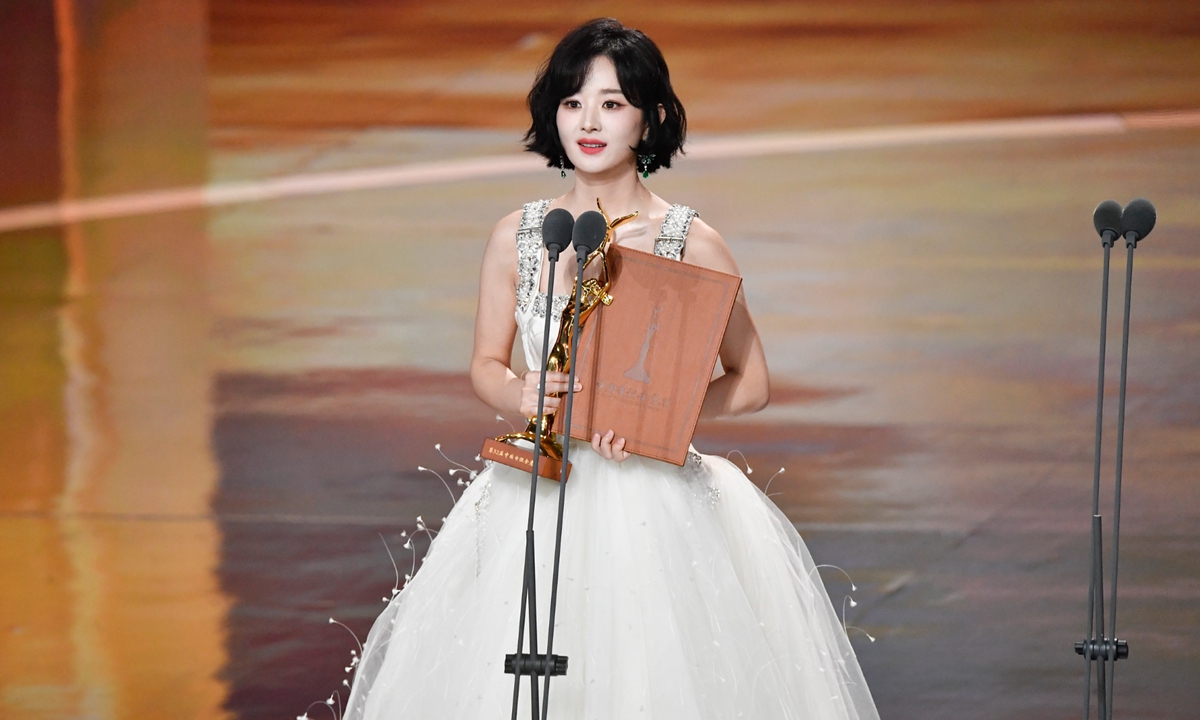
Chinese actress Zhao Liying Photo: VCG
Chinese actress Zhao Liying has reportedly sued the operator of popular short-drama platform Hongguo Short Drama and its parent company Douyin over the alleged unauthorized use of her likeness, bringing renewed attention to the growing problem of AI-generated content using celebrities' faces and voices without their consent.According to a report by the Dahe Daily, business information platform Qichacha recently showed that the Beijing Bimo Liuxiang Technology Co Ltd had a court hearing notice added to its records. The case, which was scheduled for Tuesday at the Mentougou District People's Court in Beijing, lists Zhao as the plaintiff and Beijing Douyin Information Service Co Ltd, Beijing Bimo Liuxiang Technology and an individual identified by the surname Shi as defendants.
Qichacha records show that Beijing Bimo Liuxiang Technology, established in July 2021, is wholly owned by Beijing Douyin Information Service and is associated with Hongguo Short Drama, a popular short-drama app in China.
The case has also become a trending topic on China's X-like platform Sina Weibo. Some users have posted screenshots and clips from AI-generated short dramas on Hongguo featuring characters whose faces resemble Zhao, as well as scenes with AI-generated voices that sound similar to hers. The posts have fueled wider online discussions about the unauthorized use of people's likenesses and voices in AI-generated content.
Zhao's case is among a growing number of controversies involving the unauthorized use of celebrities' images in short dramas.
Several other Chinese actors, including Yi Yangqianxi, Yang Zi, Xiao Zhan, Deng Wei and Cheng Yi, have also been embroiled in disputes over the unauthorized use of their likenesses in AI-generated short dramas.
The issue extends beyond celebrities to voice actors, whose voices are increasingly vulnerable to AI replication.
"I have indeed seen many colleagues around me, including myself, whose voices have been used in various types of videos and audio content without our personal authorization," voice actor Ji Guanlin told the Global Times.
She said voice actors have collectively spoken out on social media against such practices, while some have also sought legal remedies.
Under China's Civil Code, a "portrait" refers to an external image of a specific individual that can be used to identify them. This means AI-generated images do not have to be exact replicas of a person's appearance to potentially constitute infringement, according to Li Yunkai, an intellectual property lawyer with the Beijing Tianyuan Law Firm.
Li told the Global Times that the key question is whether the person can be identified by the general public. Comments under videos and discussions on other social media platforms can also be taken into account when determining whether an AI-generated character is recognizable as a particular person.
Additionally, distribution parties may also bear responsibility in these cases, not just the production companies. There is another issue beyond portrait rights. If AI-generated content places a recognizable person in vulgar scenarios, involves false endorsements or portrays them in a negative storyline, it could also infringe upon people's right to protect their reputation, Li said.
Similar protections apply to voices. China's Civil Code stipulates that the protection of a person's voice is governed by the relevant provisions on portrait rights. A September opinion issued by the Supreme People's Court states that using a person's voice as training material for AI without their consent, imitating their timbre, intonation and pronunciation style, and generating synthetic speech that can be recognized as belonging to that person may constitute an infringement of their voice rights.
As complaints mount, regulators are also stepping up oversight.
China's National Radio and Television Administration has launched a two-month campaign, running from November 1 to the end of December, targeting vulgar and homogeneous content in micro short dramas, according to the Xinhua News Agency.
A key focus is tackling the unauthorized use of people's faces and voices, commonly described as "face theft" and "voice theft," and regulating AI-generated short-drama production.
Zhang Peng, a cultural researcher and associate professor at Nanjing Normal University, told the Global Times that AI infringement mainly involves unauthorized face-swapping, voice imitation and the creation of virtual identities using other people's likenesses and voices.
AI has significantly lowered the cost and technical barriers to reproducing personal characteristics, while some creators exploit celebrities' popularity for commercial gain. Platforms' tendency to publish content before addressing complaints, combined with technological limitations in content review and high legal costs, makes infringement difficult to prevent, he said.
He called for clearer responsibilities throughout the production and distribution process, urging platforms to verify authorization, clearly label AI-generated content, remove infringing material promptly and suspend repeat offenders.
Digital watermarking, content-tracing technologies and authorization databases could also help identify unauthorized material, he said.
"Creators should develop the understanding that authorization must come before use," Zhang said, adding that protecting individual's rights while clarifying the responsibilities of technology developers, producers and platforms is essential to ensuring the healthy development of the film and television industry.
RELATED ARTICLES