ARTS / CULTURE & LEISURE
Maximum fine raised to $1.5m under revised Qinshihuang Mausoleum protection regulations
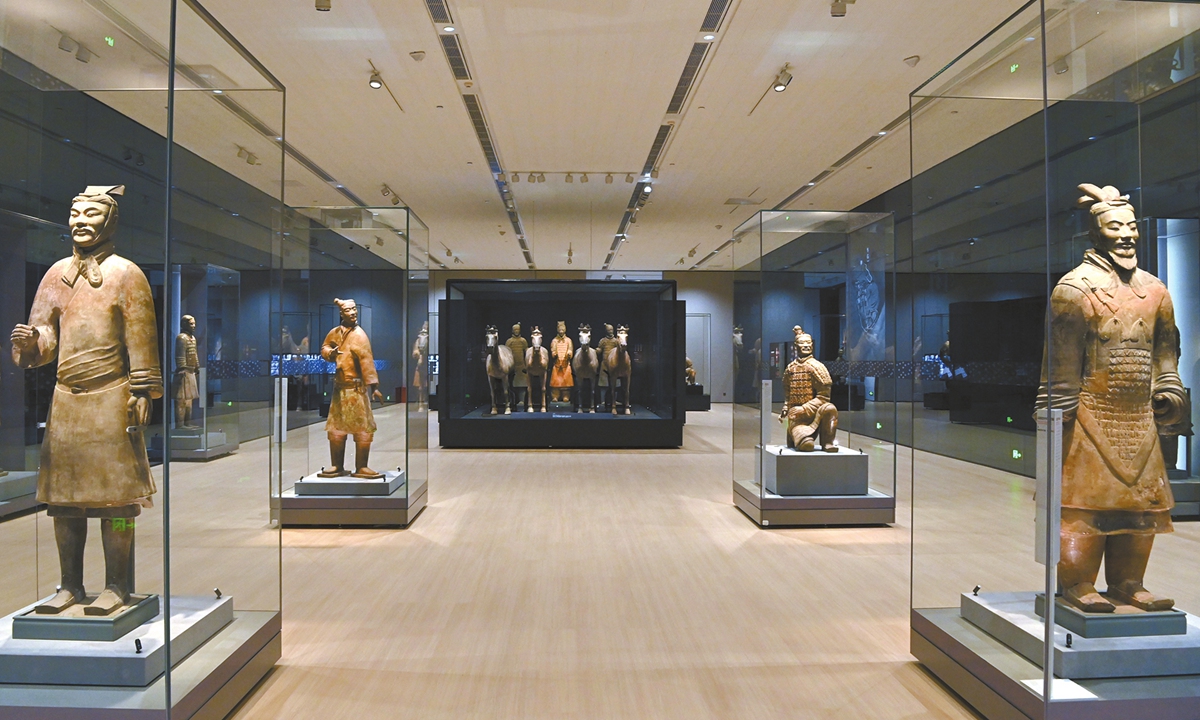
Terracotta warriors are on display at the exhibition in Xi'an to commemorate the 50th anniversary of the discovery of the Terracotta Warriors.
Fines for violating regulations for the protection of the Mausoleum of Qinshihuang have been substantially increased under revised local regulations, with the maximum penalty for offending organizations rising to 10 million yuan ($1.5 million). Emperor Qinshihuang of the Qin Dynasty (221BC-206BC) unified China for the first time.The revised Shaanxi Provincial Regulations on the Protection of the Mausoleum of Qinshihuang recently took effect following amendments adopted by the Standing Committee of the Shaanxi Provincial People's Congress, strengthening controls over construction and other potential threats to the UNESCO World Heritage site.
Under the revised Article 34, organizations found responsible for violations that result in damage to cultural relics or other serious consequences face fines ranging from 500,000 yuan to 5 million yuan, while individuals face fines of between 50,000 yuan and 500,000 yuan.
In particularly serious cases, organizations can be fined up to 10 million yuan. Offenders may also be required to cover the costs of repairing and restoring damaged cultural relics. Additionally, authorities can downgrade the professional qualifications of the organizations involved or revoke their certificates in serious cases.
The provisions cover unauthorized construction, blasting, drilling and excavation within the mausoleum's protected area, as well as construction projects carried out without legally required archaeological surveys and exploration in the protected area or its surrounding construction control zone. They also prohibit construction in the control zone without approval from the relevant cultural relics authorities for the project design.
The Shaanxi provincial regulations, a local legislative framework specifically designed to protect the mausoleum, were first adopted in 2005 and have undergone four rounds of amendments.
The list of prohibited activities has been expanded to include the construction of pollution-generating facilities and the indiscriminate dumping, scattering or burning of solid waste, bringing environmental protection measures more closely in line with cultural heritage conservation.
The revised rules further clarify restrictions on activities within the protected area. In principle, construction projects unrelated to cultural relics protection, as well as blasting, drilling and excavation, are prohibited. Where exceptional circumstances make such activities necessary, approval must be obtained from the National Cultural Heritage Administration and the Shaanxi provincial government.
The Mausoleum of Qinshihuang, located in Xi'an, capital of Northwest China's Shaanxi Province, is one of China's most significant archaeological sites. Its discovery is closely associated with the Terracotta Warriors, the thousands of life-size clay soldiers and horses buried to accompany the emperor in the afterlife. It was included on the World Heritage list by UNESCO in 1987.
"The increase in penalties reflects the growing emphasis on protecting cultural heritage and the recognition that the potential damage caused by unauthorized construction and other activities can be irreversible," Liu Zheng, a member of the Chinese Society of Cultural Relics, told the Global Times.
"Previous fines may not have been sufficient to deter violations, particularly when large-scale construction projects are involved. By significantly raising the financial consequences and clarifying legal responsibilities, the revised regulations are expected to strengthen deterrence, improve compliance and ensure that economic development does not come at the expense of the preservation of important archaeological sites," said Liu.
Ai Jing, a second-level principal staff member with the Legislative Affairs Commission of the Standing Committee of the Shaanxi Provincial People's Congress, said the revision aims to ensure consistency across the legal framework, clarify responsibilities and update regulatory mechanisms, according to the China News Agency.
"It seeks to prioritize the protection of cultural heritage while promoting coordinated development. It also puts into practice the principles of prioritizing protection, strengthening management, exploring cultural value, ensuring effective use and bringing cultural relics to life, as part of efforts to promote the high-quality development of China's cultural heritage sector," Ai said.
RELATED ARTICLES