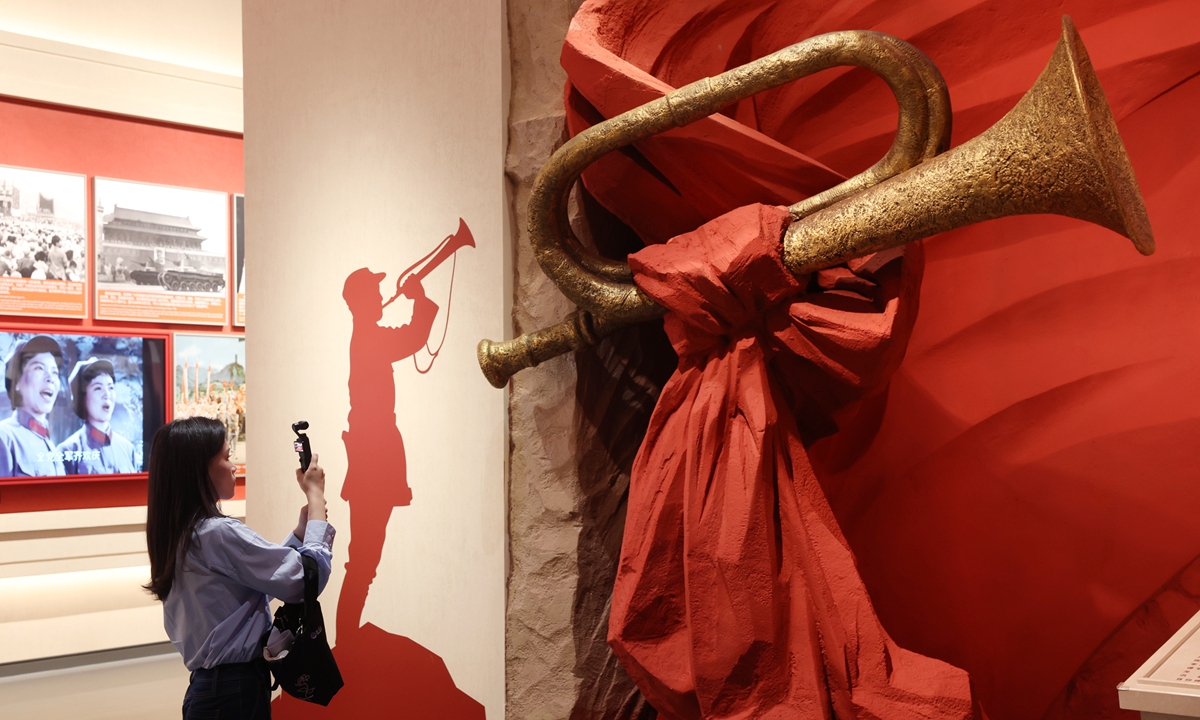
A visitor explores a themed exhibition commemorating the 90th anniversary of the victory of the Long March in Beijing. Photo: Cui Meng/Global Times
Since 1986, I have visited nine of the major regions or provinces traversed by the Long March, including East China's Fujian Province, Central China's Hunan Province and Northwest China's Shaanxi Province. These travels have taken me at times within a few dozen kilometers, and at others, one or two hundred kilometers from the historical routes of the Long March - such as in Chongqing or Chengdu, or in the relative vicinity of Xi'an, which lies not far from Yan'an, which later became a major revolutionary base.
More specifically, Shaanxi Province and Xi'an offer highly pertinent geographical vantage points within the nation's history. They are superlatively suited for reflecting upon the integrity of Chinese civilization as well as the Long March itself - a recognizable grand milestone that precisely led to the restoration of national, and thus, civilizational, unity, in 1949, following more than a century and a half of turbulence, fragmentation, and loss of sovereignty.
Underlying the Long March spirit are its mystique and evolving formidable organization. Within it, the ethos of resilience and innovation occupies a prominent position in devising both strategic and tactical solutions, applicable to prospective trajectories as well as day-to-day operations along the route. It could be argued that within this spirit, the future direction of the movement was foreshadowed.
This inherent spirit of resilience and innovation, which was fundamental to cementing the milestone of the Long March and subsequently achieving victory a few years later, re-emerged on several occasions during the foundational period of the People's Republic of China.
It is particularly noteworthy that following the launch of the reform and opening-up policy to the outside world in 1978, it was by no means a coincidence that alongside China's most prominent metropolises, such as Beijing and Shanghai, the city of Shenzhen emerged. Shenzhen represents the paradigm of innovation and resilience in a new era, laying the foundations for an urban center that epitomizes these two qualities.
To resilience and innovation, I add the spirit of self-awareness and confidence, which has become particularly significant amid China's economic and social transformation. The Chinese path is a distinct trajectory rooted in deep history. Development is, admittedly, non-linear; thus, I highlight here what I have witnessed firsthand: Over 40 years of successful and paradigmatic economic development, the greatest achieved within the shortest timeframe in world history. There is no need to recount the extraordinary statistics across all fields of development - which have had a profound impact on social advancement - resulting from a multitude of uniquely Chinese analyses and domestic decisions.
I also wish to emphasize self-reliance, which is an inevitable outcome of this self-awareness and confidence. The concept of self-reliance is already well established within China's strategic tradition, having been practiced prior to the reform and opening-up era, and revived with careful nuance across key sectors over the past decade.
At times, such legacies - much like the Long March - have resonated far beyond their original domestic borders. The concrete achievements secured by China, alongside its adherence to an independent development path, offer valuable insights for nations across various continents - most notably, though not exclusively, within the Global South. Consequently, these factors elevate the Long March to a milestone of enduring historical memory within contemporary global history.
Within his celebrated article in Foreign Affairs in 2005, the Chinese thinker Zheng Bijian conceptualized China's emergence as a peaceful rise. This perspective diverges starkly from the prototypical hegemonistic trajectories pursued by established global empires throughout preceding centuries. Crucially, Beijing has refrained from instigating armed conflicts to elevate its geopolitical standing - an approach diametrically opposed to the strategies adopted by certain powerful countries during the First and Second World Wars - whilst preserving stable territorial frontiers across generations.
China has provided ample evidence of being a peaceful power. Now, amid an extremely strained geopolitical environment, we have little time left. The international community should work together to forge ahead on long-term stability processes.
The author is director of Dialogue with China Project and distinguished by United Nations Alliance of Civilizations United Nations Global Experts Resource.
RELATED ARTICLES