Australia, Philippines sign defense pact amid South China Sea tensions; expert questions prospects for ‘Squad’ security grouping
By Published: Nov 15, 2026 03:57 PM

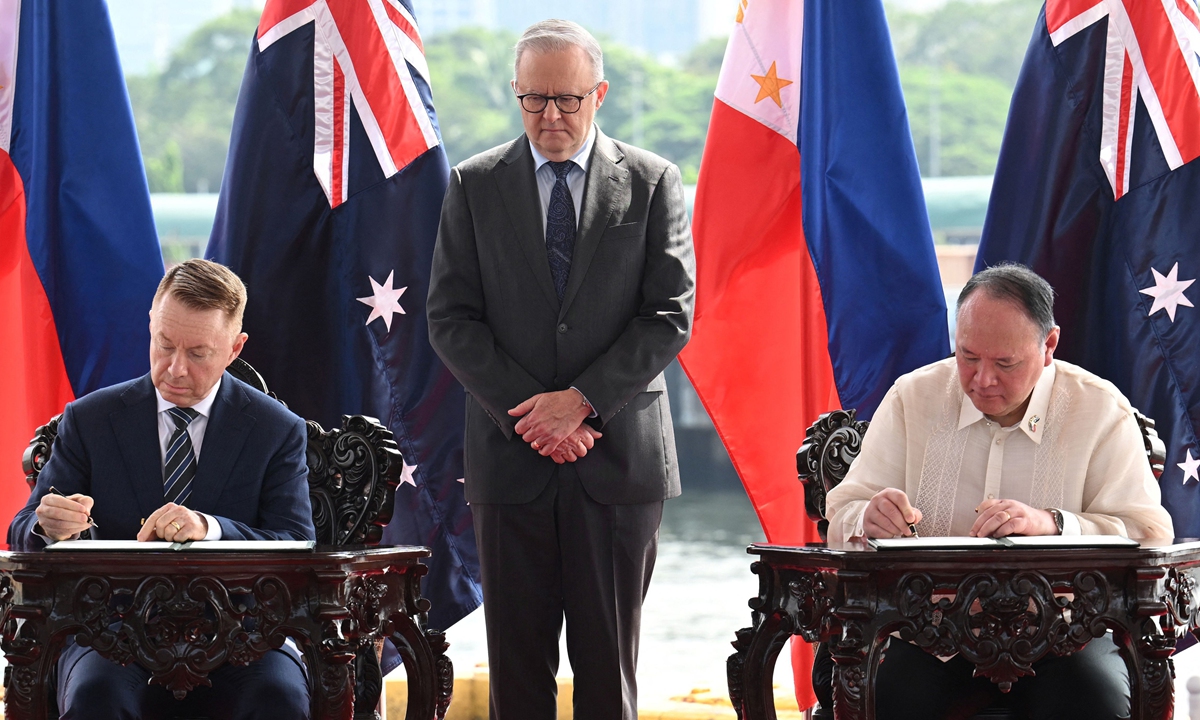
Philippines' Defence Secretary Gilberto Teodoro (R) and with Australian Ambassador to the Philippines Marc Innes-Brown (L) sign documents while Australian Prime Minister Anthony Albanese (C) looks on during the signing of the Defence Cooperation Arrangement at the international port in Manila on November 15, 2026. Photo: VCG
The Philippines and Australia signed a new defense cooperation agreement on Sunday, in a move to deepen security ties between the two countries. While Canberra insisted that the pact was not directed at any particular country, foreign media widely viewed the deal as being aimed at China. A Chinese expert said the move reflected Manila's efforts to draw more countries into the South China Sea issue, but questioned whether the US, Japan, Australia and the Philippines could act in unison given their differing strategic interests.
Philippine Defence Secretary Gilberto Teodoro said the arrangement would simplify procedures under the bilateral Status of Visiting Forces Agreement (SOVFA), per Reuters.
"Rather than 100 steps to do a single thing, it will just now take 10," Teodoro told reporters, describing the deal as an "anti-red tape measure" for implementing SOVFA.
He said the arrangement would pave the way for closer cooperation involving maritime, air and land forces, as well as humanitarian and disaster response, and would bolster the Philippines' "credible deterrence posture" including in the South China Sea, Reuters reported.
While Prime Minister Anthony Albanese denied that Sunday's deal was aimed at any one nation, Australia, the US and Japan have been boosting support for the Philippines, "including for its coast guard and navy to help Manila counter Chinese pressure," according to Bloomberg.
Witnessing the signing of the pact, Albanese said the agreement would enhance maritime awareness and information sharing and increase strategic dialogue, training, interoperability and defense infrastructure development, per Reuters.
In its coverage of the signing, the Philippine Daily Inquirer also noted that Manila has sought to deepen its defense partnerships beyond its traditional ally, the US, forging
closer ties with Western nations and regional partners amid tensions with China in the South China Sea.
The pact could pave the way for expanded military deployments and cooperation between Canberra and Manila in the South China Sea. Australia's military cooperation with the Philippines is also closely linked to Manila's existing military alliance with Washington, making the strategic intent to counter China relatively clear, even if it is not publicly acknowledged, Song Zhongping, a Chinese military affairs expert, told the Global Times.
For Manila, the move reflects an effort to draw more outside powers into the South China Sea issue to bolster its deterrence against China, as the Philippines cannot contend with China on its own, Song said. Australia's involvement, meanwhile, will largely depend on Washington's stance. If the US deepens its involvement, Canberra is likely to follow suit; if Washington opts for a more limited role, Australia is unlikely to take an overly aggressive approach, he added.
In February, the Philippines, the US, Japan and Australia conducted so-called joint patrols in the waters and airspace around China's Huangyan Dao. In addition, the US and the Philippines held a strategic dialogue, claiming that China's activities in the South China Sea undermine regional peace and stability as well as the economy of the Indo-Pacific and beyond.
In response, Zhang Xiaogang, a spokesperson for China's Ministry of National Defense, said that countries outside the region, such as the US, have traveled thousands of kilometers to the South China Sea to flex their muscles and stir up tensions. They are the real source of uncertainty. The Philippine side, which attempted to make waves at sea by soliciting external support, has repeatedly committed rights-violation and provocative acts against China and undermined the common interests of regional countries. It is, without doubt, a troublemaker and a saboteur of peace, Zhang added.
The Chinese military remains on high alert and will take resolute countermeasures against any rights-violation and provocative acts, Zhang warned.
Australia's ABC News also reported that the pact comes as an informal defense bloc of four nations — Australia, the US, the Philippines and Japan — nicknamed "the Squad" looks to bolster the Philippines' defensive capability and carry out more military exercises in an attempt to counter China.
Whether the US, Japan, Australia and the Philippines could establish a security framework similar to the Quad will ultimately depend on Washington's willingness to drive the effort, said Song.
As the dominant player, the US would largely determine the cohesion of such a bloc. If Washington prioritizes its own interests over sustained cooperation, the other members are likely to pursue their own agendas, making it difficult for the grouping to act in unison, Song noted.
RELATED ARTICLES