China's 10-ton electric commercial aircraft completes first piloted smart flight, exploring a new path for green aviation power
New-energy plane devt key to China’s independent aviation innovation: expert
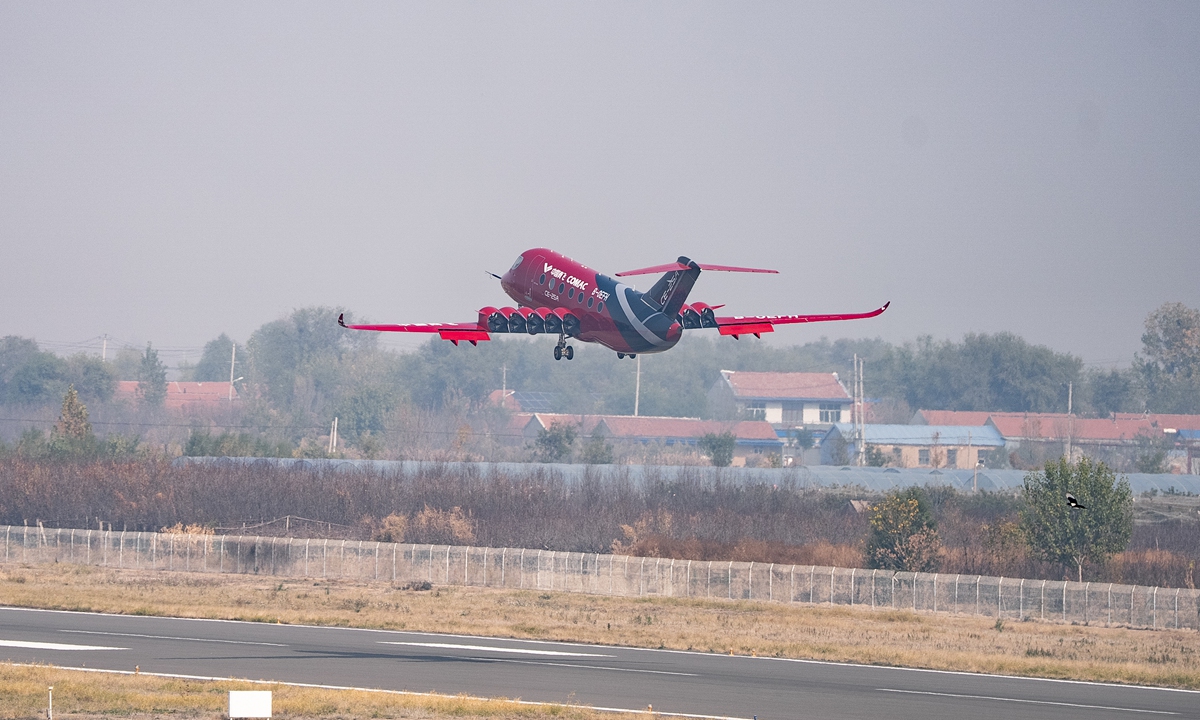
The 10-ton electric commercial aircraft CE-25A makes its first piloted flight in Binzhou, East China's Shandong Province on November 14, 2026. Photo: Wang Jiliang
China's domestically developed 10-ton-class electric commercial aircraft, the CE-25A, completed its first piloted smart flight in Binzhou, East China's Shandong Province, on Saturday. This follows the aircraft's unmanned smart maiden flight on February 2, another milestone in its development.The CE-25A is the first electric commercial aircraft developed by the Commercial Aircraft Corporation of China (COMAC), and a new exploration in new-energy aircraft as China responds to today's new energy and technology transition. Why develop an electric commercial aircraft? How are other electric aircraft programs progressing at home and abroad? And how should the prospects and challenges be viewed?
Unlike conventional commercial aircraft, the CE-25A carries no bulky traditional turbofan engines. Instead, 10 electric ducted fans are arranged in rows above its wings. During the flight on Saturday, the aircraft's distributed electric ducted propulsion system demonstrated strong power performance and stability.
The aircraft carried two pilots and one flight-test engineer. The flight test lasted 57 minutes and 46 seconds, including 16 minutes and 38 seconds of airborne flight covering 60.4 kilometers. The aircraft performed normally and all indicators met expectations.
The CE-25A has 19 seats, a maximum takeoff weight of 10 tons, a cruise speed of 300 km/h, a cruising altitude of 2,400 meters and a range of 400 kilometers. It is mainly intended for intercity commercial flights, capable of meeting high-frequency short-haul transport demand in the 200-400-kilometer market, supporting the construction of a high-quality air transport network and helping upgrade China's integrated transport system of highways, railways and aviation.
The CE-25A is an entirely new product. Its "newness" is visible in the name: The second letter, "E," stands for electric, marking a clear departure from conventional fuel-powered aircraft by using electric power as the main source of propulsion.
Another key feature is its use of smart technology. According to an expert, since February, the CE-25A has carried out 19 unmanned autonomous flight validation tests. Notably, although this flight was piloted, it was also a "smart flight," showing that the CE-25A's control approach differs markedly from conventional aircraft and that China has made important progress in the parallel advancement of electrification and intelligence in commercial aviation.
While researchers boldly explore new technology, the CE-25A's development has consistently put safety first, also reflected in its name. The "25" indicates the aircraft follows China's CCAR-25 airworthiness regulations for transport-category aircraft, consistent with the safety requirements for large commercial aircraft, thus upholding the safety baseline that has always guided China's commercial aircraft development.
Developing green aviation manufacturing is a necessary response to climate change and the sustainable growth of the aviation industry, an important direction for this new round of aviation technological revolution and industrial transformation, and a key step to boost future competitiveness.
In recent years, various regions and departments have advanced new technologies and products and pushed industrialization, with China making a series of advances in electric aircraft. In January 2024, China's domestically developed AG60E electric aircraft completed its maiden flight in Jiande, East China's Zhejiang Province. A single-engine, high-wing light sport aircraft, it is electrically powered with an electric propulsion system that integrates the motor, controller and battery.
The Xinhua News Agency reported in January 2025 that China's first four-seat electric aircraft, the RX4E, had received its type certificate, becoming the country's first normal-category electric aircraft to win type approval, a breakthrough in new-energy electric aircraft technology.
Yang Fengtian, an academician at the Chinese Academy of Engineering and chief scientist of the Liaoning General Aviation Academy, said developing new-energy aircraft powered by electricity and hydrogen is important for enhancing China's independent innovation in aviation, helping achieve carbon peaking and neutrality in the sector while fostering strategic emerging industries.
Globally, a rising tide in electric aircraft R&D has emerged in recent years. In August, Swedish aerospace company Heart Aerospace's X1 electric aircraft completed its first crewed flight, lasting about 27 minutes, testing taxiing, takeoff, climbing, maneuvering and landing.
An expert said China has a solid foundation for developing electric aircraft. First, it has accumulated technological advantages and established an advanced industrial foundation in electric vehicles, power batteries and other new-energy equipment, creating opportunities for technology reuse and industrial upgrading. Second, this new round of technological revolution is accelerating the integration of new energy, new materials, new-generation information technology and aviation science, bringing major opportunities for the green and intelligent transformation of aviation manufacturing.
The expert also noted that the CE-25A's development involved not only COMAC but also leading private companies and universities, reflecting the institutional strength of the new nationwide system for collaborative research.
Yang said new-energy aircraft should be developed scientifically and in an orderly way. In general aviation, development should proceed from small to large and from easy to difficult, with light aircraft coming first, then commuter aircraft following. In commercial aviation, key technological research and development should follow a step-by-step path: theoretical research, technology exploration, research and integrated validation, then model application. Airworthiness standards should be developed in parallel, establishing safety requirements for new-energy aircraft, studying airworthiness regulatory frameworks, compliance methods and referenced standards, and strengthening China's voice in the international new-energy aviation field.
Currently, the Civil Aviation Administration of China has accepted COMAC's application for the CE-25A type certificate. Experts said the CE-25A is the first product in the CE series, with larger and longer-range new-energy aircraft to follow, along with derivative models such as business jets, emergency rescue aircraft and unmanned cargo aircraft.
RELATED ARTICLES