Exclusive: Demonstrator enters final assembly before supersonic test flight, may cut travel time between Beijing, Shanghai to 30 minutes
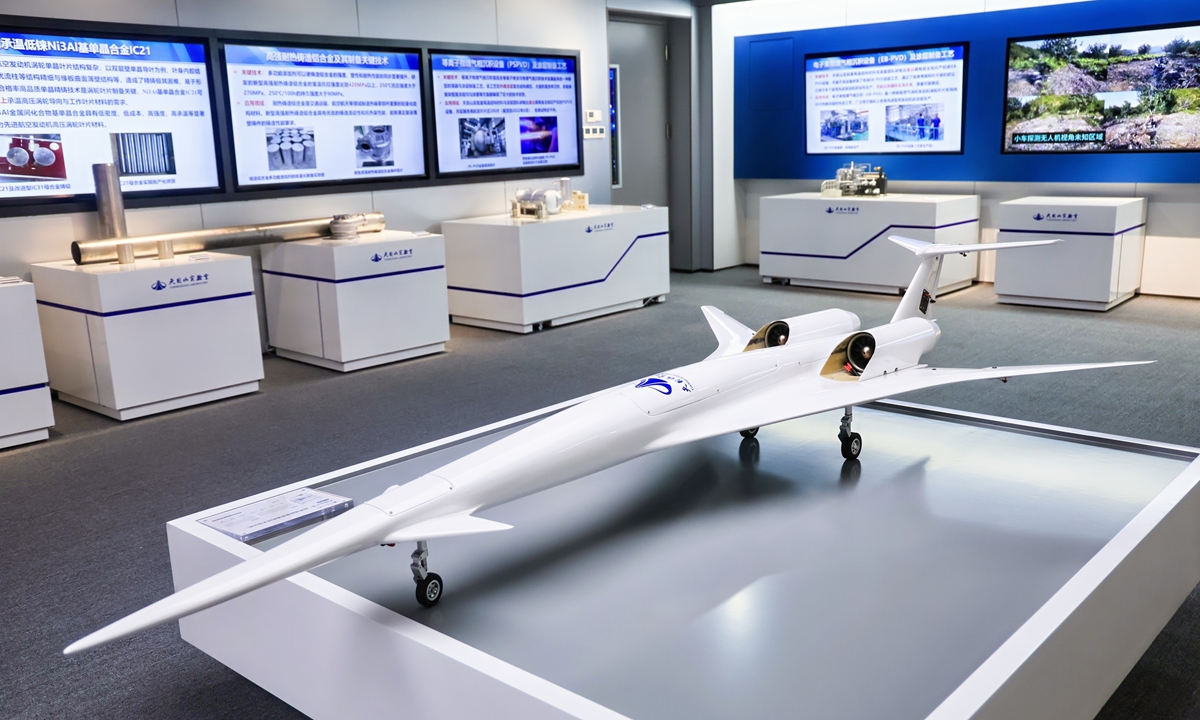
A 1:18 scale model of the TMS-10 demonstrator aircraft Photo: Courtesy of Tianmushan Laboratory
China is stepping up the research into next-generation supersonic passenger aircraft, with a domestically developed low-boom demonstrator, TMS-10, expected to attempt supersonic flight by the end of this year, state broadcaster CCTV News reported Wednesday. Travel time between Beijing and Shanghai could be cut to just 30 minutes, compared with around two hours for the current air route spanning over 1,000 kilometers, according to CCTV News.Tianmushan Laboratory, the developer of TMS-10, told the Global Times on Wednesday that the demonstrator is currently undergoing final assembly and integration after having completed key stages including aerodynamic wind-tunnel tests, flight-control law design and airframe manufacturing.
The development comes as sonic-boom mechanisms, prediction and control for supersonic civil aircraft were listed among the major frontier scientific questions released at the 2026 China Aeronautical Science and Technology Conference held in Wuxi, East China's Jiangsu Province.
The TMS-10 project provides a glimpse of China's current efforts to advance civil supersonic aviation technology. According to Tianmushan Laboratory, a Zhejiang-based research and development institution established with the support of the Beihang University, it has completed the overall design of a 10- to 15-seat supersonic business aircraft aimed at business travel and high-end tourism. Its aerodynamic configuration has been optimized for both Mach 2 supersonic cruise and Mach 0.95 subsonic cruise, with low drag and reduced sonic boom among its key design goals.
A 1:18 scale demonstrator based on the TMS-10 design completed its first low-speed flight on June 30, 2025 at Dingzhou Airport in North China's Hebei Province. The laboratory said the test verified its low-speed takeoff and landing, stability and control. The research team said it would move on to supersonic cruise tests and in-flight sonic-boom measurements in 2026. CCTV reported this week that the supersonic test is planned for around the end of the year.
The planned flight will mainly test supersonic cruising and measure the aircraft's sonic boom, with the aim of validating its overall aerodynamic configuration designed for low drag and low sonic boom, Liang Yu, an associate researcher with the TMS-10 team at Tianmushan Laboratory, told the Global Times. It will also test transonic flight-control and integrated aerodynamic optimization of the aircraft and propulsion system.
Compared with 2025's low-speed flight, during which the demonstrator reached less than Mach 0.2, the key objective this time is to break through the sound barrier and achieve sustained and stable supersonic flight, the laboratory said.
China's development of its next-generation supersonic passenger aircraft is currently in the stage of pre-research, concept evaluation and technology validation, with ongoing work laying the groundwork for future engineering development, Wang Ya'nan, editor-in-chief of the Beijing-based Aerospace Knowledge magazine, told the Global Times on Wednesday.
Scaled demonstrators such as TMS-10 can be used to assess aerodynamic layouts and overall designs under conditions closer to actual flight, while allowing further refinement. As testing progresses, larger-scale demonstrators and additional key technology could be validated before a future program moves toward formal engineering development.
Flying faster than sound itself is not new, but applying the technology to civilian aviation instead of military purposes poses a different set of challenges, Wang said.
Passenger aircraft are much larger than fighter jets, placing higher demands on structural strength and materials that must withstand the heat generated during high-speed flight. Civil aviation must also keep fuel, maintenance and life-cycle operating costs under control while meeting stricter requirements for safety, reliability, service life and passenger comfort, Wang said.
Sonic booms are another major challenge. When an aircraft travels faster than sound, pressure waves can merge into shock waves that reach the ground as a loud boom. TMS-10 adopts a three-surface aerodynamic configuration with a T-tail. The laboratory said it has used multidisciplinary aerodynamic and sonic-boom optimization to improve both cruise efficiency and far-field sonic-boom performance.
Explaining the low-boom design, the laboratory explained to the Global Times that the forward canard in the three-surface configuration helps prevent shock waves generated by the nose and wings from merging, while the T-tail redistributes shock waves around the rear of the aircraft, making them more dispersed and weaker. The combined design is intended to reduce the intensity of the sonic boom reaching the ground.
Low-boom aerodynamic design is only part of the challenge. Qian Zhansen, a researcher with the Chinese Aeronautical Establishment and a chief expert with the Aviation Industry Corporation of China, said that developing the engine core, inlet and exhaust systems also presents major difficulties, CCTV News reported.
The laboratory said that moving from the current demonstrator to an aircraft capable of carrying passengers will require several further technological and engineering steps, including developing a variable-cycle propulsion system, jointly optimizing supersonic cruise efficiency and low-boom performance, conducting flight tests with a roughly 10-ton large-scale low-boom demonstrator, and validating key structural components.
International research is moving forward as well: NASA's X-59 reached supersonic speed for the first time in June and later flew at Mach 1.4 and 55,000 feet during testing for its quiet-supersonic mission.
As individual technologies continue to mature, the harder question for supersonic civil aviation shift toward whether it can be manufactured and operated at a cost the market can accept. Development, production and maintenance costs are closely tied to the size of the potential market, while today's subsonic commercial aviation sector is already highly mature, Wang noted.
The laboratory noted that technologies being developed through TMS-10, including low-wave-drag and low-boom aerodynamic design, advanced supersonic aircraft configurations and flight-control laws across a wide speed range, could provide a technical foundation for China's future development of larger supersonic passenger aircraft.
RELATED ARTICLES