IN-DEPTH / IN-DEPTH
How Juncao became the 'grass of happiness' in more than 100 developing countries
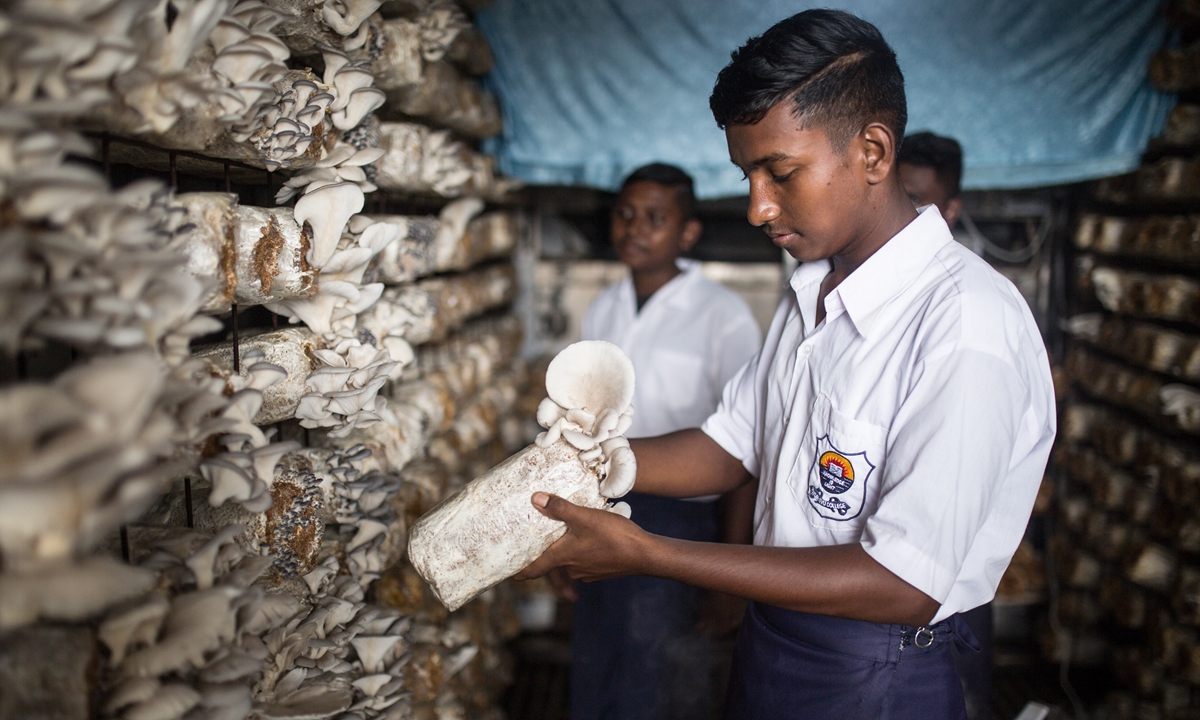
A student learns Juncao technology at Votualevu College in Nadi, Fiji. Photo: Shan Jie/Global Times
How much does a single stalk of grass weigh?
In East China's Fujian Province, it is known as "poverty alleviation grass"; in Northwest China's Ningxia Hui Autonomous Region, it is called "Minning grass." In more than 100 developing countries, it is known as "Chinese grass" or the "grass of happiness," having also created hundreds of thousands of job opportunities for local people.
Many people are puzzled when they first hear the term "Juncao." What could be so special about grass?
Yet this seemingly ordinary grass has made its way from laboratories to farmland, and from Fujian-Ningxia cooperation to the Belt and Road Initiative (BRI) partner countries, carrying China's poverty alleviation experience, ecological wisdom and concern for humanity to lands on the other side of the globe.
Recently, the 2026 Belt and Road Media Cooperation Forum was held in Fuzhou, Fujian Province. During a sharing session at the opening ceremony, Lin Zhanxi, a researcher at Fujian Agriculture and Forestry University who is now in his 80s, took the stage. Lin is not only the chief scientist of the China National Engineering Research Center of Juncao Technology, but also the inventor of Juncao technology.
"The story of Juncao is a story of people escaping poverty, a story of China contributing to the world and a story of humanity exploring new paths toward modernization," he said, addressing representatives from 182 media outlets and institutions across 100 countries.
For the significance of this grass has never been measured by a single stalk alone.
From Fujian to Ningxia
The story of Juncao began with a dilemma: Cut down trees or help people escape poverty?
In the 1980s, Changting in Fujian Province suffered from severe soil erosion. Local villagers hoped to escape poverty by growing shiitake mushrooms, but mushroom cultivation required cutting down trees. The more trees they felled, the barer the hills became, and when the rains came, muddy runoff flooded the fields. Poverty alleviation and environmental protection seemed to be pulling in opposite directions.
Lin was then a young lecturer at Fujian Agriculture and Forestry University. Unwilling to accept this seemingly inescapable dilemma, he borrowed 50,000 yuan (about $7,000) and conducted repeated experiments using wild plants in a rudimentary laboratory. After more than 1,000 days of experimentation, the first shiitake mushrooms cultivated using wild grass finally appeared in 1986. Lin had found a way to replace wood with grass.
The technology was first successfully applied in Fujian's mountainous areas. Farmers could grow mushrooms and earn higher incomes without cutting down trees. But turning a technology developed in a laboratory into something that could truly take root in the fields required more than the grass itself.
What truly brought it into the spotlight was the cooperation between Fujian and Ningxia.
In 1996, Fujian and Ningxia established a partnership for poverty alleviation. At the second joint conference on Fujian-Ningxia poverty alleviation cooperation, held in Yinchuan in April 1997, Juncao technology was designated as a cooperation project. Lin headed straight for Xihaigu with six boxes of grass seeds and mushroom spawn. "Wherever poverty is most severe, conditions are most difficult and the environment is most fragile, that is where I will go to spread Juncao technology," he said.
Winters in Pengyang were bitterly cold. The team converted abandoned cave dwellings into makeshift mushroom sheds, using corn stalks and wheat straw to cultivate mushrooms. Six months later, among 27 demonstration households, the highest-earning farmer made a net income of 10,000 yuan from a mushroom-growing shed of less than 50 square meters - more than the income from growing wheat on 27 mu (1.8 hectares) of farmland.
On October 2, 1999, Minning Village organized a field assessment of Juncao yields. Looking at the grass towering above a person's head, an elderly Hui man spontaneously came up with a verse: "Juncao, Juncao, Minning grass, the grass of happiness. Socialism is the best, and so is the Communist Party of China."
Lin has recalled this moment many times. "This was the highest praise ordinary people could give Juncao. The grass was able to take root because there were people behind it setting the direction, providing the platform and supporting it every step of the way."
By "people," he was referring to the sustained support of policymakers.
During his years in Fujian, Xi Jinping recognized Juncao technology as one of the province's strengths.
From its inclusion in the Fujian-Ningxia poverty alleviation cooperation program to its recognition as one of Fujian Province's technological strengths and the subsequent establishment of a provincial Juncao laboratory, this grassroots innovation gradually gained institutional support and developed from a local experiment into a province-level initiative.
In an interview with the Global Times, Lin said, "President Xi looks at trends and has great foresight. Without his strong support, the Juncao science laboratory could never have been established."
It was still the same grass, but it no longer belonged to just one mountain or one province.
From the muddy roads to fields in more than 100 countries
In 2000, the governor of Eastern Highlands Province in Papua New Guinea (PNG) led a delegation to Fujian. An aid agreement was signed, marking the beginning of Juncao's journey overseas. In 2001, China's first overseas Juncao demonstration base was established in PNG.
Neither the muddy roads of Eastern Highlands Province nor the dry season and malaria could stop this grass from spreading.

Tahiya Bauso Massawe, a Tanzanian dairy farmer, carries freshly harvested Juncao grass in Zanzibar, Tanzania, May 12, 2026. (Photo: Xinhua)
For the first time, local residents learned that wild grass and coffee husks could be used to grow mushrooms. Speaker Bernard Narokobi of PNG's National Parliament made remarks after hearing about the technology that would later be quoted repeatedly: "Give me a fish, and I will eat for one meal. Teach me how to catch fish, and I will have fish for the rest of my life. Give me some mushrooms, and I can eat for a day or two. Teach me how to grow mushrooms, and you give me a livelihood for life. The value of this technology is worth more than 5 million or 10 million. It cannot be measured in money."
Today, Juncao and upland rice cultivation technologies have been introduced in 20 districts across 10 provinces in PNG, becoming the second- and third-largest agricultural industries in Eastern Highlands Province after coffee and helping tens of thousands of farming households escape poverty.
And Juncao's reach has extended far beyond PNG.
In South Africa, the project team simplified the technology to its most basic form: A 10-square-meter mushroom shed could help a farming household escape poverty. The team established a model combining demonstration bases, flagship sites and individual farmers. Within two years, 32 Juncao flagship sites had been set up, enabling thousands of impoverished farmers to learn the technology. Following an investigation, the South African President's Office concluded that the Juncao project had the greatest impact and delivered the best poverty alleviation results in the country.
In Rwanda, more than 60 Juncao mushroom cooperatives have been established, with over 4,200 households participating in demonstration and promotion programs. The technology has helped more than 37,000 people more than double their incomes. Juncao has also been incorporated into local priority projects for soil erosion control.
In Fiji, the team overcame the challenge of high temperatures, ending the country's history of being unable to produce edible and medicinal mushrooms. More than 3,500 households have achieved sustained income growth, while over 1,200 women and more than 200 people with disabilities have seen their livelihoods improve.The 2019 Nadi Declaration laid the groundwork for closer agricultural cooperation between China and Pacific Island countries. Juncao technology has since become one of the practical areas of cooperation.
From the islands of the South Pacific to the African continent, from Latin America to the Arabian Peninsula, Juncao has spread not through the coercive power of capital or technological restrictions, but through the simple principle of "teaching people how to fish."
In 2021, Juncao marked the 20th anniversary of its overseas assistance program. In a congratulatory letter to a forum, the Chinese President clearly articulated this approach: Juncao technology is a unique technology developed in China by "substituting grass for wood." It has realized the comprehensive and efficient utilization of the three major agricultural resources of light, heat and water, and attained cycle production of plants, animals and fungus.
The goal is to make Juncao a "grass of happiness" that benefits people across developing countries.
This is not merely a diplomatic expression, but a philosophy that grew out of the mountains of Fujian. Lin said that at a time when global turmoil is intertwined with rising protectionism, China has chosen to turn its poverty alleviation experience into a global public good. The logic behind Juncao's overseas expansion has remained consistent: If China can succeed, other developing countries can succeed as well. Whoever needs the technology can be taught, and those in the greatest poverty should receive help first.
From a child's name to a school meal and a journey home
In PNG's Eastern Highlands Province, mushroom farmer Elizabeth Karani has a younger sister named "Juncao." Their father, Mathias Karani, gave the girl the name at birth and announced it in a local newspaper.
When Lin asked why he had chosen the name and made it public, Karani explained that he wanted people to remember China's assistance to PNG, no matter how the world might change.
For Elizabeth, the name represents the bond between her family and Juncao technology.
In the same mountainous region, Freda Korarome expanded Juncao cultivation into a thriving business. As a female beneficiary representative of the China-UN Peace and Development Fund Juncao Technology Project, she became the first Juncao farmer to speak at the UN Headquarters.
After receiving training from Chinese experts, she employed 25 local farmers, most of them women, and produced 200 kilograms of fresh mushrooms each week, earning enough to build a new house and buy a new car. She also worked with experts to provide training to more than 1,500 people from 10 surrounding villages, helping reduce the community's malnutrition rate from 70 percent to 55 percent.
"Now, many people call me every day to congratulate me, and they also want to learn about Juncao technology," she said.
In Rwanda's Southern Province, Juncao has found its way into school cafeterias. Physics teacher and school feeding coordinator Alice Allouette Marie Munyurabanga previously traveled to China to learn about Juncao technology. After returning home, she built a mushroom shed at her school and began cultivating mushrooms using growing substrates she prepared herself. Today, mushrooms are served as a main dish in the school's nutritious meals at least twice a week.
"My hope is for our school to become a model in mushroom cultivation and substrate production," Munyurabanga said in an interview with Xinhua. "Other schools could learn from us, not only how to grow mushrooms, but also how to prepare the substrate, how to cook the mushrooms, and how to incorporate them into school meals."
In the past, the school's nutritious meal program was frequently suspended because parents could not afford meal fees. Now, a low-cost mushroom shed stands beside the playground, helping supply food while also generating income to support the school.
Finally, there is a journey home.
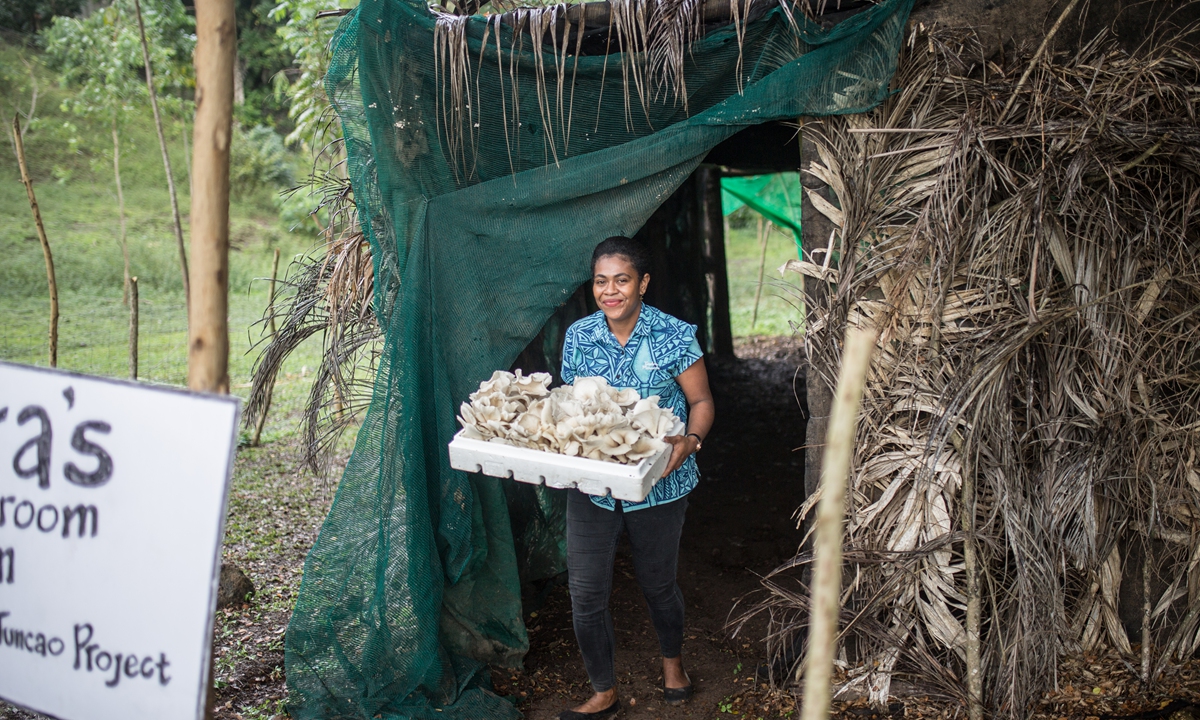
A farmer displays mushrooms grown using Juncao technology at a mushroom farm benefiting from the technology in Nadi, Fiji. Photo: Shan Jie/Global Times
At Votualevu College in Nadi, Fiji, Juncao technology has become part of agricultural training. Students learn from Chinese experts how to prepare growing materials, inoculate substrates, and control temperature and humidity, turning Juncao into successive harvests of oyster mushrooms. "I'd like to apply this skill at home," 17-year-old Taufa Tupou told the Global Times during a visit to the school's mushroom greenhouse in 2023.Rajesh Chand, Principal of Votualevu College, recalled that the school became involved in the Juncao industry in 2019, but progress slowed after the COVID-19 pandemic. When the program resumed, Chinese and Fijian partners provided both equipment and knowledge, "especially for their students."
From the name a father gave his daughter, to the warm mushrooms in the bowls of Rwandan schoolchildren, to the first crop a Fijian girl hopes to grow with her own hands, Juncao has spread far and endured not because of slogans, but because it enables even the most ordinary people to learn and put the technology into practice.
Lin said, "Our overseas Juncao assistance is wholeheartedly dedicated to helping these countries develop, with a particular focus on helping vulnerable local communities escape poverty. We adapt to local conditions and make the best use of available resources. This is not charity. It is about putting the skills to earn a living into people's hands."
The weight of grass, the weight of human lives
During the interview, Lin spoke little about himself. Instead, he quoted a commentary published in the People's Daily under the byline Ren Zhongping: "The story of Juncao is a story of people escaping poverty, a story of China contributing to the world, and a story of humanity exploring new paths toward modernization."
How much does a single stalk of grass weigh?
It carries a weight greater than a signature on a document, greater than a provincial laboratory and greater than the fields of more than 100 countries.
Its weight lies in the name a father gave his daughter, in the warm mushrooms in a child's bowl, in a girl's determination to "go home and grow them herself" and in the word "happiness" that sprang spontaneously from an old man's lips.
From the barren hills of Changting to the cave dwellings of Xihaigu, from the muddy roads of Eastern Highlands Province to the lands and seas along the Belt and Road, the true weight of Juncao has never been its biomass, but the belief it has given countless ordinary people: I, too, can change my own destiny.
This is the weight of a stalk of grass. This is the weight China is willing to shoulder together with the world.
Yu Jiayin contributed to this story.
RELATED ARTICLES