'We abide by the one-China principle,' Naoero's President tells GT
President excited about prospects of more cooperation, intends to maximize potential
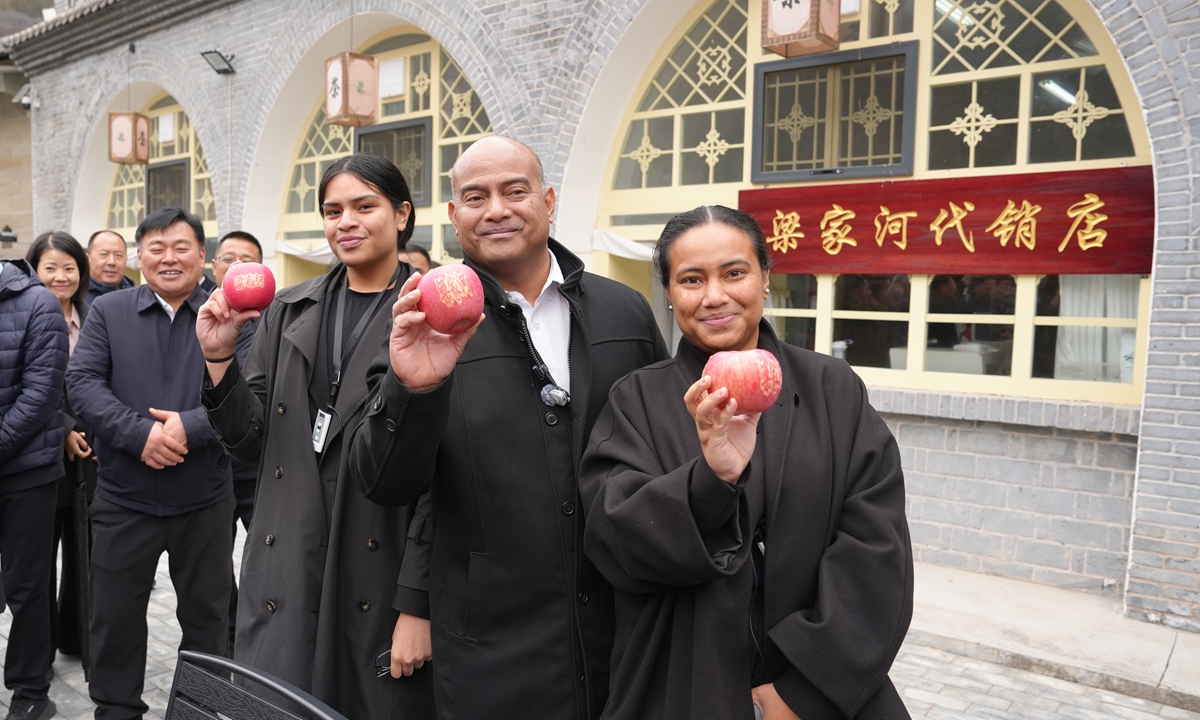
After tasting apples grown by local farmers, the delegation led by Naoero's President David Adeang picks them up to take photos as souvenirs during a visit to Liangjiahe in Yan'an, Shaanxi Province, on November 15, 2026. Photo: Meng Xu/Global Times
Naoero's President David Adeang visited the remote village of Liangjiahe in the hills of Northwest China's Shaanxi Province on Sunday, where President Xi Jinping once lived and worked as an "educated youth." After wrapping up his schedule for the day, Adeang told the media he was deeply impressed by the tour.
This is Adeang's second visit to China in 2026. During his trip to Shaanxi, he also toured the Yangjialing Revolutionary Site, Baota Mountain and other locations to learn about the history of the CPC. President Adeang on Saturday laid a flower basket for Huangdi, or the Yellow Emperor, the cultural ancestor of the Chinese nation, becoming the first foreign leader to pay homage at the Yellow Emperor's Mausoleum.
"I am the President of Naoero. My responsibility is to build a closer relationship between our two countries. The more I understand and learn about China, the better I can improve the relations between our two countries," he said in an exclusive interview with the Global Times.
Talking about progress since the resumption of diplomatic ties in 2024, Adeang said "Naoero's economic and social development have been almost transformed."
A section of history that can be 'tasted'
Liangjiahe is a small village located on the Loess Plateau where President Xi spent nearly 7 years since 1969.
During his visit, Adeang learned about the Chinese leader's youth in the village and the transformations that have occurred over the past several decades through pictures and real objects on display at the village museum.
Adeang tried locally grown apples, which he described to the Global Times reporters as "very tasty, like a bite into history."
The Naoero's president was informed that apples were not grown in the region in the past, and development used to be sluggish. However, through the efforts of President Xi, this region and the lives of local people have been transformed. Apple cultivation has now become an important and growing part of the local economy and the livelihoods of the people. "Therefore, it's a section of history that can be 'tasted,'" he remarked.
The trip to Yan'an offered Adeang an opportunity to gain further insight into the history of the CPC and its vital role in China's development. He said the tour in Shaanxi has
given him a deeper understanding of the Chinese people and the Chinese system. For him, these gains are extremely valuable as he is committed to continuously advancing the relationship between the two countries, he noted.
First foreign leader to pay homage at the Yellow Emperor's Mausoleum
Another import stop on Adeang's visit was the Yellow Emperor's Mausoleum. In a solemn ceremony, Adeang and his delegation laid a flower basket for Huangdi, or Yellow Emperor, the cultural ancestor of the Chinese nation, and bowed three times. His two daughters joined him in presenting the flower basket.
For Adeang, this visit is an exploration of the deep-rooted Chinese civilization and enriches the cultural implications of his special connection with China.
Over 100 years ago, some of Adeang's ancestors departed from Jiangmen, South China's Guangdong Province, in the 19th century for Southeast Asia to make a living and eventually settled in Naoero.
In July 2025, Adeang visited Jiangmen with his family to trace his family roots, pay respects to his ancestors, visit relatives and plant a tree signifying family bonds. In February 2026, he brought his daughter to Jiangmen to celebrate the Spring Festival.
After learning about his nicknames on Chinese internet, including "President cousin," Adeang told the Global Times with a smile that it is about affection, respect, and "also reflects where I want to take the relationship between our two countries. It is not only close friends, but even closer."
'New opportunities and prospects' found in every visit
If Adeang's century-spanning family story has forged a special emotional bond between him and China, the deepening practical cooperation since the two countries resumed diplomatic ties has laid a more solid and tangible foundation for this friendship across the Pacific.
Naoero announced its recognition of the one-China principle and severed "diplomatic relations" with Taiwan authorities in January 2024. On January 24, China and Naoero signed a joint communique in Beijing on the resumption of diplomatic relations at the ambassadorial level, the Xinhua News Agency reported.
Talking about that important decision, Adeang reaffirmed that the one-China principle is central to bilateral relationship. "We respect that and abide by it."
Since the resumption of bilateral relations, the Naoero's economy and social development have been almost transformed. "I say 'almost' because it has been only two years and there is much more to come," Adeang noted.
The prospects are becoming concrete and clear in every cooperation project.
In Naoero, a China-aid sports center is taking shape, and Chinese medical experts traveled across the ocean in September to treat more than 300 patients, providing nearly 500 traditional Chinese medicine consultations and services. Adeang also experienced acupuncture and cupping therapy.
The Chinese Embassy in Naoero told the Global Times that rapid progress in bilateral cooperation cannot be made without solid mutual political trust. Since the resumption of diplomatic ties, Naoero has consistently committed to the one-China principle, reaffirming its stance publicly multiple times and upholding it with concrete actions. In May, the Naoero's government issued a directive to all public servants and employees of state-owned enterprises to adhere to the one-China principle.
In July 2026, China successfully conducted the test launch of a strategic missile by a submarine in the high seas of the Pacific Ocean, which was a routine arrangement of annual military training and complied with international law and international practice; however, it rattled some ill-intentioned Western countries. They not only made unwarranted remarks about China's move but also ganged up to condemn it. Against this backdrop, Naoero has taken an impartial stance and spoken up for China. During this year's Pacific Islands Forum Leaders' Meeting, Naoero dissented against the adoption of a statement that contains innuendos against China.
Previously expressing his hope to visit China at least once a year, Adeang told the Global Times that his intentions are not solely about family bonds.
Whenever Adeang and his cabinet come to China, they are impressed by the range of new opportunities and prospects. "It is an exciting relationship. We hope and intend to maximize its potential," Adeang noted.
RELATED ARTICLES