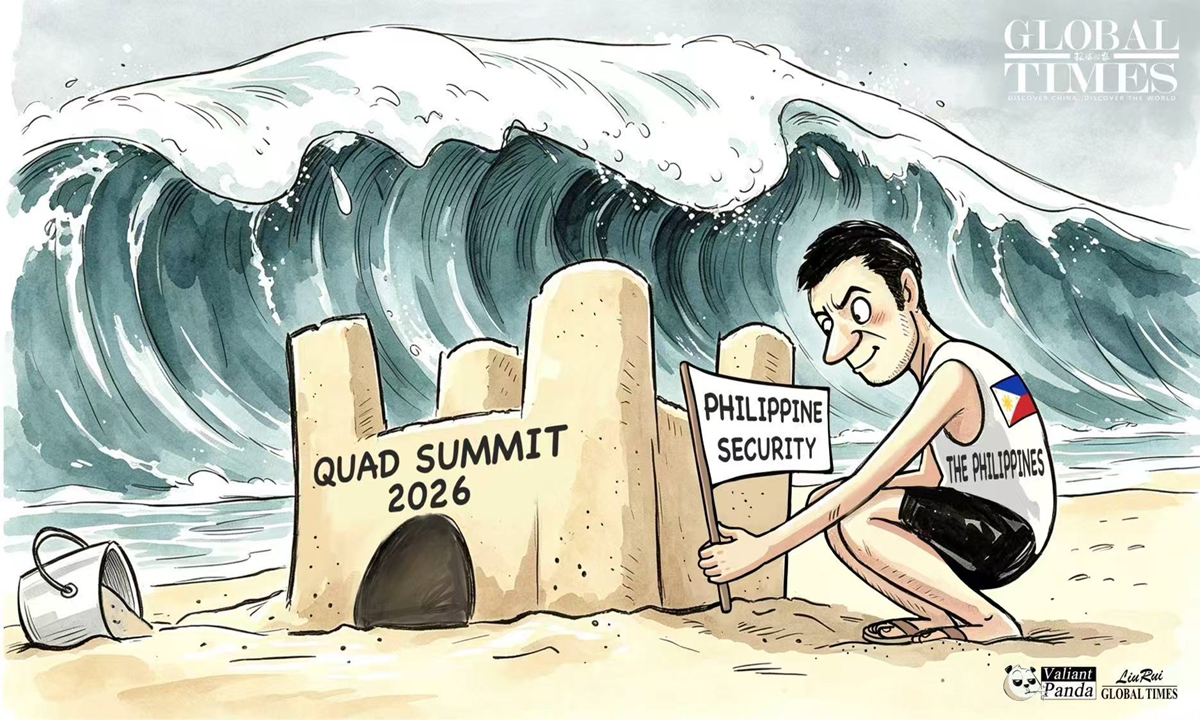
Security built on sand. Illustration: Liu Rui/GT
After the Meeting of Defense Ministers from Australia, Japan, the Philippines, and the US was held in Cebu, Philippines, in October, where they agreed to further strengthen defense cooperation, a summit of the leaders of the four Quad countries - the US, Japan, India and Australia - is set to convene in Manila on Tuesday, on the sidelines of the 49th ASEAN Summit. As ASEAN chair for 2026, the Philippines is gradually seeking to embed its security concerns within the regional security agenda shaped by external powers, particularly the US. Manila appears to operate under the belief that the closer its ties with Washington, the greater the Philippines' security. Yet does this strategic logic hold up against real‑world realities?The Philippines not only seeks US protection but also hopes to raise the political and strategic costs for the US of abandoning its support during a crisis by continuously deepening their strategic ties. By opening more military facilities and strengthening joint operations with countries such as the US, Japan and Australia, the Philippines is striving to prove that it is not only a loyal ally of the US but also an indispensable partner in advancing US regional strategy.
The problem is that the Philippines' strategic value to the US and the extent to which the US is willing to assume security risks for the Philippines are two separate matters.
Sitting at a strategic point with access to both the South China Sea and the Taiwan Straits, Philippine military facilities carry substantial weight for US force projection, intelligence and surveillance, and military operations across the western Pacific. Against the backdrop of intensifying China-US strategic competition, the Philippines' geopolitical value has become even more prominent. While the US' strengthened military cooperation with the Philippines serves to safeguard the security of its ally, it also advances its own regional strategic objectives.
The fact that the US needs the Philippines' strategic location does not mean it is willing to bear the cost of the Philippines' security demands. For Washington, the Philippines is a crucial fulcrum for maintaining the US military presence in the western Pacific and enhancing strategic deterrence against China.
In recent years, the US has indeed repeatedly reaffirmed its security commitments to the Philippines. These commitments have undoubtedly bolstered the confidence of the Philippine government and have also served as a key external factor enabling the Marcos administration to adopt a hardline stance on South China Sea issues.
Yet, would the dominant ally risk direct great-power conflict merely to uphold the allegiance of a smaller partner? As a rational actor, it will likely prioritize risk control and cost-benefit calculus, at most probing near the brink of conflict to signal pressure, rather than resorting to immediate use of force. Moreover, the US-Philippines Mutual Defense Treaty does not mean that the US must automatically take military action in response to any friction in the South China Sea. Whether an incident constitutes an armed attack under the treaty, the nature of any response, and the measures adopted all hinge on the facts on the ground and US domestic constitutional processes.
What warrants even greater vigilance is that US support may embolden the Philippines to act recklessly over South China Sea issues, leading some Filipino politicians to overestimate their own ability to manage maritime disputes while underestimating the risks of escalation. Should Manila misread US political rhetoric as unconditional military assurances and take actions beyond its own risk‑bearing threshold, it may find, when a crisis spirals out of control, that Washington's actual response falls short of its expectations - leaving the Philippines to bear the brunt of the consequences.
No country can anchor its security purely on another major power's strategic needs. The more the Philippines chases security through deepened ties with the US, the more it must guard against the resulting strategic dependence and the risk of losing control. Washington can recalibrate its regional strategy based on its own interests, yet Manila cannot change its geographical location, or escape the reality of long‑term coexistence with its neighbors. After all, the US is far away, whereas China is close by.
As the 2026 ASEAN Chair, the Philippines should strike a balance between its own security concerns and ASEAN's collective interests, rather than turning ASEAN's multilateral cooperation platform into an instrument that fuels bloc‑driven confrontation.
The author is director of the Center for Philippine Studies at Jinan University. opinion@globaltimes.com.cn
RELATED ARTICLES