IN-DEPTH / IN-DEPTH
Diving 4,600 meters into the Pacific aboard Jiaolong: An underwater climb reveals the wonder, skill and patience behind deep-sea exploration
Inside a titanium sphere just over two meters across, Global Times reporter watched the Pacific disappear into darkness. The depth reading kept climbing, the cabin grew colder and a question began to intrude on the excitement: What had led to this moment?
The answer began on October 26, when the Global Times reporter joined the research vessel Deep Sea No. 1 and its manned submersible Jiaolong for a monthlong scientific expedition. On November 2, that journey took the reporter to the seabed some 4,600 meters below the surface, in the Ontong Java Plateau region of the South Pacific.
For someone who grew up following science news and stories of exploration, the chance to descend in Jiaolong felt like a childhood dream come true. Jules Verne's Twenty Thousand Leagues Under the Sea had given generations of readers a way to imagine such a journey. Now, the reporter was about to embark on the said journey, with a pilot and an engineer in place of Captain Nemo.
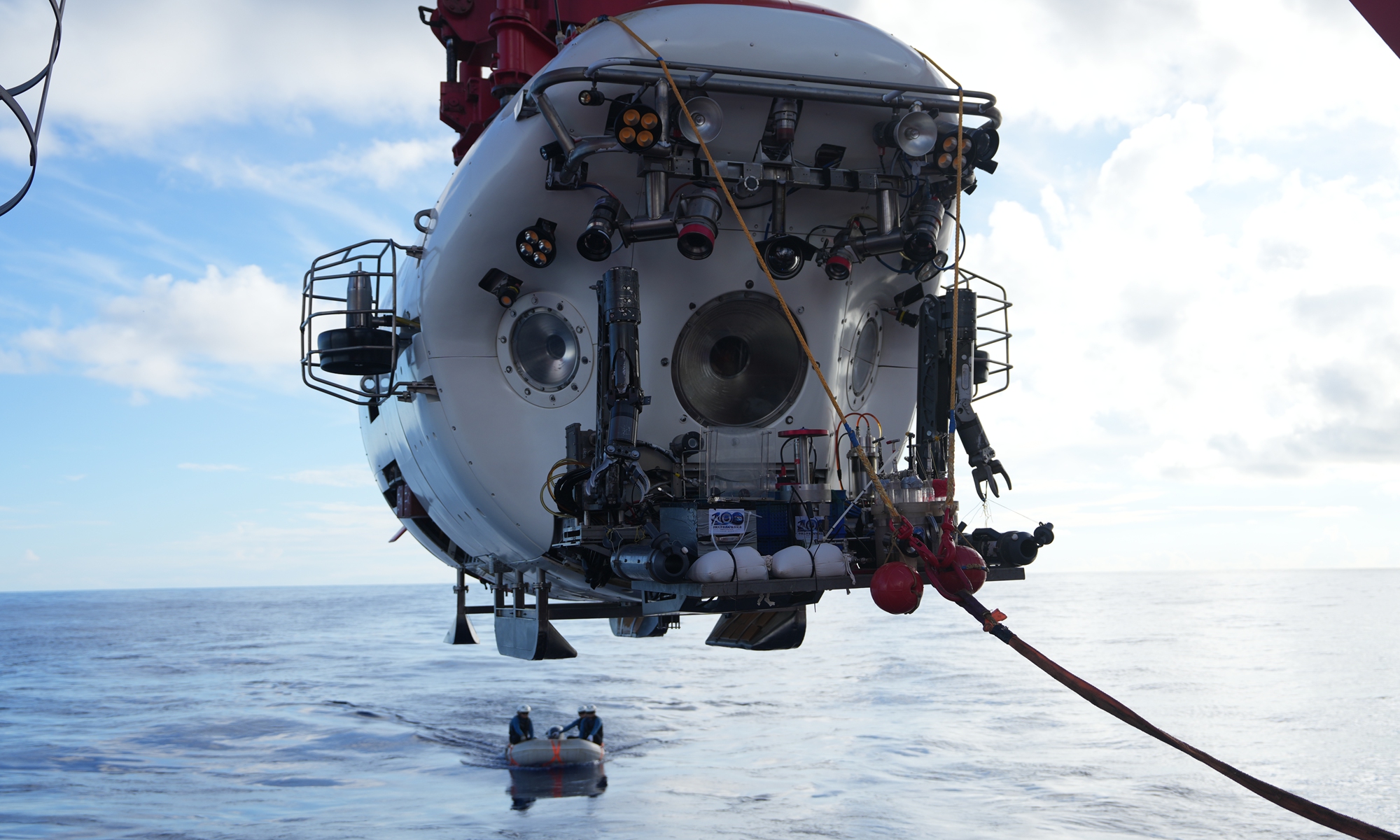
Jiaolong had long been a familiar name in the news. China's first independently designed and integrated deep-sea manned submersible reached 7,062 meters in 2012, a milestone in the country's exploration of the ocean. At about 8.7 meters long and 4 meters wide, it carries cameras, robotic arms and thrusters around a pressure-resistant cabin built to hold three people.
Its hundreds of dives offered reassurance, but the prospect of becoming one of its occupants brought a nervousness familiar to anyone boarding an aircraft for the first time.
Two days before the dive, pilot Fu Wentao took the reporter through the safeguards. Jiaolong was designed to operate at depths of 7,000 meters, well beyond this mission's destination. Its ballast weights, he explained, were held by electromagnets and designed to drop away if power failed, allowing the submersible to become buoyant and rise.
Backup systems provided further protection, while a typical dive used no more than about half the main battery's charge.
Understanding these arrangements helped settle everyone's nerves. Fu also outlined the mission: descend to around 4,600 meters, travel roughly 2 kilometers along the seabed, then begin the ascent from higher ground. The entire dive would last about 10 hours. Food, extra clothing and heat packs were prepared alongside the scientific equipment.
Into the darkness
Early that morning, after equipment checks, pilot Tang Jialing, engineer Wang Xiangxin and the reporter climbed into Jiaolong. The spherical cabin was compact, with instruments taking up much of the space around the crew, but each person had a porthole through which to watch the world outside.
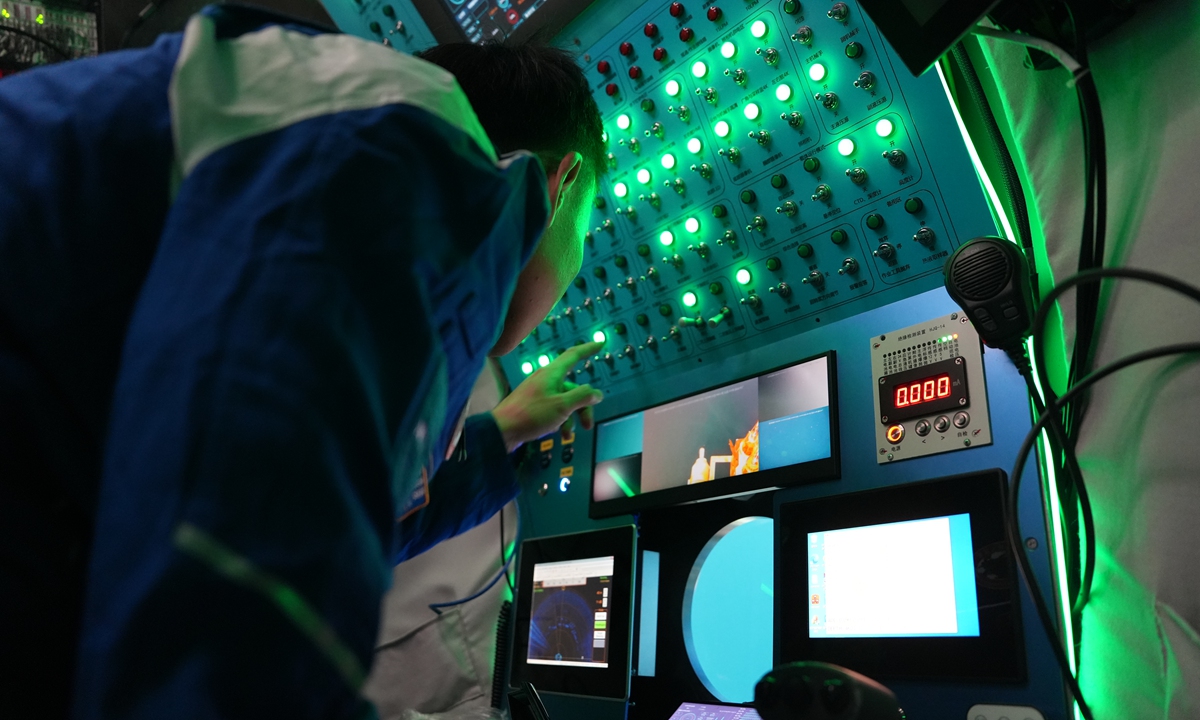
Beside the two smaller side windows were hand controls for the external cameras. Above Tang's central position, a panel held switches for communications, equipment power and ballast release. In front of him were controls for maneuvering the submersible and operating its hydraulic robotic arms, which would become the crew's hands on the seabed.
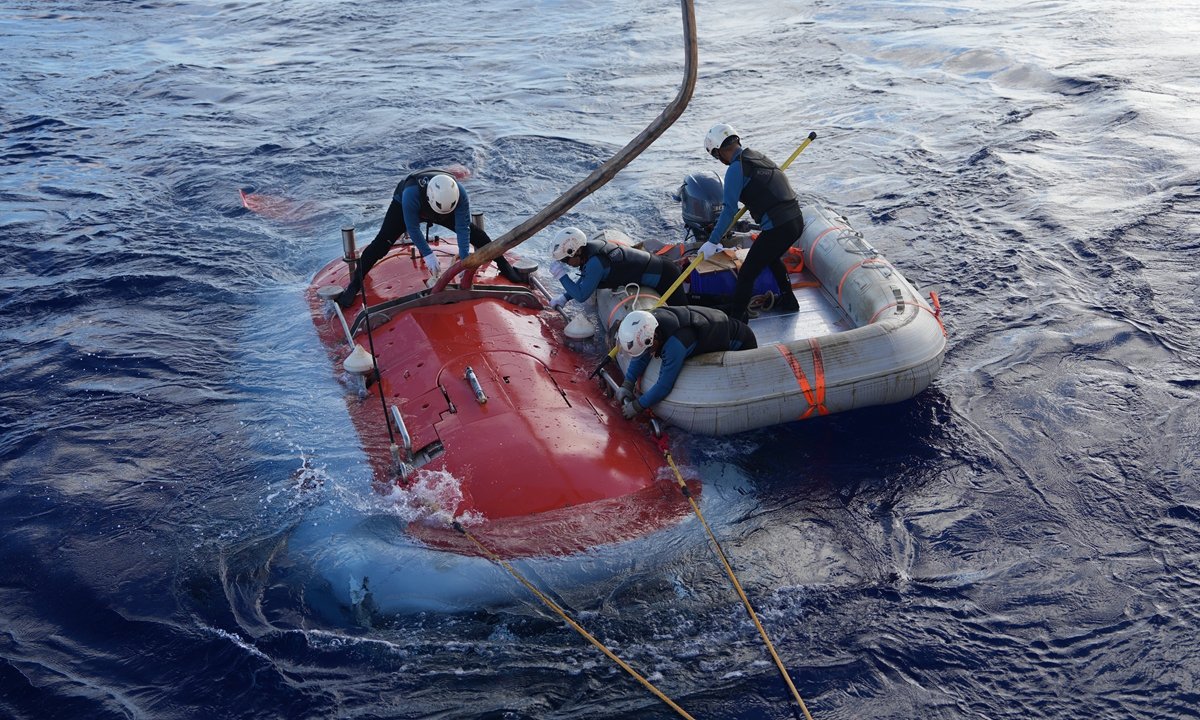
Deep Sea No. 1's lifting system lowered the crew into the water, where divers detached the securing lines. Jiaolong then took in seawater through its ballast system and began to sink, drifting down like a falling leaf. At roughly 40 meters a minute, the descent would take about two hours, leaving time to eat and review the work ahead.
What struck the reporter first was the stillness. The sea surface could be restless and changeable; beyond the windows, the water seemed motionless. Increasing pressure announced itself only through the instruments. There was no view into the distance, just darkness and the knowledge that more water was gathering overhead.
For years, the reporter had followed Jiaolong through reports of depth records and the samples it brought back. Inside the cabin, those achievements revealed themselves with more human scales: a pilot checking his instruments, an engineer preparing for the work below, and a team aboard the mother ship monitoring the dive.
The cabin was not silent. An acoustic communications system developed by the Chinese Academy of Sciences kept the crew in contact with Deep Sea No. 1, transmitting updates on the position, depth and condition. Its pulses reminded the reporter of dolphin calls.
Once the depth display passed 4,000 meters, Tang began preparing for the arrival. He checked the submersible's condition and attitude, switched on the external lights and watched for the bottom. As the submersible approached the seabed, he released the descent ballast, bringing the long downward journey to an end.
The view changed abruptly. Rocks and patches of sediment emerged in the lights, recorded by Jiaolong's 4K cameras. After the darkness of the descent, the brightly lit foreground looked almost familiar, its pale green cast reminding the reporter of shallower water seen while snorkeling.
Moving through it required equipment built for a very different environment. Chinese-made thrusters, powered by domestic lithium battery packs, drove the more than 20-ton submersible forward.
Researchers aboard Deep Sea No. 1 had explained that overseas technology restrictions had encouraged the replacement of imported components, while improvements among Chinese suppliers increasingly offered better alternatives. Here, those changes were carrying the crew across the seabed.
Climbing underwater mountain
The assignment was to collect deep-water and geological samples and examine the terrain along the route. Deep Sea No. 1 had already mapped the area from the surface, but the map could not show every detail the crew now encountered through the windows.
Tang watched the ground ahead, looking for changes in the rocks and places worth sampling.
A display tracked the route against the planned course and showed the mother ship's position overhead. Jiaolong's 475th dive soon produced a useful observation: a patch of seabed dotted with nodules, whose location the team surveyed and recorded before continuing toward higher ground.
Animal sightings were scattered. Grenadier fish and squat lobsters appeared along the way, while sponges nestled in crevices like small white roses. The longer the reporter watched, the more the reporter understood how easily an unfamiliar form of life could be overlooked among the rocks.
Close inspection of such habitats has already brought discoveries. During Jiaolong expeditions in 2023 and 2024, scientists found a previously unknown worm living inside glass sponges on northwestern Pacific seamounts at around 1,000 meters deep, according to the Second Institute of Oceanography under China's Ministry of Natural Resources.
Named Eunice siphoninsidiator, the worm shelters in the sponge's central cavity and ambushes other small animals living there. Its Chinese name evokes an assassin. What looks like a quiet sponge can conceal a relationship between species that scientists are only now beginning to understand.
After about two hours of exploration along the bottom, the team reached the foot of a rocky underwater mountain. Examining the rocks, Wang tentatively identified basalt, suggesting that the formation had been built by volcanic activity. Dark, tightly packed rock covered its slopes.
As Jiaolong climbed, the scenery grew stranger. Shrimp drifted past like slivers of ice. Farther up, sponges rose on slender stalks that appeared to stretch 3 or 4 meters, their broad tops opening into the water like butterfly nets left suspended in the deep.
The difficulty became clear when he tried to retrieve a rock from the mountainside.
Each pause near the bottom could disturb sediment, sending a cloud across the view. Waiting for it to clear meant holding position on a slope; moving without a clear view risked bringing the submersible too close to the rock face.
Tang was one of China's first Jiaolong pilots. After more than 18 years working with the vehicle and helping to upgrade its equipment, he knew its movements intimately. Yet even that experience could not make every attempt straightforward.
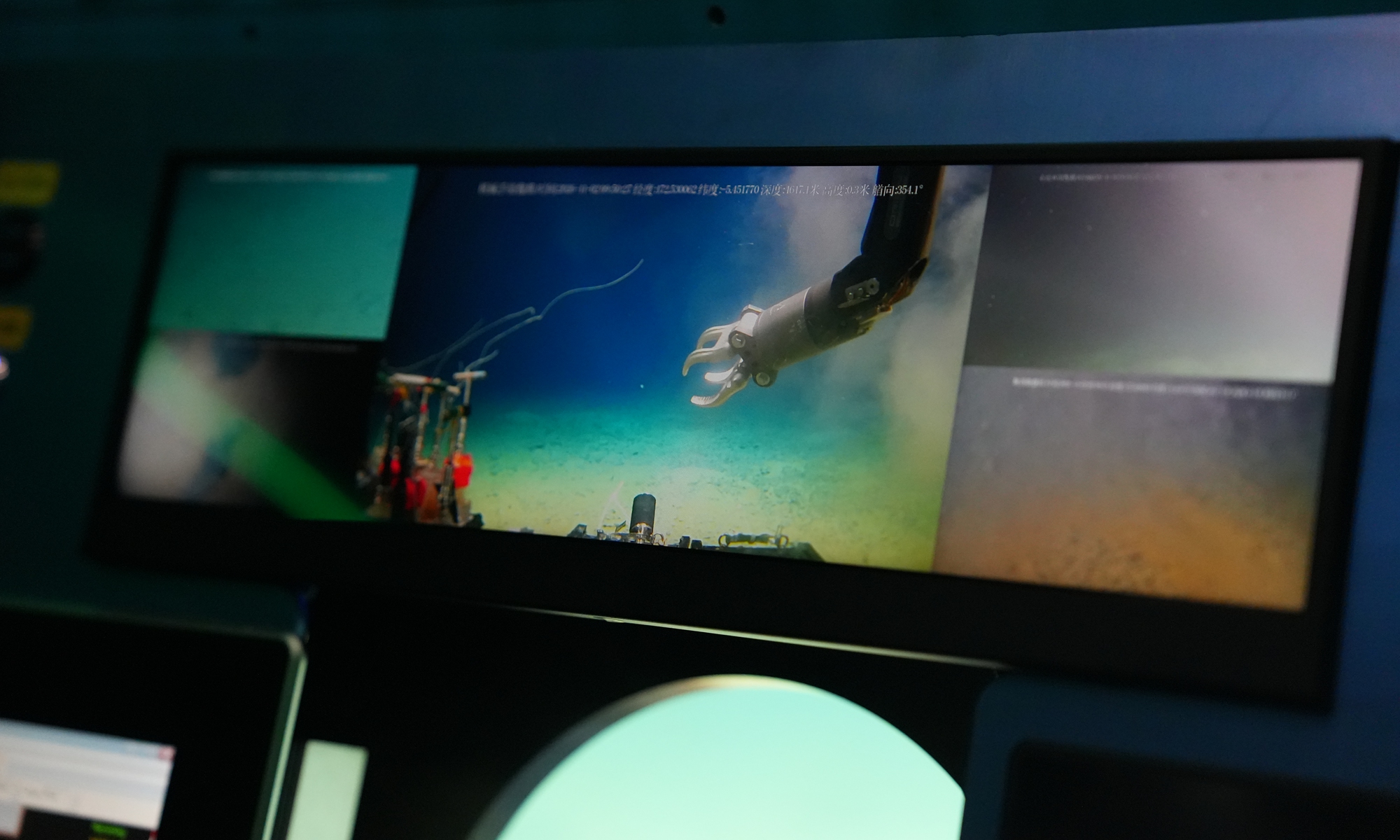
He found a promising rock and steadied Jiaolong. Looking between the porthole and the camera display, he extended the robotic arm and closed the gripper around it. The rock lifted from the seabed, but before it reached the sample basket, it slipped free and fell.
Disturbed sediment spread across the window like a sandstorm. For a while, the rock disappeared. The team had to wait for the water to clear enough to try again, conscious that the specimen might slide farther down the slope.
As visibility began to return, Tang leaned forward from his kneeling position at the controls, bringing his face close to the window. The cabin wall was cold, but his attention remained fixed outside.
Both hands worked the controls as he searched for the fallen rock, aligned the arm and adjusted the gripper.
This time, the rock held. Slowly, he drew it toward Jiaolong and lowered it into the sample basket. The reporter had imagined deep-sea exploration in terms of extraordinary depths and unfamiliar creatures.
Watching that rock finally come aboard, the reporter began to appreciate how much of it consisted of patient, exacting work. The specimen would reach researchers on the surface because someone had persisted with it here.
On that submerged mountain, the Global Times reporter thought of the answer famously attributed to British mountaineer George Mallory when asked why he wanted to climb Everest: "Because it's there."
The same curiosity had brought the team down through 4,600 meters of water, though curiosity alone could not put a rock in the basket.
That took Tang's hands, Jiaolong's engineering and the people waiting above on Deep Sea No. 1. Beyond the reach of the lights, the mountain continued. The crew had collected a small piece of it; there was still far more to see.
The answer began on October 26, when the Global Times reporter joined the research vessel Deep Sea No. 1 and its manned submersible Jiaolong for a monthlong scientific expedition. On November 2, that journey took the reporter to the seabed some 4,600 meters below the surface, in the Ontong Java Plateau region of the South Pacific.
For someone who grew up following science news and stories of exploration, the chance to descend in Jiaolong felt like a childhood dream come true. Jules Verne's Twenty Thousand Leagues Under the Sea had given generations of readers a way to imagine such a journey. Now, the reporter was about to embark on the said journey, with a pilot and an engineer in place of Captain Nemo.
Jiaolong had long been a familiar name in the news. China's first independently designed and integrated deep-sea manned submersible reached 7,062 meters in 2012, a milestone in the country's exploration of the ocean. At about 8.7 meters long and 4 meters wide, it carries cameras, robotic arms and thrusters around a pressure-resistant cabin built to hold three people.
Crew members aboard the Shenhai-1 support vessel detach the main lifting cable from the Jiaolong manned submersible in preparation for its dive on November 1, 2026.
Its hundreds of dives offered reassurance, but the prospect of becoming one of its occupants brought a nervousness familiar to anyone boarding an aircraft for the first time.
Two days before the dive, pilot Fu Wentao took the reporter through the safeguards. Jiaolong was designed to operate at depths of 7,000 meters, well beyond this mission's destination. Its ballast weights, he explained, were held by electromagnets and designed to drop away if power failed, allowing the submersible to become buoyant and rise.
Backup systems provided further protection, while a typical dive used no more than about half the main battery's charge.
Understanding these arrangements helped settle everyone's nerves. Fu also outlined the mission: descend to around 4,600 meters, travel roughly 2 kilometers along the seabed, then begin the ascent from higher ground. The entire dive would last about 10 hours. Food, extra clothing and heat packs were prepared alongside the scientific equipment.
Into the darkness
Early that morning, after equipment checks, pilot Tang Jialing, engineer Wang Xiangxin and the reporter climbed into Jiaolong. The spherical cabin was compact, with instruments taking up much of the space around the crew, but each person had a porthole through which to watch the world outside.
Beside the two smaller side windows were hand controls for the external cameras. Above Tang's central position, a panel held switches for communications, equipment power and ballast release. In front of him were controls for maneuvering the submersible and operating its hydraulic robotic arms, which would become the crew's hands on the seabed.
Crew members aboard the Shenhai-1 support vessel detach the main lifting cable from the Jiaolong manned submersible in preparation for its dive on November 1, 2026.
Deep Sea No. 1's lifting system lowered the crew into the water, where divers detached the securing lines. Jiaolong then took in seawater through its ballast system and began to sink, drifting down like a falling leaf. At roughly 40 meters a minute, the descent would take about two hours, leaving time to eat and review the work ahead.
What struck the reporter first was the stillness. The sea surface could be restless and changeable; beyond the windows, the water seemed motionless. Increasing pressure announced itself only through the instruments. There was no view into the distance, just darkness and the knowledge that more water was gathering overhead.
For years, the reporter had followed Jiaolong through reports of depth records and the samples it brought back. Inside the cabin, those achievements revealed themselves with more human scales: a pilot checking his instruments, an engineer preparing for the work below, and a team aboard the mother ship monitoring the dive.
The cabin was not silent. An acoustic communications system developed by the Chinese Academy of Sciences kept the crew in contact with Deep Sea No. 1, transmitting updates on the position, depth and condition. Its pulses reminded the reporter of dolphin calls.
Pilot Tang Jialing checks the status of China's manned submersible Jiaolong during a dive on November 2, 2026. Photos on this page: Feng Fan/Global Times
Once the depth display passed 4,000 meters, Tang began preparing for the arrival. He checked the submersible's condition and attitude, switched on the external lights and watched for the bottom. As the submersible approached the seabed, he released the descent ballast, bringing the long downward journey to an end.
The view changed abruptly. Rocks and patches of sediment emerged in the lights, recorded by Jiaolong's 4K cameras. After the darkness of the descent, the brightly lit foreground looked almost familiar, its pale green cast reminding the reporter of shallower water seen while snorkeling.
Moving through it required equipment built for a very different environment. Chinese-made thrusters, powered by domestic lithium battery packs, drove the more than 20-ton submersible forward.
Researchers aboard Deep Sea No. 1 had explained that overseas technology restrictions had encouraged the replacement of imported components, while improvements among Chinese suppliers increasingly offered better alternatives. Here, those changes were carrying the crew across the seabed.
Climbing underwater mountain
The assignment was to collect deep-water and geological samples and examine the terrain along the route. Deep Sea No. 1 had already mapped the area from the surface, but the map could not show every detail the crew now encountered through the windows.
Tang watched the ground ahead, looking for changes in the rocks and places worth sampling.
A display tracked the route against the planned course and showed the mother ship's position overhead. Jiaolong's 475th dive soon produced a useful observation: a patch of seabed dotted with nodules, whose location the team surveyed and recorded before continuing toward higher ground.
Animal sightings were scattered. Grenadier fish and squat lobsters appeared along the way, while sponges nestled in crevices like small white roses. The longer the reporter watched, the more the reporter understood how easily an unfamiliar form of life could be overlooked among the rocks.
A screen inside Jiaolong displays its robotic arm working on the seafloor on November 2, 2026.
Close inspection of such habitats has already brought discoveries. During Jiaolong expeditions in 2023 and 2024, scientists found a previously unknown worm living inside glass sponges on northwestern Pacific seamounts at around 1,000 meters deep, according to the Second Institute of Oceanography under China's Ministry of Natural Resources.
Named Eunice siphoninsidiator, the worm shelters in the sponge's central cavity and ambushes other small animals living there. Its Chinese name evokes an assassin. What looks like a quiet sponge can conceal a relationship between species that scientists are only now beginning to understand.
After about two hours of exploration along the bottom, the team reached the foot of a rocky underwater mountain. Examining the rocks, Wang tentatively identified basalt, suggesting that the formation had been built by volcanic activity. Dark, tightly packed rock covered its slopes.
As Jiaolong climbed, the scenery grew stranger. Shrimp drifted past like slivers of ice. Farther up, sponges rose on slender stalks that appeared to stretch 3 or 4 meters, their broad tops opening into the water like butterfly nets left suspended in the deep.
The difficulty became clear when he tried to retrieve a rock from the mountainside.
Each pause near the bottom could disturb sediment, sending a cloud across the view. Waiting for it to clear meant holding position on a slope; moving without a clear view risked bringing the submersible too close to the rock face.
Tang was one of China's first Jiaolong pilots. After more than 18 years working with the vehicle and helping to upgrade its equipment, he knew its movements intimately. Yet even that experience could not make every attempt straightforward.
He found a promising rock and steadied Jiaolong. Looking between the porthole and the camera display, he extended the robotic arm and closed the gripper around it. The rock lifted from the seabed, but before it reached the sample basket, it slipped free and fell.
Disturbed sediment spread across the window like a sandstorm. For a while, the rock disappeared. The team had to wait for the water to clear enough to try again, conscious that the specimen might slide farther down the slope.
As visibility began to return, Tang leaned forward from his kneeling position at the controls, bringing his face close to the window. The cabin wall was cold, but his attention remained fixed outside.
Both hands worked the controls as he searched for the fallen rock, aligned the arm and adjusted the gripper.
This time, the rock held. Slowly, he drew it toward Jiaolong and lowered it into the sample basket. The reporter had imagined deep-sea exploration in terms of extraordinary depths and unfamiliar creatures.
Watching that rock finally come aboard, the reporter began to appreciate how much of it consisted of patient, exacting work. The specimen would reach researchers on the surface because someone had persisted with it here.
On that submerged mountain, the Global Times reporter thought of the answer famously attributed to British mountaineer George Mallory when asked why he wanted to climb Everest: "Because it's there."
The same curiosity had brought the team down through 4,600 meters of water, though curiosity alone could not put a rock in the basket.
That took Tang's hands, Jiaolong's engineering and the people waiting above on Deep Sea No. 1. Beyond the reach of the lights, the mountain continued. The crew had collected a small piece of it; there was still far more to see.
RELATED ARTICLES