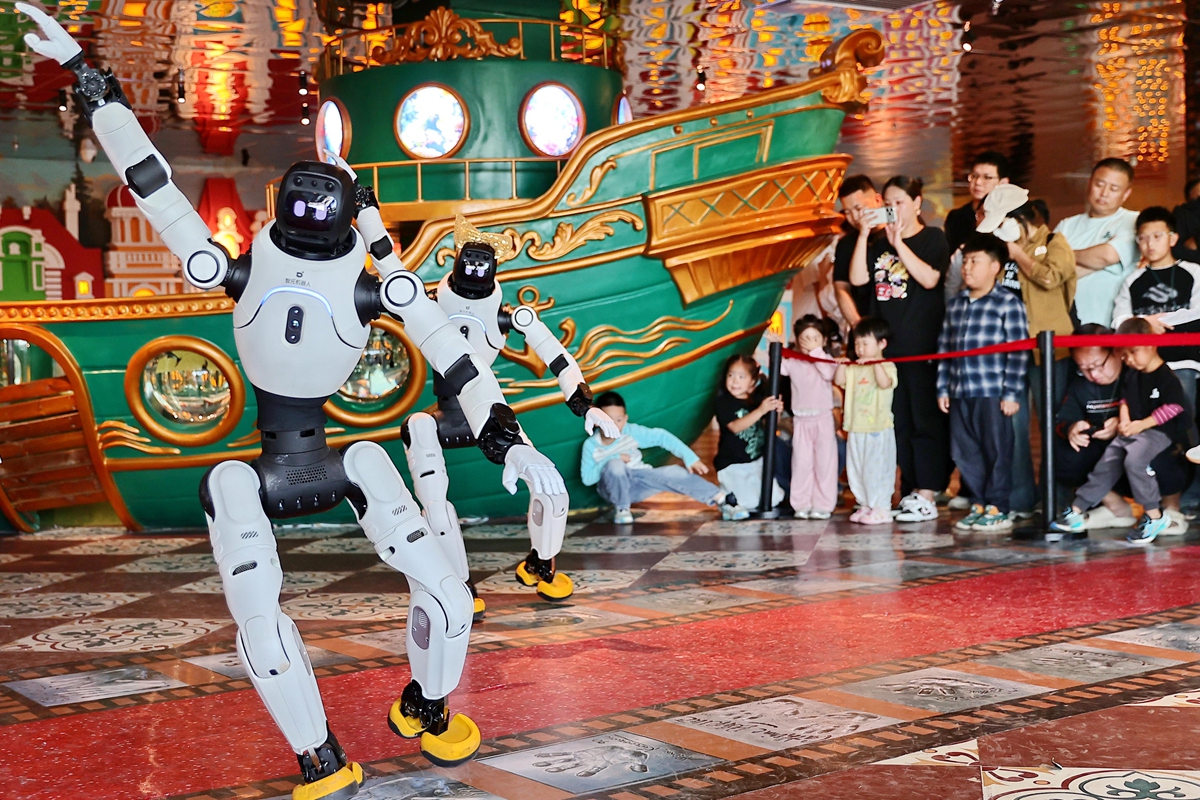
Visitors watch an intelligent robot dance performance at an aquarium in Qinhuangdao, North China's Hebei Province, on October 7, 2026. Many parents and children visited the aquarium on the last day of the seven-day National Day holidays. Photo: IC
When humanoid robots took to the runway and danced to K-pop music in Hong Kong on Monday, the performance offered more than a glimpse of futuristic entertainment. It illustrated how Chinese robotics technology and South Korean entertainment content can be brought together to explore new commercial opportunities.Chinese firm Star Plus Legend Holdings and South Korea's Galaxy Corp signed a memorandum of understanding (MOU) on Monday to expand their existing cooperation into robot entertainment and artificial intelligence (AI) robotics.
According to an announcement, the planned collaboration covers robot parks, global robot tours and the joint development of AI toys and companion robots targeting markets in China, South Korea and beyond.
The partnership provides a fresh perspective on the potential of China-South Korea economic cooperation, with companies from the two countries bringing their complementary strengths and joining hands in exploring new business opportunities.
Chinese robotics company Unitree participated in the performance, while Galaxy Corp brought its experience in entertainment content and robot performances. Star Plus Legend has established cooperation with Unitree to develop consumer robots incorporating entertainment intellectual property (IP).
What makes this cooperation particularly noteworthy is that it goes beyond a single performance or business agreement. The two companies established a partnership in November 2025, when Star Plus Legend acquired a stake of no more than 7 percent in Galaxy through an investment fund. Their initial cooperation covered concerts, exhibitions and entertainment IP development. The latest MOU extends that relationship into the joint development of robotics products and entertainment applications.
The partnership also points to a broader opportunity for China-South Korea economic cooperation. While the two countries have long been connected through trade and industrial supply chains, the latest collaboration shows how businesses can go a step further by combining their strengths to jointly develop new products and consumer experiences. In emerging industries such as embodied AI, this cooperation could help turn technological capabilities into commercial opportunities and create new sources of demand.
For robotics companies, one of the key challenges is finding applications that can translate technological advances into sustainable commercial demand. Entertainment offers a possible testing ground. Robot performances, interactive venues and consumer products based on popular characters could help companies explore how embodied AI might reach a broader consumer market.
Some initial applications are already taking shape. According to Star Plus Legend's announcement, Galaxy operates the Galaxy Robot Park in Seoul, where visitors can experience robot performances and interactions. These examples suggest that the integration of entertainment IP and robotics is beginning to move beyond demonstrations into physical commercial spaces, although its longer-term business potential remains to be tested.
The potential value of such cooperation is not limited to the Chinese and South Korean markets. Galaxy founder and chief executive Choi Yong-ho expressed hope that businesses from the two countries could work together to explore international opportunities, according to local Hong Kong media.
The latest business partnership also comes against the backdrop of growing exchanges between China and South Korea in emerging technologies. On November 3, a forum on embodied AI technology and industrial cooperation was held in Seoul, bringing together representatives from government institutions, research organizations, universities and enterprises from both countries. Discussions focused on core technologies, industrial applications, commercialization challenges and technical standards.
The forum followed a China-South Korea science and technology innovation exchange conference held in Seoul on October 28, which focused on AI, embodied intelligence and advanced manufacturing. Taken together, these exchanges indicate that the two countries are exploring cooperation in a range of emerging industries.
Against this backdrop, the significance of the Hong Kong partnership goes beyond robots dancing to K-pop. It illustrates a new positive trend for China-South Korea economic cooperation in which manufacturing capabilities, emerging technologies and creative content are brought together to develop new products and markets.
If such cooperation can move from individual projects to sustainable commercial applications, it could create fresh opportunities for businesses on both sides and inject new momentum into bilateral economic ties.
RELATED ARTICLES