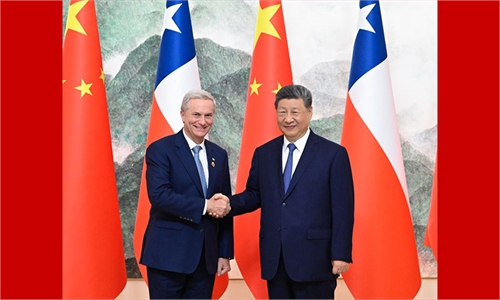
President Xi meets Asia-Pacific leaders ahead of APEC meeting;bilateral talks energize ties and lay groundwork for regional consensus: experts
Exchanges give fresh momentum to bilateral relations: experts
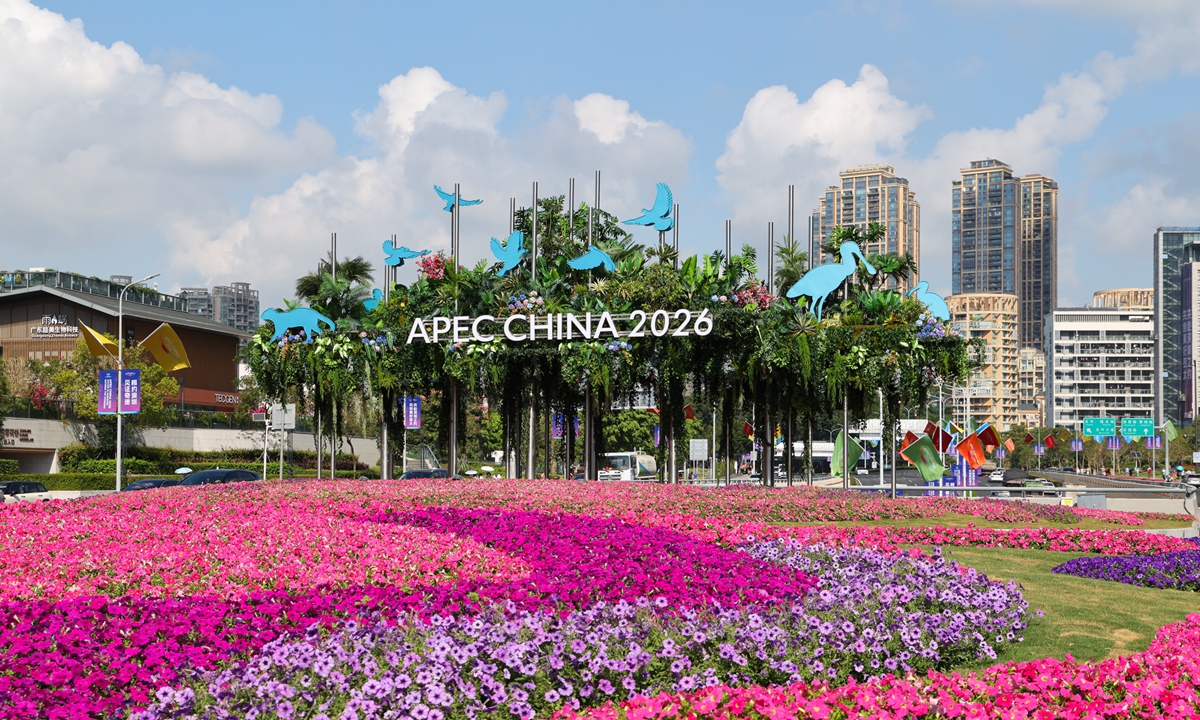
An APEC-themed installation is seen in Shenzhen, South China's Guangdong Province. The 33rd APEC Economic Leaders' Meeting will be held in Shenzhen from November 18 to 19. Photo: Xinhua
Ahead of the 33rd APEC Economic Leaders' Meeting set to unfold Wednesday and Thursday in Shenzhen, South China's Guangdong Province, Chinese President Xi Jinping held a series of bilateral meetings on Tuesday with leaders from multiple Asia-Pacific economies.This intensive round of head-of-state diplomacy sets bilateral priorities before leaders gather for multilateral deliberations. Chinese experts said that such engagements embody a well-established practice in China's diplomacy of using multilateral occasions to advance bilateral relations, while translating bilateral consensus into building broader regional understanding.
APEC provides a platform for both bilateral engagement and multilateral cooperation, creating opportunities for leaders to address differences and improve relations through direct exchanges, Chen Fengying, a research fellow at the Beijing-based China Institutes of Contemporary International Relations, told the Global Times on Tuesday.
At a time of complex international dynamics, high-level exchanges can chart directions for regional cooperation and help translate support for multilateralism into practical action, experts said.
Head-of-state diplomacy sets direction
Xi on Tuesday morning met with Canadian Prime Minister Mark Carney in Shenzhen, according to the Xinhua News Agency. During their meeting, Xi said that the improvement and development of China-Canada relations is a right choice that serves the interests of both peoples and is conducive to world peace, stability, development and prosperity.
The development of China-Canada relations over the years has shown that mutual respect, equality and mutual benefit, and seeking common ground while respecting differences are essential, Xi said, according to Xinhua.
The meeting came as the two countries work to improve relations and expand cooperation. A spokesperson for China's Ministry of Commerce announced on Tuesday afternoon that in addition to the two-year tariff exemption, under the supplementary arrangement, Canada will further expand exemptions for Chinese steel and aluminum products. Meanwhile, China will make additional adjustments to its anti-discrimination measures against certain Canadian agricultural and aquatic products in accordance with relevant laws and regulations.
The meeting with Carney was part of a packed day of bilateral diplomacy. Xi also met with Papua New Guinea (PNG) Prime Minister James Marape; General Secretary of the Communist Party of Vietnam Central Committee and Vietnamese President To Lam; Mexican President Claudia Sheinbaum Pardo; Peruvian President Keiko Fujimori; and Chilean President Jose Antonio Kast, Xinhua reported.
Chinese experts believed that head-of-state diplomacy helps advance China's diplomatic outreach covering major countries, neighboring states and developing economies. These face-to-face, in-depth exchanges with leaders from diverse economies allow China to share its strategic assessments and cooperation propositions directly, manage differences, consolidate mutual trust, and lay solid groundwork for deliverables from the multilateral session, they argued.
Wang Yiwei, professor at the School of International Studies, Renmin University of China, told the Global Times on Tuesday that the APEC event creates precious windows for high level interactions, facilitating visiting foreign leaders to take the opportunity for in person engagement with China's top leadership to inject fresh impetus into bilateral relations, and these conversations advance bilateral cooperation in parallel with wider regional agendas.
Bilateral talks build broader consensus
Experts said such head-of-state diplomacy steers Asia-Pacific cooperation with strategic vision. Upholding dialogue over confrontation and partnership rather than alliance, it encourages all parties to focus on shared development and jointly preserve the dynamism of the Asia-Pacific as the primary engine of global growth. It facilitates separate, candid exchanges with diverse Asia-Pacific partners, managing differences and identifying areas of alignment to pool gains from bilateral cooperation into collective momentum for joint Asia-Pacific action.
The different priorities discussed on Tuesday showed how bilateral engagement can contribute to regional goals, from industrial development to environmental governance and multilateral coordination.
In his meeting with Marape, Xi said the two sides should strengthen coordination within multilateral fora such as the United Nations and APEC, uphold international fairness and justice, expand cooperation in tackling climate change and protecting the marine environment, and safeguard the common interests of the Global South, Xinhua reported.
When meeting with To Lam, Xi said that in recent years, the top leaders of the two parties and the two countries have maintained close exchanges and reached important consensus on building a higher-level China-Vietnam community with a shared future that carries strategic significance. This has helped advance bilateral relations and injected positive energy into regional peace and development, Xi added, according to Xinhua.
APEC brings together economies with different sizes, needs and stages of development, Wang noted. Those differences provide concrete starting points for cooperation, Wang said. PNG's interest in agriculture, for example, creates opportunities for cooperation in agricultural digitalization and more convenient customs clearance and quarantine procedures. Vietnam's industrialization needs offer scope for closer industrial cooperation.
During his meeting with Sheinbaum, Xi said that advancing China-Mexico relations to new heights, across broader areas and in greater depth is of great significance to implementing their respective national development strategies and supporting the Global South in seeking strength through unity, according to Xinhua.
Noting that Chile was the first South American country to establish diplomatic relations with the People's Republic of China, Xi said the bilateral ties had withstood the test of a changing international landscape and maintained sound and steady development for a long time.
When talking with Kast in Shenzhen, Xi noted that the most valuable experience guiding bilateral ties is mutual respect, equality and win-win results.
During his meeting with Fujimori, Xi noted that the protocol upgrading the China-Peru free trade agreement took effect officially about two weeks ago, and the Chancay Port, built with the participation of Chinese enterprises, has given a strong boost to economic and trade cooperation between Asia and Latin America.
Wang said the emphasis on different partners' concerns reflects an effort to find common ground and build consensus while accommodating differences.
China can also work with partners on traditional and new infrastructure, the digital transformation of industry, the development of digital industries and green energy, Wang said. Responding to these needs helps give substance to a shared regional agenda.
The constructive tone of these meetings was also reflected in international media reporting. Reuters reported on Tuesday that Carney pointed to "greater predictability and stability" in China-Canada relations, with the Associated Press also reporting that Carney saw the stabilizing bilateral trade as indicative of how the two countries could work together pragmatically to solve problems.
Vietnamese broadcaster Voice of Vietnam on Tuesday reported about the bilateral meeting between Chinese and Vietnamese leaders, pointing to bilateral political trust, trade, investment and strategic infrastructure connectivity. It also highlighted To Lam's hope that Vietnam could build on the outcomes of China's APEC host year as it prepares to host the forum in 2027.
Chen said that bilateral meetings at the leadership level can lay a solid foundation for a successful APEC gathering.
Exchanges before the APEC Economic Leaders' Meeting help foster a positive atmosphere, coordinate positions and build consensus, Chen said. Signals emerging from these one-on-one conversations carry weight for the subsequent multilateral deliberations.
RELATED ARTICLES