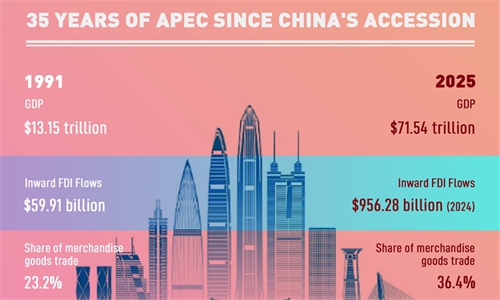
Looking out to the Pacific from Shenzhen Bay: Asia-Pacific co-op’s roadmap becomes clearer: Global Times editorial
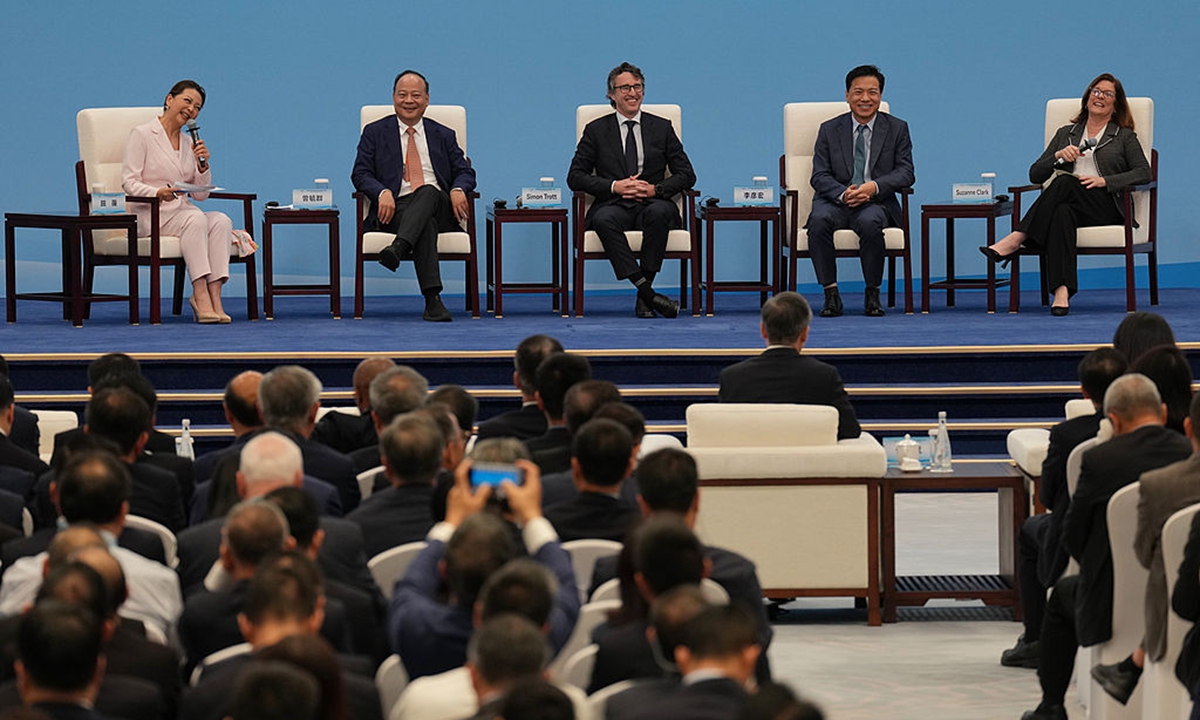
From left, Tian Wei, CGTN moderator, Robin Zeng, founder, chairman and CEO of CATL, Simon Trott, CEO of Rio Tinto, Robin Li, co-founder and CEO of Baidu, and Suzanne Clark, president and CEO of the US Chamber of Commerce, sit on the stage at the 2026 APEC CEO Summit held ahead of the APEC China 2026 summit in Shenzhen, South China's Guangdong Province, on November 17, 2026. Photo: VCG
The 2026 APEC CEO Summit is held in Shenzhen from Tuesday to Wednesday. More than 2,000 representatives from political and business circles across 21 APEC economies and 13 non-APEC economies gathered in Qianhai, with 115 Fortune Global 500 companies in attendance. Among the participating economies, major US corporations including Boeing, HP, Citigroup, and Google accounted for the largest share - nearly 20 percent - taking part to discuss the next phase of business cooperation and development in the Asia-Pacific.
At this historic moment, with the world's eyes fixed on Shenzhen, the summit, themed "To Prosper and Win the Future Together" - conveyed the global business community's confidence in the Asia-Pacific as the world's most dynamic economic region and a primary engine of global growth, as well as their expectations for China, in its capacity as host, to lead the way in fostering Asia-Pacific cooperation. A year ago, at the APEC CEO Summit in Gyeongju, South Korea, President Xi Jinping delivered a solemn message to the Asia-Pacific region and the world: "Walking with China means walking with opportunities, believing in China means believing in tomorrow, and investing in China means investing in the future." Over the past year, the Chinese economy has forged ahead despite mounting pressures, shifting toward new drivers of growth and higher-quality development, delivering a robust, substantive phased report for good start of the 15th Five-Year Plan (2026-30).
Amid the spillover effects of geopolitical conflicts and global industrial supply chains strained by energy crises and protectionism, China has not only demonstrated remarkable composure and resilience but has also - through high-standard opening-up - provided invaluable certainty to the Asia-Pacific and global economies. This powerfully validates the visionary insight that "the 'next China' is still China."
At present, cooperation in the Asia-Pacific region faces new circumstances and new issues. The spread of anti-globalization sentiment, coupled with the rise of unilateralism and protectionism, is undermining the foundations of free and open trade and hindering the development of a Free Trade Area of the Asia-Pacific (FTAAP).
The international landscape is marked by turbulence and complexity; geopolitical rivalries are intensifying, and there is a growing tendency to politicize economic and trade issues or overstretch the security issue - all of which create divisions and obstacles for regional cooperation. Furthermore, significant development disparities among APEC members continue to constrain the overall effectiveness of regional cooperation. At this critical historical juncture, addressing the development challenges of the Asia-Pacific and unlocking the full potential of regional cooperation requires, more than ever, visionary guidance and concrete, actionable pathways. The times call for Chinese wisdom and Chinese solutions.
Since the 2014 APEC meeting in Beijing, which prompted participating economies to endorse the roadmap for APEC's Contribution to the Realization of the FTAAP and the APEC Connectivity Blueprint for 2015-2025, China has consistently stood on the right side of history over the past decade. From advancing the FTAAP toward tangible progress to facilitating the implementation of the Connectivity Blueprint across land and sea, China has consistently stood on the right side of history, and created shared opportunities for the Asia-Pacific region through its own opening-up and development, while providing direction and momentum for regional cooperation through forward-looking ideas and pragmatic actions.
At this critical historical juncture, China hoists the banner for advancing Asia-Pacific cooperation, which is not only of great significance in opening a new chapter in regional development, but will also inject more positive energy into global economic growth and international cooperation.
As the host, China has fully leveraged the APEC CEO Summit as a bridge, consistently taking concrete steps to build consensus among regional businesses and remove obstacles to cooperation. The Shenzhen summit will launch a Shenzhen initiative at the 2026 APEC CEO Summit, marking the first time in the summit's 30-year history that an outcome document will be issued in the form of an initiative. The document will systematically incorporate and consolidate the business community's key proposals and offer recommendations to the APEC Economic Leaders' Meeting. The roadmap for Asia-Pacific cooperation is becoming clearer.
During the summit, Chinese and international participants will engage in business dialogues under the theme "new landscape of the Asia-Pacific economy and opportunities for cooperation." The discussions will cover seven topics: connectivity, AI, sustainable development, the FTAAP, digital economy cooperation, the Guangdong-Hong Kong-Macao Greater Bay Area, and the coordinated digital and green transition. These topics not only reflect the forefront of global industrial transformation but also address the shared development aspirations of Asia-Pacific economies. They represent both a "wish list" and an "action list" for cooperation, offering targeted approaches to overcoming growth challenges and unlocking the potential for collaboration.
Looking back at the history of Asia-Pacific cooperation, following the prevailing trends and seizing opportunities have been consistent themes. From Juncao and upland rice technology in the highlands of Papua New Guinea and Luban Workshops in Southeast Asian countries to the Punta Sierra Wind Farm in Chile and the Cirata Floating Solar Power Plant in Indonesia which Chinese companies helped build, China has consistently been willing to listen to the voices of developing and smaller economies within the Asia-Pacific family. It has also responded to the business community's shared aspirations to reduce trade barriers and facilitate the free flow of factors. By sharing opportunities through openness and pursuing win-win outcomes through cooperation, China has helped lay a solid foundation for the "Asia-Pacific miracle."
Looking out toward the Pacific Ocean from Shenzhen Bay, one sees a region vast enough to accommodate the shared aspirations of all sides for prosperity. By translating their commitment to openness into mutually beneficial actions and pooling their innovative strengths to drive regional growth, the Asia-Pacific business community can surely write a new chapter in the "Asia-Pacific miracle," turn the vision of an Asia-Pacific community into reality, and inject sustained and powerful momentum into a world undergoing turbulence and transformation.
RELATED ARTICLES