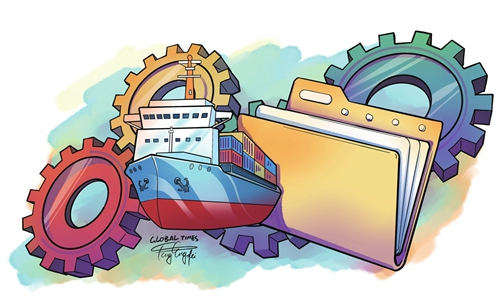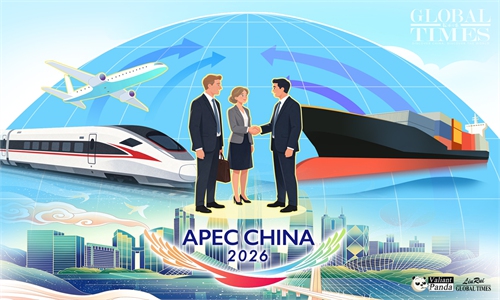
APEC cooperation. Illustration: Tang Tengfei/GT
Editor's Note:All eyes are on Shenzhen this week, as the city prepares to host the 33rd APEC Economic Leaders' Meeting from Wednesday to Thursday. Leaders and representatives from the 21 APEC member economies will gather in Shenzhen to chart a new blueprint for Asia-Pacific cooperation, centered on the theme "Building an Asia-Pacific Community to Prosper Together." APEC provides a flexible, institutionalized "safe space" where economies at vastly different stages of development can engage in practical experimentation and regulatory harmonization, Warwick Powell (Powell), an adjunct professor at the Queensland University of Technology and former policy advisor to Kevin Rudd, shared his insights with Global Times (GT) reporter Li Aixin. He added that as an enabling power, China exemplifies a model of development that actively empowers its partners through real economic substance rather than conditional mandates.
GT: What key highlights and takeaways of the meeting are you looking forward to most?
Powell: The selection of Shenzhen as the host city for the 2026 APEC meeting provides a powerful lens through which to view the future of regional cooperation. Born as a special economic zone and transformed into a global engine of technology and manufacturing, Shenzhen embodies the spirit of pragmatic experimentation and structural adaptation that the Asia-Pacific desperately needs today.
The key highlights I am looking for center on practical frameworks for artificial intelligence governance, digital supply chain resilience and green transition investments. Against the backdrop of global economic fragmentation, protectionist headwinds and rising geopolitical friction, the region is searching for tangible mechanisms to maintain openness. Shenzhen's ethos reminds us that growth is driven by connectivity, innovation and an unwavering commitment to trade facilitation rather than insular economic nationalism.
The gathering will test whether member economies can look past zero-sum distractions to refocus on shared developmental imperatives, setting a pragmatic standard for technological collaboration and sustainable economic integration across the Pacific.
GT: China will have hosted APEC three times: Shanghai in 2001, Beijing in 2014 and Shenzhen in 2026. What does each hosting tell us about China's evolving role?
Powell: China's three APEC hosting traces an extraordinary arc of national and regional evolution. In Shanghai in 2001, just as China entered the WTO, the focus was on integration - signaling a developing nation's commitment to joining the global trading system and opening its markets to the world. By Beijing 2014, China had become the world's second-largest economy and a primary engine of regional growth, using the meeting to champion the Free Trade Area of the Asia-Pacific and launch ambitious connectivity initiatives. Now, hosting in Shenzhen in 2026, China steps forward not merely as a manufacturing powerhouse or trading hub, but as an enabling power.
Today, China offers vital public goods rooted in advanced digital infrastructure, green energy technologies, AI governance frameworks and resilient supply chain networks. By sharing its industrial scaling capabilities and clean-energy transitions, China helps developing economies leapfrog traditional developmental bottlenecks, providing structural stability and mutual prosperity in an era of acute global uncertainty.
GT: What do you see as the ultimate goal or value of Asia-Pacific cooperation? You have often described China as an "enabling power." In the context of the APEC meeting, how is this role reflected in concrete terms?
Powell: The ultimate value of Asia-Pacific cooperation lies in cultivating an open, interconnected economic ecosystem where sovereign economies - regardless of size - can leverage complementary strengths to achieve shared prosperity. As an enabling power, China exemplifies a model of development that actively empowers its partners through real economic substance rather than conditional mandates.
In the context of APEC, this empowering role is reflected in concrete terms through deep industrial integration, infrastructure financing and the co-creation of resilient supply chains. Rather than locking partners into asymmetrical dependencies, China provides the physical building blocks, digital platforms and green transition technologies that enable developing economies in the Global South to upgrade their productive capacities. By supplying, for example, affordable solar assets, clean energy solutions, modern machinery and equipment, high-performance logistics, and advanced digital tools, China helps unlock domestic growth potential across the region.
This partnership-driven approach proves that regional stability is built on tangible developmental empowerment, mutual economic interdependence and shared upward mobility.
GT: From the perspective of member economies, what tangible development outcomes has APEC delivered, and what is its practical appeal amid growing global uncertainty?
Powell: Over more than three decades, APEC has served as the architect of regional economic integration, systematically lowering tariff and non-tariff barriers, championing trade liberalization through the Bogor Goals, and fostering microeconomic connectivity across the Pacific basin. In an era marked by rising protectionist barriers, weaponized supply chains and fractured trade architecture, APEC's most vital practical appeal is its non-binding, consensus-driven architecture.
Unlike zero-sum treaty negotiations or coercive trade blocs, APEC provides a flexible, institutionalized "safe space" where economies at vastly different stages of development can engage in practical experimentation and regulatory harmonization. For developing and developed nations alike, it functions as an indispensable economic coordination platform and dialogue channel.
To translate this platform into concrete outcomes moving forward, member economies must leverage APEC to pilot digital trade protocols, streamline cross-border data flows and align green finance mechanisms, ensuring that regional integration remains an active shield against global fragmentation.
GT: Many people are closely watching interactions among major powers at the APEC meeting. What positive ripple effects will these interactions have on other Asia-Pacific economies?
Powell: Constructive dialogue and positive signals between major powers within the APEC framework generate vital stabilizing effects for the entire Asia-Pacific region. When major economies choose the path of "jaw-jaw" over geopolitical confrontation, it immediately lowers systemic volatility, reduces risk premiums on cross-border investments and injects much-needed predictability into global commerce.
For medium and smaller Asia-Pacific economies, this thaw expands strategic autonomy and diplomatic space, freeing them from the damaging pressures of forced alignment or binary blocs. A stable great-power relationship within a multilateral setting ensures that regional supply chains remain open, technological cooperation can proceed without disruptive blockades and trade corridors can function efficiently.
Ultimately, a predictable security and economic environment allows emerging economies to focus their sovereign energies where they matter most: on domestic structural upgrading, sustainable infrastructure development and the material wellbeing of their people.
GT: What change in Asia-Pacific cooperation do you find most worth looking forward to over the next decade?
Powell: Over the next decade, the most transformative shift in Asia-Pacific cooperation will be the transition from mere physical and trade interconnection to deep, systemic co-evolution and digital-green structural synchronization. As we work to fully deliver on the Putrajaya Vision 2040 and build an Asia-Pacific community with a shared future, regional integration must move beyond traditional goods trade into the co-governance of digital economies, energy flows, digital systems interoperability while preserving national data security and sovereignty, and ecological transitions. This means establishing seamless cross-border frameworks for artificial intelligence, harmonizing interoperable digital currency and payment rails, and integrating regional clean-energy grids.
Rather than simply trading finished products, economies will increasingly co-design sustainable supply chains anchored by high-efficiency manufacturing and shared technological standards. By anchoring regional cooperation in biophysical sustainability, technological empowerment and mutual resilience, the next decade of APEC can pioneer a robust, multipolar model of globalization that successfully navigates the complex challenges of the 21st century.
RELATED ARTICLES