The Shenzhen moment: jointly composing Asia-Pacific's next chapter of prosperity
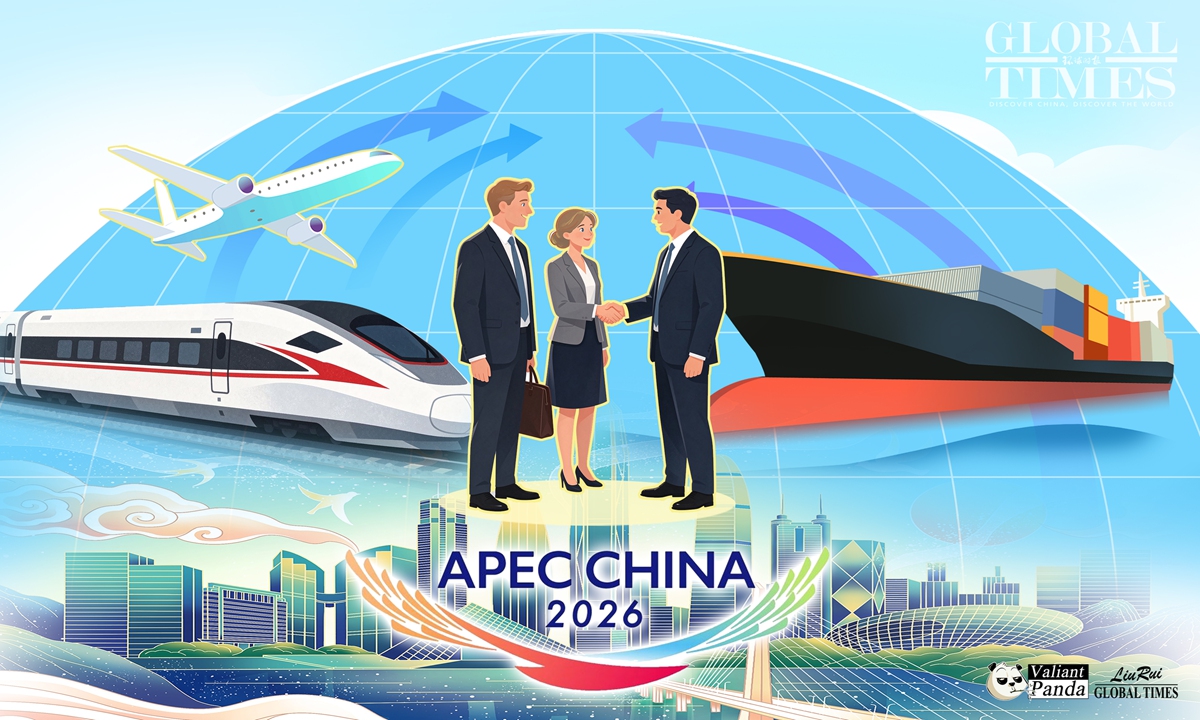
APEC China 2026. Illustration: Liu Rui/GT
Editor's Note:After more than three decades of sustained efforts and exploration, the building of an Asia-Pacific community has reached a pivotal juncture, moving from aspiration to action. Grounded in a commitment to inclusive consultation, the 33rd APEC Economic Leaders' Meeting in Shenzhen embraces openness, innovation and cooperation as the pillars of shared aspirations across the Asia-Pacific. Building on the cooperative spirit of the Shanghai and Beijing APEC meetings, it opens a new chapter in regional prosperity and development. Against this backdrop, the Global Times launches a special commentary exploring the global significance of this Shenzhen moment for Asia-Pacific cooperation.
The world's attention is turning to the South China Sea coast, where APEC is ushering in its Shenzhen moment. Twelve years after the Beijing APEC meeting outlined a long-term blueprint for the Free Trade Area of the Asia-Pacific (FTAAP), the 33rd APEC Economic Leaders' Meeting will be held in Shenzhen on November 18 to 19 under the theme "Building an Asia-Pacific Community to Prosper Together."
In November 2020, Chinese President Xi Jinping pointed out that "We can build an Asia-Pacific community with a shared future featuring openness and inclusiveness, innovation-driven growth, greater connectivity, and mutually beneficial cooperation." The Asia-Pacific's experience has shown that its success is built on genuine multilateralism, open regionalism, a willingness to go with the trend of economic globalization, and a focus on mutual benefit and shared success.
The upcoming APEC meeting in Shenzhen will build on the valuable consensus accumulated through more than three decades of Asia-Pacific cooperation. With openness, innovation and cooperation as its three priorities, the meeting will advance the building of an Asia-Pacific community from a long-term aspiration toward practical actions. It will inject fresh momentum into unity and collective progress across the Asia-Pacific region, which stands at a crossroads.
The roots of APEC's community-building spirit
Since its founding, APEC has embodied the shared aspirations of regional economies to pursue development together and share prosperity. Through its efforts to address the challenges of different eras and forge consensus among members, APEC has gradually developed a distinctive model of cooperation suited to the Asia-Pacific.
In the late 1980s, as economic globalization gathered pace, the Asia-Pacific emerged as one of the world's most dynamic economic regions, while calls for stronger regional economic coordination among its economies grew increasingly loud. In November 1989, at the initiative of then Australian prime minister Bob Hawke, the first APEC Ministerial Meeting was held in Canberra, marking the organization's formal emergence on the international stage.
In 1993, APEC economic leaders met for the first time at Blake Island, Seattle, which marked a major turning point in the organization's development. The meeting's Leaders' Declaration stated: "Our economies are moving toward interdependence and there is a growing sense of community among us. We are united in our commitment to create a stable and prosperous future for our people." The meeting placed the vision of an Asia-Pacific community at the center of APEC's agenda, setting long-term goals that went beyond short-term economic and trade considerations.
As the vision of an Asia-Pacific community took shape, APEC entered a crucial stage of institutional development. The adoption of the "Bogor Goals" at the 1994 APEC Economic Leaders' Meeting in Indonesia marked a turning point. Under the goals, APEC leaders committed to achieving free and open trade and investment by 2010 for industrialized economies and by 2020 for developing economies. APEC members agreed to pursue this goal by further reducing barriers to trade and investment and by promoting the free flow of goods, services and capital. This provided regional integration with a clear, actionable and measurable roadmap for openness.
The 1997 Asian financial crisis swept across the region, delivering a severe shock to regional economies and putting progress toward the Bogor Goals to a practical test. In response to changing circumstances, APEC remained committed to trade and investment liberalization while actively addressing emerging challenges, including financial risks, public health and climate change. In the process, the concept of an Asia-Pacific community continued to expand.
As the 21st century unfolded, Asia-Pacific industrial and supply chains became increasingly integrated, the global division of labor grew more specialized, and new development issues continued to emerge.
In 2020, Malaysia hosted the APEC Economic Leaders' Meeting virtually, during which members endorsed the APEC Putrajaya Vision 2040. The vision established the long-term goal of creating an open, dynamic, resilient and peaceful Asia-Pacific community by 2040. It identified three economic drivers: trade and investment; innovation and digitalization; and strong, balanced, secure, sustainable and inclusive growth. This marked APEC's formal entry into the post-Bogor era and the beginning of a new stage in which cooperation would be guided by a long-term vision.
Over more than three decades, APEC has remained true to its original mission of promoting economic growth and improving people's well-being. Through inclusive consultation, it has continuously strengthened the intellectual and institutional foundations of an Asia-Pacific community, contributing to the region's prosperity and development.
China's contributions and responsibilities in the Asia-Pacific
Grounded in the Asia-Pacific's diverse development realities and guided by open regionalism, APEC has charted a distinctive path of development in which consensus guides actions and practical projects turn visions into reality. Through the collective efforts of its member economies, APEC has grown into the region's highest-level and most comprehensive multilateral economic dialogue platform. It has accumulated substantial practical achievements in four major areas: trade and investment liberalization, connectivity mechanisms, innovation and green transformation, and inclusive development.
Since joining APEC in 1991, China has remained a steadfast practitioner, an active builder and an important contributor to openness and cooperation in the Asia-Pacific. Committed to its fundamental national policy of opening-up, China has deeply integrated itself into regional economic cooperation, continuously contributing Chinese solutions, wisdom and strength to Asia-Pacific development. China has hosted the APEC Economic Leaders' Meeting twice - in Shanghai and Beijing - each at a pivotal moment in the region's integration process. The upcoming Shenzhen meeting will be the third. Throughout these meetings, China has consistently advocated openness, inclusiveness, mutual benefit and win-win cooperation, helping forge regional consensus and leaving a clear imprint on APEC's history.
In 2001, when APEC leaders gathered in Shanghai, the repercussions of the Asian financial crisis had not yet fully subsided, and the future of the global multilateral trading system remained uncertain. Asia-Pacific economies broadly hoped to restore confidence in openness and find a reliable foundation for regional economic recovery. As host, China successfully convened the ninth APEC Economic Leaders' Meeting under the theme "Meeting New Challenges in the New Century: Achieving Common Prosperity through Participation and Cooperation."
The Shanghai meeting produced a series of landmark outcomes with practical significance. It adopted two core documents, the 2001 Leaders' Declaration and the Shanghai Accord, reaffirming members' commitments to achieving the Bogor Goals and refining the implementation of Individual Action Plans and Collective Action Plans. These documents established a clear direction for APEC's second decade. Through its role as host, China sent a clear message to the Asia-Pacific and the wider world: It would firmly uphold the rules-based multilateral trading system, pursue development through openness and achieve shared benefits through cooperation.
By the time of the 2014 APEC Beijing meeting, the global economic recovery remained weak. Bilateral and multilateral free trade arrangements were proliferating, trade rules were becoming increasingly fragmented, and global value chains were undergoing accelerated restructuring. Differences among economies over the future direction of Asia-Pacific integration had become increasingly apparent, and the international community looked to APEC for a comprehensive regional strategy. Acting in the broader interests of the Asia-Pacific, China took the initiative in coordinating the agenda and helping steer regional integration.
The Beijing meeting delivered a comprehensive set of landmark institutional achievements. It endorsed the Beijing Agenda for an Integrated, Innovative and Interconnected Asia-Pacific - the 22nd APEC Economic Leaders' Declaration, and Shaping the Future Through Asia-Pacific Partnership - Statement on the 25th Anniversary of APEC. It also approved the Roadmap for APEC's Contribution to the Realization of an FTAAP and the APEC Connectivity Blueprint for 2015-2025, formally launching the process toward the FTAAP. The meeting also adopted the APEC Accord on Innovative Development, Economic Reform and Growth, and released the Beijing Declaration on Fighting Corruption, broadening the scope of practical cooperation. Together, these achievements placed the FTAAP on APEC's formal agenda and incorporated innovation-driven growth, reform and transformation, and comprehensive connectivity into an integrated framework. They helped advance Asia-Pacific cooperation toward a new stage of more inclusive regional integration.
Twelve years later, the 2026 Shenzhen APEC meeting will carry forward the legacy of cooperation established in Shanghai and Beijing.
Shenzhen is a major gateway for China's opening-up to the world. The city itself is a vivid illustration of an opening-up strategy based on mutual benefit and win-win cooperation.
As the first major opportunity for a collective progress check following the adoption of the Putrajaya Vision 2040, China's APEC host year has featured a series of ministerial meetings, including the APEC Ministers Responsible for Trade Meeting in Suzhou, the Digital and AI Ministerial Meeting in Chengdu, and the Food Security Ministerial Meeting in Hangzhou. These meetings have helped translate medium- and long-term visions, including the Asia-Pacific partnership and the FTAAP, into practical pathways for building an Asia-Pacific community.
The three meetings reflect China's growth alongside the Asia-Pacific. The Shanghai meeting focused on embracing openness and building mutual trust and consensus. The Beijing meeting concentrated on setting the direction and establishing a partnership framework. The Shenzhen meeting will focus on strengthening mechanisms and translating visions into concrete actions. China has consistently integrated its own development into the broader pursuit of common development across the Asia-Pacific, practiced open regionalism and upheld genuine multilateralism. Working together with other Asia-Pacific economies, China will continue to inject sustained momentum into regional economic prosperity and the building of an Asia-Pacific community with a shared future.
The Shenzhen action plan
Building on more than three decades of cooperation, the Shenzhen APEC meeting, under the theme "Building an Asia-Pacific Community to Prosper Together," will focus on three priority areas: openness, innovation and cooperation. By carrying forward the objectives of the Putrajaya Vision 2040, it will advance the building of an Asia-Pacific community from vision to practice and from consensus to action.
First, keep openness at the forefront. Openness is the defining characteristic of Asia-Pacific cooperation and a central pillar of APEC's implementation of the Putrajaya Vision 2040. During China's APEC host year, three key ministerial outcome documents have been produced: the 2026 APEC Ministers Responsible for Trade Joint Statement (Suzhou Statement), the 2026 APEC Digital and AI Ministerial Statement (Chengdu Statement), and the Joint Statement on the 11th APEC Food Security Ministerial Meeting (Hangzhou Statement). These documents provide strong support for the successful convening of the Shenzhen meeting.
Against the backdrop of mounting pressure on the global economic recovery and rising protectionist sentiment, the Suzhou Statement reaffirmed the FTAAP as a shared long-term direction for regional integration while responding to the practical needs of economies at different stages of development. The statement sent a clear message to the world that the Asia-Pacific remains committed to openness and cooperation and opposed to division and confrontation, injecting confidence into regional economies facing mounting challenges.
Second, unleash the power of innovation. Innovation is the driving force behind the Asia-Pacific's transformation and development. It is also essential to bridging institutional differences and expanding opportunities for cooperation. Recognizing the considerable disparities in digital development among Asia-Pacific economies, the Chengdu Statement moved beyond a rigid approach centered on competition over a single set of rules. Instead, it established a cooperation philosophy that seeks interoperability rather than uniformity, encourages pilot projects and embraces voluntary compatibility. It identified the digital economy, AI and green transformation as priority testing grounds for aligning rules across different free trade frameworks, offering a distinctly Asia-Pacific approach to mitigating the "spaghetti bowl effect" of overlapping regional trade arrangements.
Third, deepen the foundations for cooperation. Practical cooperation is the bond that holds the Asia-Pacific community together. Building on the fact that the Asia-Pacific accounts for nearly half of global food production and trade, the Hangzhou Statement focuses on supply chain resilience, energy and food security, connectivity, and the development of small and medium-sized enterprises, against a backdrop of increasingly frequent extreme weather events and mounting supply chain disruptions. It sets a course for cooperation that returns to the fundamentals of economic development while addressing both risk resilience and people's well-being. By making food security, agricultural digitalization and emergency safeguards for industrial and supply chains key livelihood priorities for the Asia-Pacific, the declaration addresses gaps in the region's efforts to build a shared future, particularly in the areas of security and people's well-being.
The Shenzhen meeting will continue to expand the foundation for mutually beneficial cooperation. Upholding the principle of voluntary participation, it will be independently joined and taken forward by all parties. Drawing on experience exchange, capacity-building support and industrial linkages, it will advance practical projects and inclusive agendas, consolidate the social foundation of the Asia-Pacific community, foster a stable and friendly environment for cooperation in openness and innovation, and help the Asia-Pacific community grow steadily and deliver tangible results.
RELATED ARTICLES