Illustration: Xia Qing/GT
In the early spring breeze of 2026, To Lam, General Secretary of the Communist Party of Vietnam Central Committee and Vietnamese President, embarked on a state visit to China. Just days after being elected as president of Vietnam, he chose China as his first overseas destination - a clear and telling choice that spoke for itself. The wave of headlines brought me back to my time in Hanoi.In 2023, I headed to Hanoi for a reporting trip. What struck me first was the ceaseless river of motorcycles, cars backed up at traffic lights, and cranes bristling across the skyline - proof that the city was bursting with rapid development.
What struck me most was the unexpected sense of familiarity. Young Vietnamese told me they had watched My Fair Princess and Empresses in the Palace; they were fans of Sisters Who Make Waves and Jackson Yee; and they craved hotpot, Peking duck, and even stinky tofu. We all celebrate the Spring Festival - pasting couplets, gathering for reunion dinners - and shared remarkably similar childhood memories. Talking with a fluent Chinese-speaking guide, I sometimes felt just like catching up with an old friend.
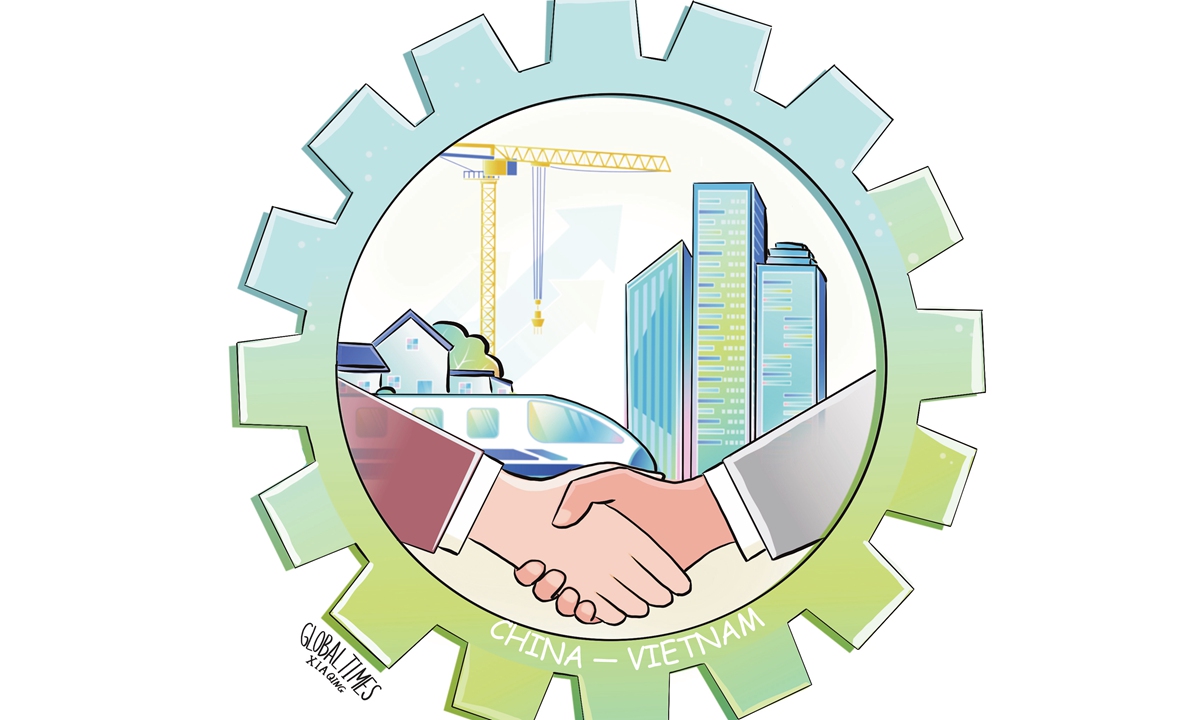
This people-to-people connection is further reinforced through practical, on-the-ground cooperation. A Vietnamese professor in China told me how Chinese-built projects have dramatically improved daily commuting in Hanoi. The city's dense population used to cause traffic jams during rush hour, but congestion has eased considerably thanks to Vietnam's first urban light rail project, the Cat Linh-Ha Dong metro line, built by a Chinese company.
Vietnam now aims for ambitious annual economic growth exceeding 10 percent. Realizing this vision calls for substantial investment, industrial upgrading, and faster advances in industrialization and digital transformation. In today's complex and turbulent global environment - marked by ongoing conflicts in the Middle East, fragile supply chains, and volatile energy prices - deepening cooperation with China is particularly imperative. It represents not only a practical way for Vietnam to manage risks, but also a strategic opportunity to advance its long-term development priorities.
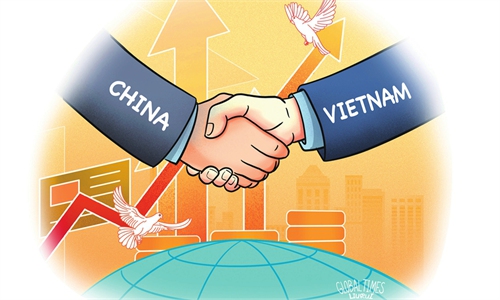
For over two decades, China has been Vietnam's largest trading partner, while Vietnam stands as China's top trading partner in ASEAN and its fourth-largest globally - a relationship built on mutual benefit and complementarity.
In 2025, bilateral trade between China and Vietnam surged past $290 billion for the first time. That's the equivalent of roughly $800 million in goods crossing the border every single day. This means a vital source of stability in an unpredictable world - steady supplies, predictable prices, reliable market access, and more secure livelihoods for ordinary people.
Deepening China-Vietnam economic cooperation is essential for solidifying the foundation of development in both countries and achieving win-win outcomes. For Vietnam, China's comprehensive industrial system, advanced technology, ample funding, and vast market make it the most reliable and convenient partner for advancing industrialization and modernization. For China, the Belt and Road Initiative and Vietnam's Two Corridors and One Economic Circle strategy are increasingly aligned. Vietnam serves as a key node for Chinese enterprises looking to expand into the ASEAN market, optimize regional industrial layouts, and broaden the scope of external cooperation. This mutually beneficial relationship has become a solid bond for the two countries' joint pursuit of development.
Looking ahead, expectations are rising for even closer collaboration. There is growing momentum and active discussion around advancing high-speed and standard-gauge rail connectivity, as well as deeper cooperation in renewable energy, cutting-edge technology, and the digital economy.
Railways generate powerful spillover effects that fuel growth all along their routes. Late last year, construction kicked off on the first phase of the Lao Cai-Hanoi-Hai Phong standard-gauge railway. Once completed, it will deliver tighter integration, faster transportation, higher freight capacity, lower logistics costs, and smoother economic flows between China and Vietnam.
At the same time, scholars studying Vietnam note that the country is seeking to phase out labor-intensive, low-tech, and pollution-heavy industries, while shifting focus toward new urbanization, renewable energy projects, and dynamic innovation ecosystems - all aimed at restructuring the economy and accelerating modernization. Deeper cooperation with China stands out as a natural and highly promising choice.
High on a mountainside overlooking the China-Vietnam border in Pingxiang, Guangxi Zhuang Autonomous Region, striking characters stand out vividly against the landscape: "Belt and Road Initiative: Shared Prosperity and Win-Win Cooperation." These words capture the very essence of the China-Vietnam relationship today - a story rooted in shared dreams of prosperity that points toward an even brighter common future.
The author is a reporter with the Global Times. opinion@globaltimes.com.cn
RELATED ARTICLES