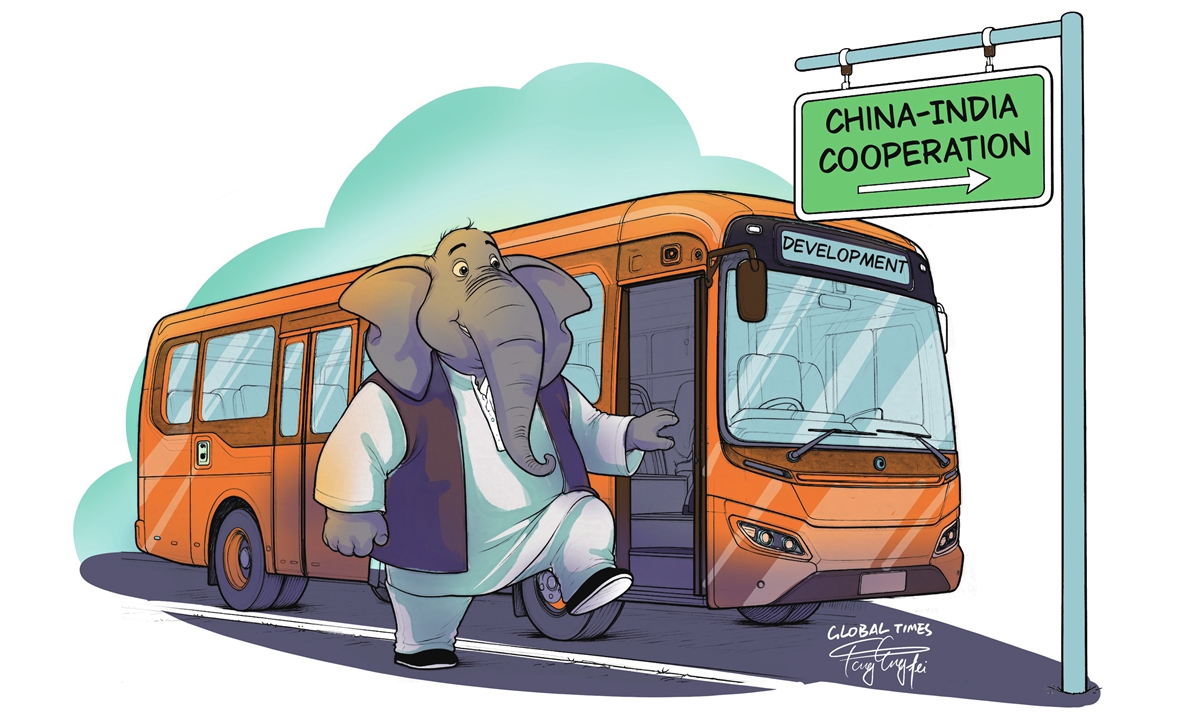
China-India cooperation. Illustration: Tang Tengfei/GT
Speaking at the Hindustan Times Leadership Summit, Indian External Affairs Minister S. Jaishankar recently recalled that when then prime minister Rajiv Gandhi visited China in 1988, the two economies were roughly comparable in size; however, China made a huge push toward modernization and industrialization in the 1980s, while India simply "missed the bus." His remarks, tinged with regret, have attracted considerable attention. Over the past four decades, the global industrial landscape has undergone profound transformations. Looking ahead from 2026, however, India can still chart its own course in the evolving global division of labor, with deepening cooperation with China as one important option.
In nearly four decades, China's GDP has grown from just over $300 billion to more than $19 trillion, while India has risen from just over $290 billion to nearly $4 trillion, leaving China's economy almost five times the size of India's. China seized the opportunities of economic globalization and industrial relocation, integrating deeply into the world economy through reform and opening-up. It made remarkable strides in infrastructure development and continuously strengthened its manufacturing competitiveness. By contrast, India has long been constrained by institutional barriers, infrastructure shortcomings and an unfavorable business environment. The divergent trajectories of the two countries reflect not only changes in the global industrial landscape, but also their respective development strategies and policy choices.
Jaishankar's remarks suggest that at least some within India's policy establishment recognize that the country cannot afford to miss the next window of development. Indeed, the global economic landscape is undergoing another profound transformation, and India still has considerable untapped potential.
The restructuring of global supply chains is opening up new opportunities for India. As multinational companies diversify their supply chains, India, the world's most populous country, has certain advantages in attracting manufacturing investment, including widespread English proficiency, a substantial pool of engineering talent and a well-established information technology services sector. If India can continue to improve its business environment, upgrade its infrastructure and reduce logistics costs, it is well positioned to benefit from the restructuring of global supply chains.
For India, the key to catching the next "bus" lies in identifying a development path suited to its own national conditions. In recent years, India has launched initiatives such as Make in India, Digital India and Atmanirbhar Bharat Abhiyaan (Self-reliant India), demonstrating its ambition to pursue strategic autonomy and explore an independent development path. Yet some in India remain trapped in an unnecessary mind-set of competition, viewing China as a country that must be "surpassed" or even "replaced," as though India's opportunities would somehow expand if China's development slowed.
China should not become a benchmark against which India measures its development anxiety. Rather, it can be a partner in helping India achieve its development goals. Together, China and India account for more than one-third of the world's population and approximately one-fifth of global GDP. The depth and breadth of cooperation between the two countries will have significant implications for economic development in Asia and beyond. Their industrial structures are more complementary than competitive. India could become an important destination for the extension of China's manufacturing supply chains rather than simply seeking to replace China. The two countries have ample room to identify areas of common interest without falling into a zero-sum rivalry.
Cooperation on renewable energy and climate change represents both a shared responsibility and an opportunity for the two countries. India has set a target of achieving net-zero emissions by 2070, while China has developed mature technologies, comprehensive industrial supply chains and extensive practical experience in renewable energy, including solar, wind and hydropower. There is considerable potential for cooperation in photovoltaic equipment supplies, smart grid development, the promotion of new energy vehicles and green finance.
This approach to cooperation should also extend to multilateral mechanisms. Within frameworks such as BRICS, the Shanghai Cooperation Organisation and the G20, China and India, as two of the largest emerging economies, share broad common interests in advancing reform of the global governance system, safeguarding the interests of developing countries and promoting a fairer and more equitable international financial order.
Nearly four decades have passed, and the two countries are no longer standing at the same starting line. But the door to development opportunities has not closed. India need not dwell on the "bus" it missed in the past, nor waste its energy on the narrative of "replacing China." Instead, it should consider how best to position itself for the next wave of global development. By building on its own strengths, embracing openness and pragmatism, and pursuing complementary cooperation with China, India can recognize that the two countries are partners rather than rivals, and sources of development opportunities for each other rather than threats. India can still find its own fast track to development.
The author is the director of the Research Department at Tsinghua University's National Strategy Institute. opinion@globaltimes.com.cn