CHINA NEOMAKE / CHINA NEOMAKE MORE NEWS
Domestically developed light helicopter completes first emergency flotation test
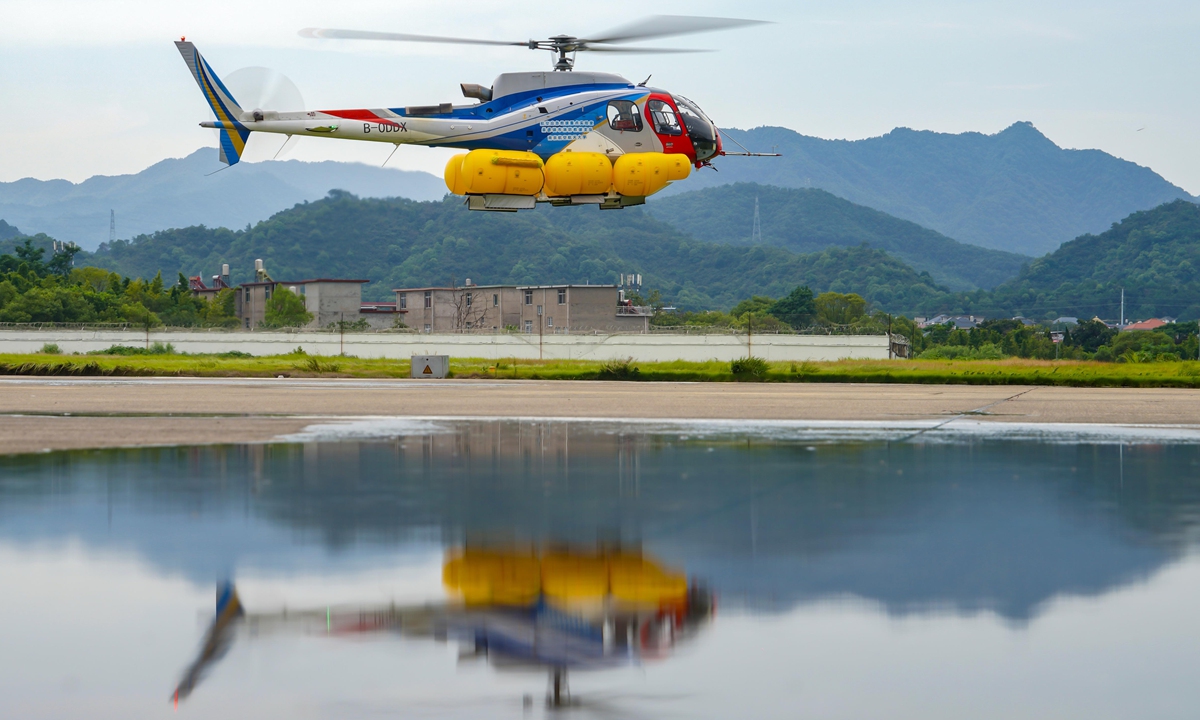
The AC311A light helicopter flies with its six emergency flotation airbags fully deployed in Jingdezhen, East China's Jiangxi Province, on November 17, 2026. Photo: Science and Technology Daily
The domestically developed AC311A light helicopter has successfully completed an emergency flotation system test flight, the Science and Technology Daily reported Wednesday, marking the first such test conducted by a domestically developed light helicopter and opening up new possibilities for its use in maritime emergency operations.The test was conducted on Tuesday in Jingdezhen, East China's Jiangxi Province, by the Aviation Industry Corporation of China (AVIC).
During the test, the helicopter flew forward at a speed of 130 kilometers per hour before the pilot activated the emergency flotation system, which inflated six airbags, each measuring 0.85 meters in diameter, on both sides of the fuselage.
The test was designed to determine the maximum flight speed at which the flotation system could be deployed in the air and to verify that the helicopter could maintain a controllable attitude during inflation, according to the report.
The rapid deployment of the airbags can significantly alter the helicopter's aerodynamic profile, generating asymmetric airflow disturbances and additional aerodynamic loads. Sudden changes in drag and pitch and rolling moments can also affect rotor airflow and flight control responses, making the test a high-risk undertaking.
To manage the risks, the test team adopted a step-by-step approach, gradually approaching the limiting operating conditions. The helicopter successfully completed the air-bag deployment test under maximum speed conditions.
The emergency flotation system is designed to enable the helicopter to make an emergency water landing in the event of an incident during flight over large bodies of water.
The system is designed to keep the helicopter afloat for more than five minutes even in relatively rough sea conditions, giving passengers and crew time to open or jettison the cabin doors and evacuate.
Its floats use a compression-based limiting structure connected to the landing gear, addressing the problem of insufficient restraint that could previously cause floats to swing significantly after inflation. Meanwhile, its gas cylinders adopt a cross-feed design, allowing the system to inflate normally even if one gas supply line fails.
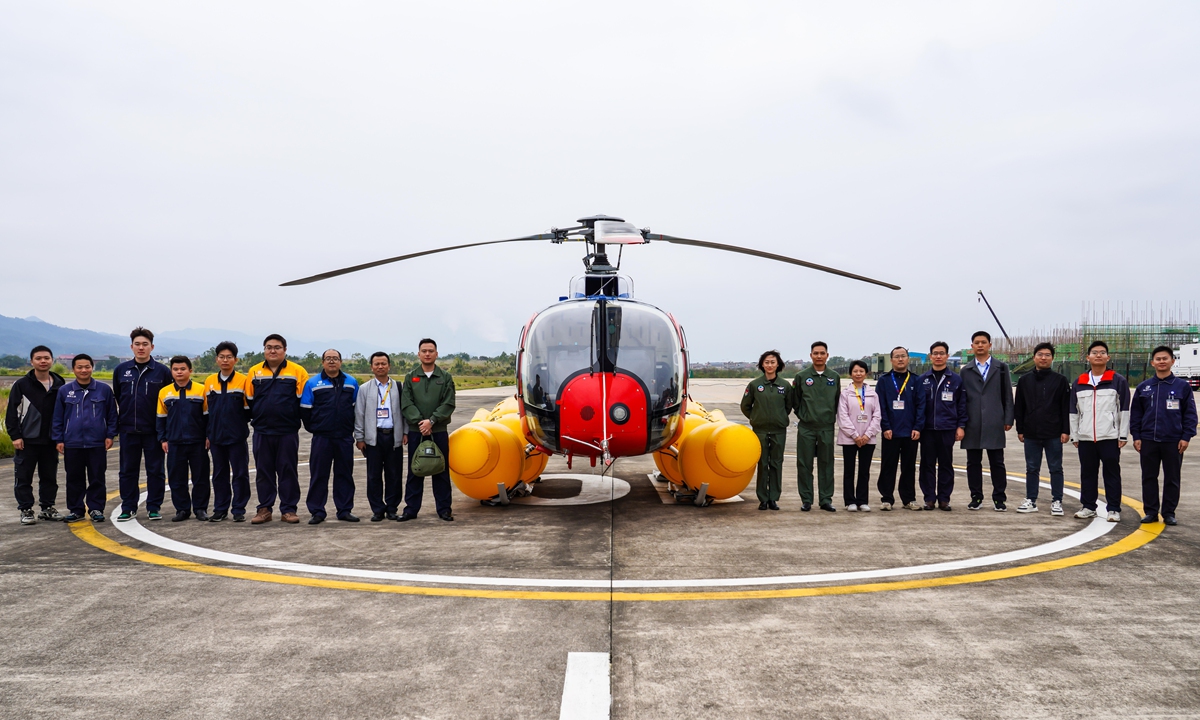
The verification test flight team poses for a group photo with the AC311A helicopter. Photo: Science and Technology Daily
Unlike a test that simply establishes whether an aircraft can remain afloat, the airworthiness certification process for the system also places particular emphasis on whether occupants can safely evacuate while the helicopter is floating, according to the report.Once the system completes airworthiness certification, the AC311A is expected to face fewer barriers to entering operational fields such as maritime supervision, offshore wind farm maintenance and emergency rescue across waterways.
The AC311A is a six-seat, two-ton multi-purpose helicopter with a maximum take-off weight of 2,250 kilograms. It received its civil aviation type certificate in 2016.
The model has gradually expanded its operational capabilities in challenging environments. It has a service ceiling of 6,000 meters and became the first domestically developed civil helicopter to enter operational service in the Xizang Autonomous Region, where it has participated in earthquake rescue operations in Nagqu and emergency response exercises in high-altitude and cold-weather conditions.
The helicopter has also been used in aerial geophysical surveys, covering a cumulative area of 60,000 square kilometers with more than 800 flight hours, according to the report.
In a more recent firefighting operation, an AC311A on standby for power-line patrols in Loudi, Central China's Hunan Province, completed a bucket-based firefighting mission in 43 minutes. Its water-cannon firefighting configuration obtained a supplementary type certificate in 2025.
RELATED ARTICLES