US pressures UN agency over flight restriction on Lai; expert warns of turning agency into geopolitical rivalry arena
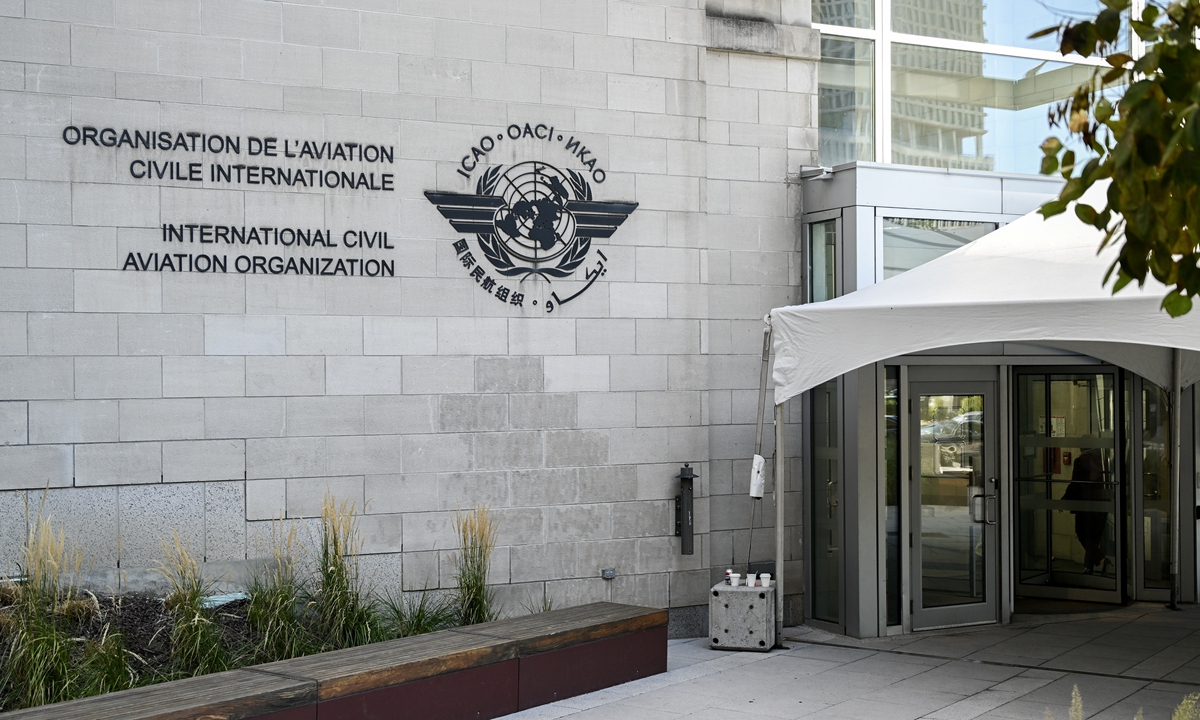
Photo: VCG
The US is seeking to pressure the UN aviation agency to challenge flight restrictions involving an aircraft carrying Taiwan regional leader Lai Ching-te, a move that China has criticized as another attempt of using the Taiwan question for political purposes. A Chinese expert warned that the US move risks turning the agency into another arena for geopolitical confrontation.
In a paper submitted to the November session of the International Civil Aviation Organization's (ICAO) governing council, Washington challenged decisions by Mauritius and Seychelles to revoke permission for an aircraft carrying Lai to cross portions of international airspace they manage during a planned trip to Africa in April, according to a Reuters report on Tuesday.
Washington pressured the ICAO Council to reaffirm that countries responsible for managing air traffic over the high seas do not have sovereignty over that airspace and cannot use that role for political purposes. The US paper claimed that withdrawing the permits could set a "dangerous precedent" and called on the ICAO to seek written explanations from Mauritius and Seychelles and assess whether further measures were necessary.
China firmly rejected the US move, accusing Washington of using the Taiwan question for political purposes and wasting international resources. The Chinese Foreign Ministry was quoted by Reuters report as saying the US document "selectively and one-sidedly cites" principles including freedom of overflight over the high seas and, "under the pretext of safeguarding freedom of navigation," smears other countries and presumes that sovereign states were at fault.
"There is only one China in the world, and Taiwan is an inalienable part of China's territory," the ministry said, urging relevant countries to stop using the Taiwan question for political manipulation.
Zhang Wensheng, deputy dean of the Taiwan Research Institute at Xiamen University, told the Global Times that Washington's latest action once again exposes the dual nature of its Taiwan policy. "On one hand, the US claims to adhere to the one-China policy and doesn't support 'Taiwan independence,' and on the other, it repeatedly supports 'Taiwan independence' political forces on the island through its actual policy implementation," he said.
The apparent contradiction between Washington's political commitments and its concrete actions is difficult to overlook, Zhang Wensheng said.
Given that Lai's push for a separatist agenda with so-called diplomatic allies runs counter to the one-China principle, the relevant countries' decision to revoke flight clearance for his aircraft is both justified and lawful, according to Zhang Wensheng.
When Lai made his "stowaway-like" travel to the southern African nation of Eswatini, spokespersons from China's Foreign Ministry and the State Council Taiwan Affairs Office commented on the relevant countries' refusal to grant him overflight clearance. Chinese Foreign Ministry spokesperson Lin Jian said on May 6 that relevant countries, in upholding the one-China principle, have refused to issue flight permits for Lai's visit. This just act is fully consistent with international law and basic norms in international relations, and fully proves that the one-China principle is where the arc of history bends and that "Taiwan independence" separatist moves have no support, Lin added.
Zhang Han, spokesperson of the Taiwan Affairs Office of the State Council, said on April 22 that "we appreciate the position and actions of the relevant countries in upholding the one-China principle." The facts once again prove that the one-China principle is a basic norm governing international relations and a prevailing consensus of the international community. It represents the general trend of the times, the greater good, and the will of the people, Zhang Han said.
Reuters reported that the dispute centers on the distinction between sovereign airspace and flight information regions (FIRs). While countries have sovereignty over airspace above their territory and territorial waters, FIRs managed by national aviation authorities can extend over international waters. Countries provide air traffic services in those areas for safety and operational purposes but do not gain sovereignty over them, according to the US paper.
By bringing the matter before the ICAO, Washington risks turning a technical aviation issue into another arena for geopolitical confrontation, rather than allowing international aviation institutions to focus on their core responsibility of ensuring safe and orderly air traffic, Zhang Wensheng said.
RELATED ARTICLES