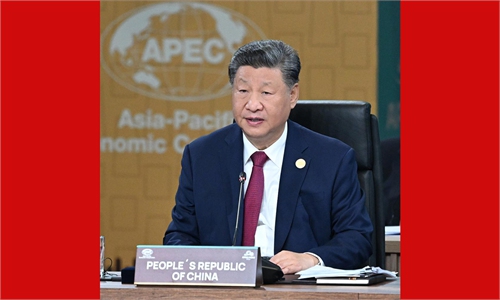
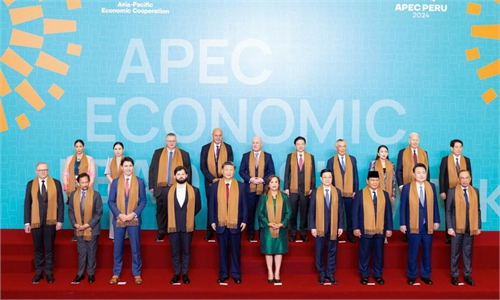
Xi calls for jointly building Asia-Pacific community to prosper together
By Sun Langchen and in Shenzhen Published: Nov 18, 2026 10:36 PM

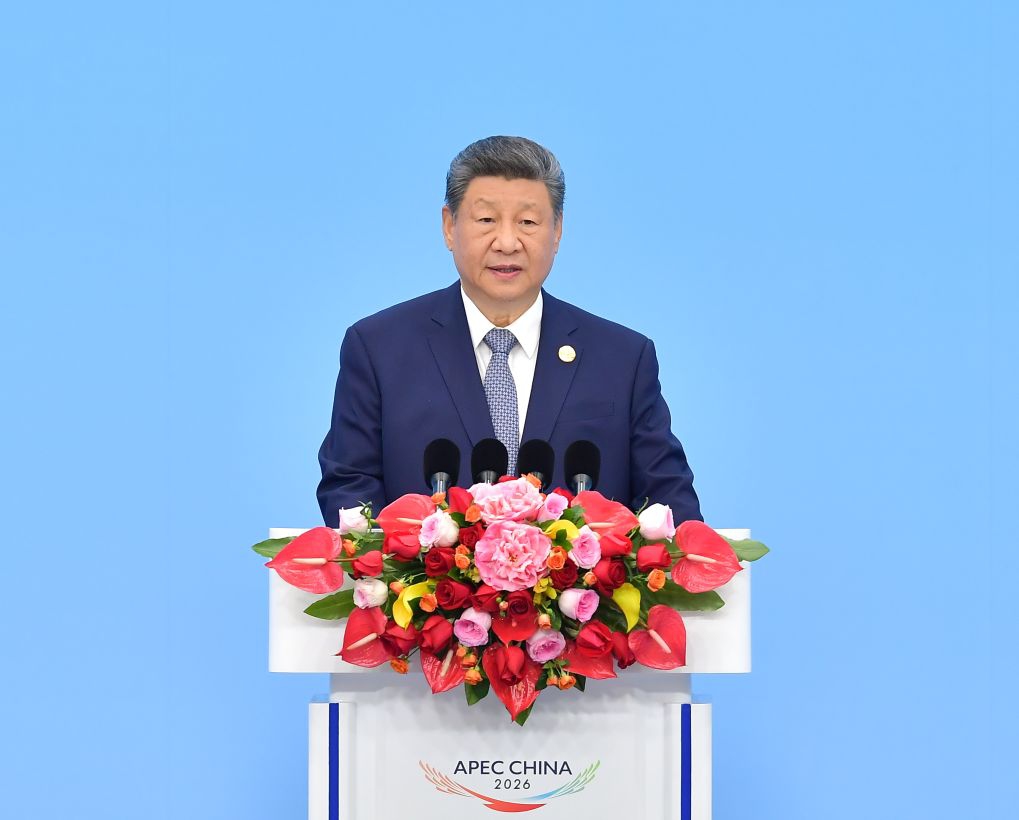
Chinese President Xi Jinping delivers a keynote speech at the opening ceremony of the Asia-Pacific Economic Cooperation (APEC) CEO Summit 2026 at the Qianhai International Convention Center in Shenzhen, south China's Guangdong Province, Nov. 18, 2026. (Photo: Xinhua)
Chinese President Xi Jinping and his wife, Peng Liyuan, on Wednesday hosted a banquet in Shenzhen, South China's Guangdong Province, to welcome guests who are here to attend the 33rd Asia-Pacific Economic Cooperation (APEC) Economic Leaders' Meeting.
Openness is deeply rooted in Shenzhen's DNA and innovation drives the city's vitality, while cooperation is where its strength comes from, Xi said in his toast, adding that the success of Shenzhen is also a microcosm of China's reform and opening-up, as well as an example of fruitful cooperation across the Asia-Pacific, the Xinhua News Agency reported.
Noting that openness, innovation and cooperation have been the distinctive features of APEC since its establishment, Xi said APEC has grasped the pulse of the times and guided the process of regional economic integration, making the Asia-Pacific the most dynamic region and a vital growth engine of the world economy.
"At the economic leaders' meeting tomorrow, we will discuss measures to expand two-way opening up, explore paths of innovation-driven growth and unfold more opportunities of practical cooperation in various fields," Xi said.
Amid uncertainties facing global economic growth and the rise of trade protectionism and unilateralism, this year's APEC meeting provides an important platform for economies to strengthen communication and deepen cooperation. China's call for building an Asia-Pacific community and promoting common prosperity not only focuses on regional economic growth, but also offers ideas for economies at different stages of development to explore open, inclusive and mutually beneficial cooperation, Chinese observers said.
Bridging the divides
Xi on Wednesday also delivered a keynote speech at the APEC CEO Summit 2026.
This year, China is hosting APEC for the third time. We are ready to work with all other parties to forge ahead with resolve, jointly build an Asia-Pacific community, and bring prosperity for all in our region, Xi said, according to Xinhua.
The speech once again demonstrated China's thinking on addressing current challenges facing the global economy, offering a new approach to cooperation through the building of an open Asia-Pacific economy, Liu Guohong, president of the China Development Institute, told the Global Times on Wednesday.
The key to the regional cooperation advocated by China, Liu said, lies in respecting the different development stages and institutional characteristics of individual economies, and finding pathways for common development through equal consultation.
In his speech, Xi also said China supports the establishment of a World Association for Bay Areas Economic Cooperation to deepen exchanges and interactions among bay areas from across the world. This will help us explore new ways for stronger economic cooperation in the Asia-Pacific.
Citing the Guangdong-Hong Kong-Macao Greater Bay Area (GBA), Liu explained how cities with different institutional systems and levels of development can coexist while advancing regional integration. He noted that economies at different stages of development and with different institutional characteristics inevitably encounter various obstacles and challenges, but the neutral nature of technology could help reduce barriers to cross-regional flows.
"APEC economies shall use the inclusive benefits of technology to break through the predicament facing the region, achieve coexistence while seeking common ground, and realize shared prosperity through inclusive development," Liu said.
This reflects a broader approach to regional cooperation: cooperation should not be conditional on economies having identical development levels or institutional systems. Instead, inclusive arrangements should allow all parties to participate, Liu added.
Foreign business representatives also offered their perspectives on the cooperation proposals and opportunities in China. In a lounge area opposite the conference venue, Global Times reporters saw business representatives engaging in lively discussions about the APEC CEO Summit.
In interviews with the Global Times at the summit, many highlighted the importance of the Chinese market, while several expressed particular appreciation for the emphasis on people-centered development and openness in the Chinese president's keynote speech.
Saravoot Yoovidhya, CEO of Thailand's TCP Group, told the Global Times that China's continued opening-up offers global investors broad opportunities and a predictable environment.
Arnaud Favry, head of APAC Government Affairs and Policy, told the Global Times China could play an important role in integrating Asian economies into a broader regional community. He stressed that in terms of innovation, China is really leading the pack. It would be beneficial for foreign actors to join forces with Chinese players to tackle the world market.
Joanna Kay, program director of International Strategy, Partnerships and Engagement, emphasized that economic development should be people-centered, bringing more countries and communities into conversation and allowing them to share development experiences. Regional economic growth can truly benefit society only when communities, families and ordinary people are placed at its center, she told the Global Times.
The experience accumulated by the GBA in trade and investment, industrial cooperation and connectivity among cities could offer a reference for Asia-Pacific economies seeking to deepen cooperation. We are not afraid of competition. Rather, we hope the Asia-Pacific can move toward a future that provides people with a better and happier life, said Xiao Geng, Professor at the Chinese University of Hong Kong (Shenzhen), also Director of the Institute of Policy and Practice at the Shenzhen Finance Institute.
The ultimate value of regional cooperation lies not only in expanding trade and investment, but also in bringing innovation into the real economy, translating growth into tangible fruits that can ensure the benefits of development reach ordinary people, he said.
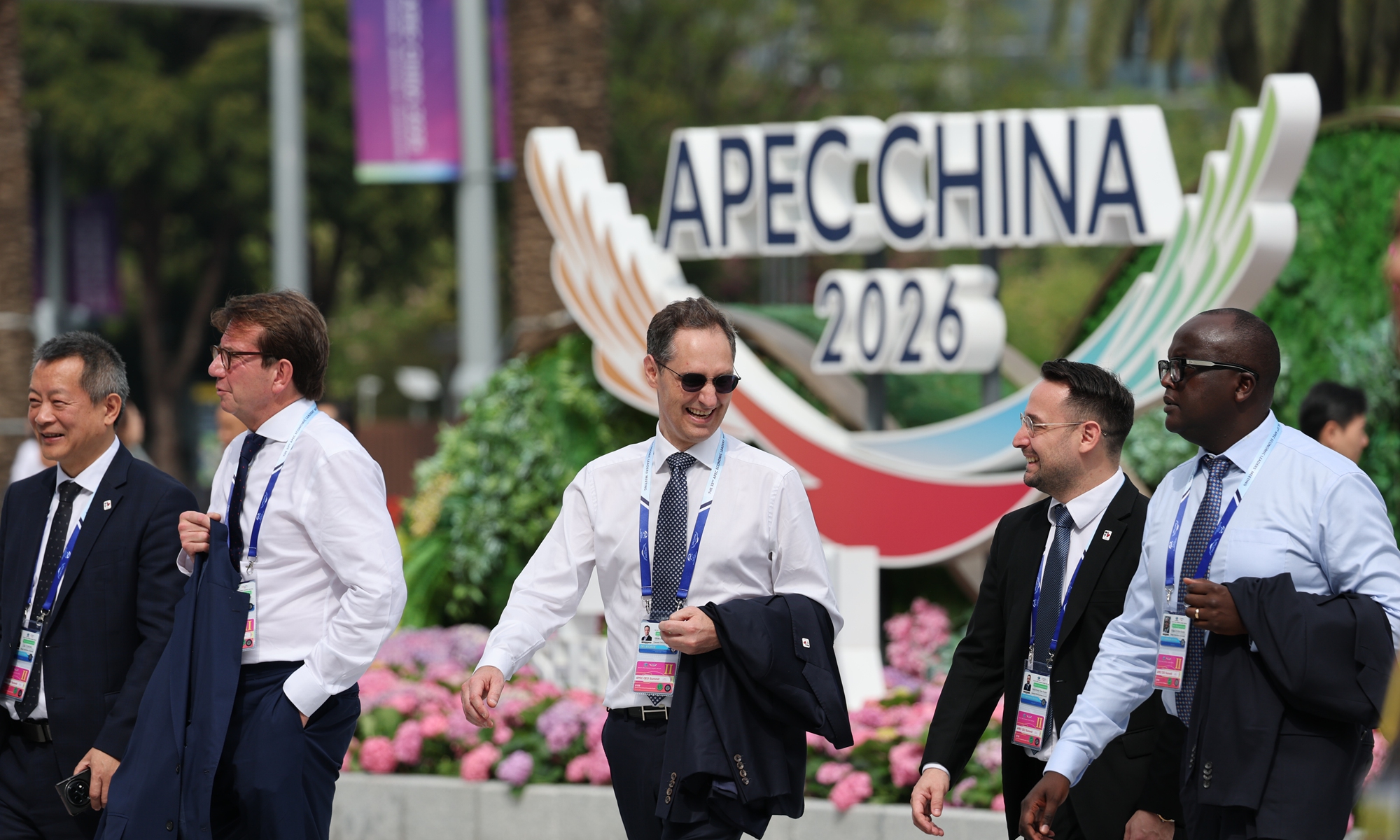
Participants exchange views outside the venue as the opening ceremony of the 2026 APEC CEO Summit is held in Shenzhen, South China's Guangdong Province on November 18, 2026. Photo: Xinhua
Vision into action
This year marks the start of China's 15th Five-Year Plan (2026-30) for economic and social development. A blueprint for China's development, the 15th Five-Year Plan also provides a list of opportunities for promoting economic growth in the Asia-Pacific and the wider world, Xi noted in the keynote speech.
China will provide the global business community with its super-large, open market, broad development prospects, as well as a cooperative environment that promotes mutual progress, said the Chinese president.
The call for greater opportunities and open market also resonated in the remarks of other leaders at the APEC CEO Summit, with discussions highlighting the importance of keeping markets open and strengthening economic ties amid global uncertainty.
The APEC CEO Summit Shenzhen Initiative 2026 was released on Wednesday. This marks the first time in the 30-year history of the summit that an outcome document has been issued in the form of an initiative.
According to Xinhua, the initiative states that, guided by four priority areas - openness and inclusiveness, innovation-driven growth, greater connectivity and mutually beneficial cooperation - the Asia-Pacific business community stands ready to work with all economies to fully implement the Putrajaya Vision 2040 and build an open, dynamic, resilient and peaceful Asia-Pacific community.
It also calls for translating this year's APEC theme, "Building an Asia-Pacific Community to Prosper Together," into concrete actions, so that the Asia-Pacific region continues to serve as the world's most dynamic engine of growth and a community of shared prosperity.
Xiao noted that a longstanding challenge for the APEC platform is how to keep its members united and going forward further. Historically, it has lacked outcome documents with strong implementability. The Shenzhen Initiative addresses a structural gap within APEC as a voluntary cooperation mechanism, seeking to build a trackable and accountable framework for future cooperation.
It systematically incorporates business community input on connectivity, an AI innovation ecosystem, the Free Trade Area of the Asia-Pacific (FTAAP), the digital economy and sustainable development. Presented to the Economic Leaders' Meeting, it serves as an "anchor for consensus" to guide follow-up cooperation, Xiao added.
Zhou Xing, vice chairman and public affairs managing partner at PwC China, told the Global Times that as fragmented rules and inconsistent standards are raising compliance costs for businesses and undermining the region's overall competitiveness, what the Asia-Pacific business community expects most is certainty.
Businesses are particularly concerned about whether measurable progress can be made in areas such as trade facilitation, the digital economy, green transformation and supply chain resilience. Consensus reached through APEC meeting should also be translated into concrete projects, cooperation platforms and channels for business participation, Zhou said.
RELATED ARTICLES