Xi calls for steady, sound development of China-ROK ties; Free Trade Agreement progress draws positive responses in S.Korea
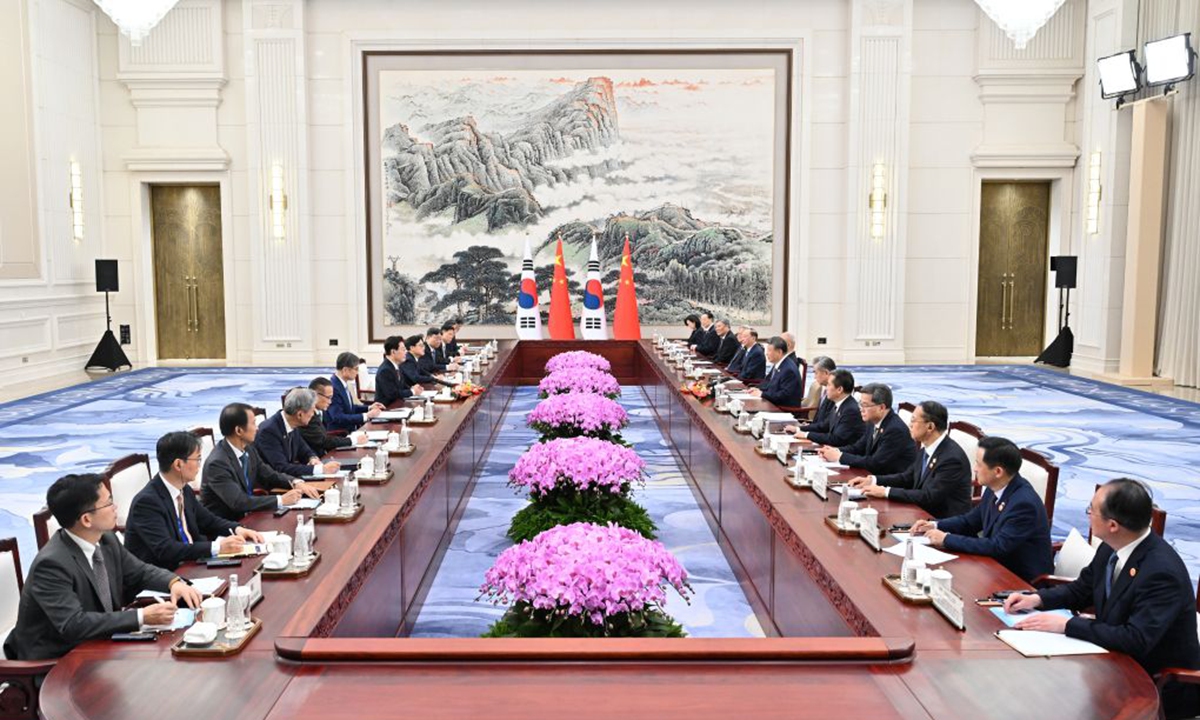
Chinese President Xi Jinping meets with President of the Republic of Korea (ROK) Lee Jae Myung, who is in China to attend the 33rd Asia-Pacific Economic Cooperation (APEC) Economic Leaders' Meeting, in Shenzhen, south China's Guangdong Province, on November 18, 2026. Photo: Xinhua
Chinese President Xi Jinping on Wednesday called for advancing the steady and sound development of relations between China and the Republic of Korea (ROK) as next year marks the 35th anniversary of diplomatic ties between the two "friendly neighbors and strategic cooperative partners," according to the Xinhua News Agency on Wednesday.
Xi made the remarks during his meeting with ROK President Lee Jae‑myung, who is in Shenzhen to attend the 33rd Asia-Pacific Economic Cooperation (APEC) Economic Leaders' Meeting on November 18-19, Xinhua reported.
The two countries should uphold strategic independence, maintain the political foundation for bilateral relations, and further consolidate and develop the relationship, Xi stressed.
China-ROK relations are currently at a relatively good stage in both diplomatic and economic terms, Lü Chao, an expert at the Liaoning Academy of Social Sciences, told the Global Times on Wednesday.
"Against this backdrop, it is significant that the two leaders have met again during APEC meeting to jointly chart new development goals for bilateral relations and economic and trade cooperation," Lü added.
China and the ROK have substantially concluded the second phase of negotiations on the China-ROK Free Trade Agreement. The two countries should make full use of this institutional arrangement to strengthen macroeconomic policy coordination and foster a collaborative ecosystem for emerging technology industries such as artificial intelligence, Xi said, per Xinhua report.
For his part, Lee said that the two countries have seen sustained momentum in the comprehensive restoration of ROK-China relations, with bilateral economic and trade cooperation growing rapidly.
The ROK's commitment to the one-China policy has not changed and will not change, Lee stressed. The ROK hopes to maintain close high-level exchanges with China, strengthen cooperation in trade, investment, and industrial and supply chains, foster closer people-to-people bonds, and pursue a more mature ROK-China strategic partnership, he said, according to Xinhua.
The meeting, their third since November last year, was conducted in a friendly and candid atmosphere and reaffirmed mutual trust between the two leaders, according to the ROK's presidential office.
The meeting also drew positive responses from ROK's government and the business community, particularly over the substantive conclusion of follow-up negotiations on services and investment under the bilateral free trade agreement.
ROK's Ministry of Trade, Industry and Resources said Wednesday that the negotiations had reached a substantive conclusion after approximately eight years and eight months. Minister Kim Jung-kwan said the outcome had established a stable institutional foundation for ROK companies to enter the Chinese market in areas including cultural content, tourism, finance and retail. The ministry added that the breakthrough also raised the level of market opening and upgraded rules for services and investment compared with the original agreement.
ROK business groups also welcomed the development. The Korea Chamber of Commerce and Industry said the agreement would open up new business opportunities for ROK companies and strengthen the country's economic growth drivers, adding that the concrete economic cooperation outcomes jointly achieved by the two countries would also have a positive impact on the continued development of China-ROK relations, according to a report by ROK media outlet Sidae on Wednesday.
The Korea International Trade Association also expected the agreement to further invigorate bilateral economic exchanges and cooperation.
Zhan Debin, director and professor of the Center for Korean Peninsula Studies at the Shanghai University of International Business and Economics, told the Global Times on Wednesday that the positive responses from ROK reflect the country's economic needs for industrial cooperation, and access to China's vast market and stable supply chains.
Zhan said they also reflect the Lee administration's pragmatic diplomatic approach to expanding cooperation with China.
According to statistics from the Chinese Foreign Ministry, China is ROK's largest trading partner, while ROK is China's second-largest trading partner. Bilateral trade reached $331.24 billion in 2025, up 1.2 percent year-on-year. From January to May 2026, bilateral trade totaled $186.14 billion, an increase of 43.8 percent year-on-year.
The Korea Herald also noted that the FTA progress could benefit ROK businesses seeking greater access to China's tourism, gaming, entertainment and other service markets, while potentially creating opportunities for further cultural exchanges.
"China-ROK economic cooperation is set to expand beyond trade in goods toward broader institutional opening-up in services, investment and related rules, providing a more stable and predictable market environment for businesses in both countries," Zhan said.
Cooperation in tourism and financial services could expand through greater market access, while artificial intelligence, the digital economy and robotics could emerge as new growth drivers, Zhan added.
"APEC itself is a platform for multilateral free trade and trade cooperation. This is a consensus among participating parties and an important foundation for the sustained development of China-ROK economic and trade cooperation," Lü said, adding that the two countries share the pursuit of free trade and multilateral cooperation, providing a basis for further bilateral engagement and regional cooperation.
"The key is to strengthen institutionalized cooperation in addition to the engaging interactions between leaders of the two countries," Zhan noted, calling for efforts to translate the current positive momentum into long-term and predictable cooperation.
RELATED ARTICLES