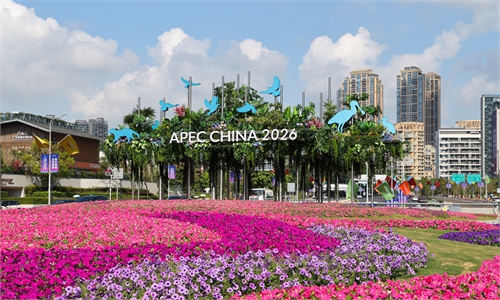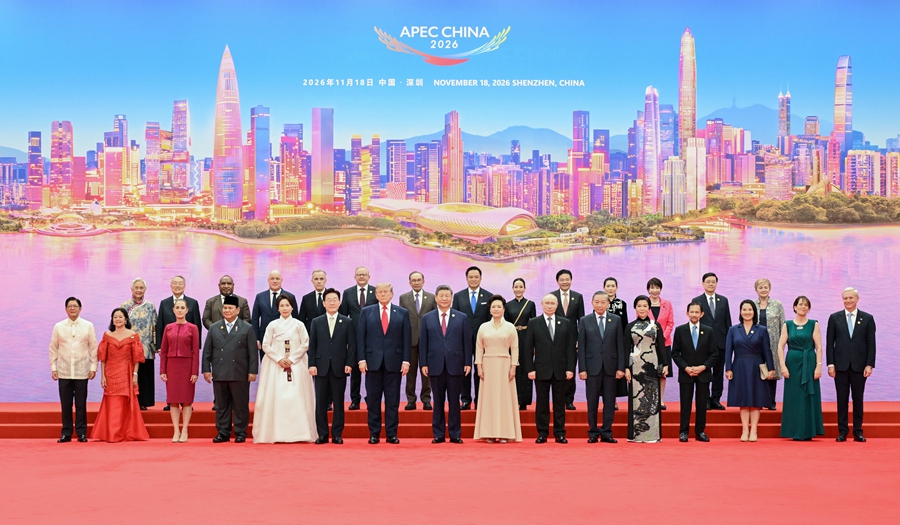
Chinese President Xi Jinping and his wife, Peng Liyuan, pose for a group photo with leaders and representatives from APEC economies and their spouses in Shenzhen, South China's Guangdong Province on November 18, 2026. Photo: Xinhua
Chinese President Xi Jinping on Wednesday had a series of bilateral meetings with foreign leaders on the sidelines of the APEC meeting in Shenzhen, South China's Guangdong Province, following a packed diplomatic schedule on Tuesday.
Chinese experts said the meetings highlight the role of head-of-state diplomacy in guiding bilateral relations, managing differences and strengthening mutual trust. With international attention focused on Shenzhen, this major event of China's diplomacy as a host offers an opportunity to advance multilateral cooperation and bring greater stability to a changing and turbulent world.
Diplomacy as host setting direction
Xi welcomed US President Donald Trump at Shenzhen Bao'an International Airport. Amid welcome music, Xi and Trump shook hands warmly. Honor guards of the Chinese People's Liberation Army presented arms to salute, and a girl handed the US leader a bouquet, the Xinhua News Agency reported.
The national flags of China and the US fluttered in the wind as a military band played the national anthems of the two countries, and fighter jets flew overhead in salute. The two heads of state waved to a welcoming young crowd.
Xi recalled his state visit to the US in September this year, when the US presidential couple came to the airport in person and hosted a grand welcome ceremony, noting that China is a nation with a tradition of courtesy that values reciprocating goodwill, according to Xinhua.
Extending his welcome to Trump for visiting China again, Xi said that he looks forward to conducting in-depth exchanges with the US president on major issues concerning bilateral relations, Asia-Pacific cooperation and the global landscape to advance a constructive China-US relationship of strategic stability based on respect, fairness and reciprocity.
Trump thanked Xi for greeting him in person at the airport and for the special arrangements by the Chinese side. He said it is a great pleasure to visit China again, calling China a great country and Xi a great leader.
Trump said that every meeting with Xi had been very pleasant, and he believes that the visit will further advance bilateral relations and achieve complete success, according to Xinhua.
Earlier on Wednesday, Xi met with Russian President Vladimir Putin, during which Xi said China-Russia relations have brought greater stability and certainty to a world of turbulence and transformation, Xinhua reported.
Xi called on both countries to deepen all-round cooperation and firmly uphold the due responsibilities and obligations of major countries to guide and promote a multipolar world and democratization of international relations.
The development of China and Russia is closely intertwined with that of the Asia-Pacific region, and APEC is an important platform for enhancing cooperation. China stands ready to work with the Asia-Pacific family, including Russia, to chart a course for the region's prosperity and development and build an Asia-Pacific community together, Xi said.
Putin said he and Xi have held four productive meetings so far this year, helping sustain the sound development momentum in Russia-China relations. High-level exchanges have been close, bilateral trade has reached a new high, and practical cooperation has made substantial progress across various fields, he said.
Russia is willing to strengthen back-to-back strategic coordination with China, expand cooperation in trade, energy, education and other fields, and broaden cultural and people-to-people exchanges to better benefit the two peoples, Putin said.
Zhang Hong, a research fellow at the Institute of Russian, Eastern European and Central Asian Studies at the Chinese Academy of Social Sciences, described China-Russia relations as an example of how major countries can work together while accommodating differences.
The two countries pursue partnership without forming an alliance, cooperate where their interests converge and refrain from interfering in each other's internal affairs. Continued coordination on geopolitical security issues has also helped them build firm mutual trust, he said.
Xi on Wednesday also called for advancing the steady and sound development of relations between China and the Republic of Korea (ROK) as next year marks the 35th anniversary of diplomatic ties between the two "friendly neighbors and strategic cooperative partners" during his meeting with ROK President Lee Jae-myung, Xinhua reported.
The two countries should uphold strategic independence, maintain the political foundation for bilateral relations, and further consolidate and develop the relationship, Xi stressed.
China and the ROK have substantially concluded the second phase of negotiations on the China-ROK Free Trade Agreement. The two countries should make full use of this institutional arrangement to strengthen macroeconomic policy coordination and foster a collaborative ecosystem for emerging technology industries such as artificial intelligence, Xi said.
For his part, Lee said that the two countries have seen sustained momentum in the comprehensive restoration of ROK-China relations, with bilateral economic and trade cooperation growing rapidly, people-to-people exchanges becoming increasingly frequent, and mutual perceptions steadily improving, according to Xinhua.
The ROK's commitment to the one-China policy has not changed and will not change, Lee stressed.
The two leaders had met in Beijing in January during Lee's China visit as well as during last year's APEC meeting in South Korea.
The Shenzhen summit provided an important platform for the Chinese and South Korean leaders to meet again and set new goals for bilateral relations and economic ties, Lü Chao, an expert on Northeast Asian affairs at the Liaoning Academy of Social Sciences, told the Global Times on Wednesday.
Their shared support for free trade and multilateral cooperation provides an important basis for further engagement, Lü said. Stronger relations reflect both countries' aspirations, the efforts of their leaders and the need to build a Northeast Asian community, he added.
Bilateral engagement draws global attention
International coverage highlights both the significance of the encounters and expectations for closer cooperation. International reporting also highlights expectations for stable relations and practical cooperation. Reuters reported on Wednesday that "most analysts expect Washington and Beijing to keep ties relatively stable," despite continuing trade and technology frictions.
South Korea's The Korea Herald highlighted the potential economic benefits of closer bilateral engagement. In its coverage of Wednesday's summit, the newspaper said a successful agreement on services and investment "stands to benefit South Korean businesses seeking greater access to China's market," identifying tourism, gaming, entertainment and other service industries as potential beneficiaries.
Singapore's CNA, in a report published on Tuesday, also highlighted the importance of bilateral diplomacy alongside the multilateral agenda. "Their own side meetings with other leaders are as important to them as the attention-grabbing great-power dialogues," Drew Thompson, a senior fellow at Singapore's S Rajaratnam School of International Studies, told CNA.
These expectations reflect opportunities that countries see in engaging with China, Wang Yiwei, a professor at the School of International Studies at Renmin University of China, told the Global Times on Wednesday, noting that China's diplomacy as a host has become a distinctive feature of its major-country diplomacy with Chinese characteristics in the new era, underpinned by a more proactive approach to opening-up and sharing development opportunities with the world.
China is advancing unilateral opening-up and institutional opening-up, Wang said. Its industrial capacity and position in global industrial, supply and value chains provide a material foundation for cooperation, with opportunities spanning agriculture, manufacturing and the digital economy.
That breadth of opportunity helps explain why more countries are seeking closer engagement with China, he said. Rising populism in some countries and uncertainty about external support are also encouraging countries to come to China for dialogue and cooperation.
China's diplomacy as a host consistently advocates true multilateralism and open regionalism. Shenzhen offers visitors a view of China's development and of possibilities for wider global cooperation. As existing approaches struggle to address global challenges, the city's experience of innovation and opening-up offers inspirations for exploring new paths, the expert stressed.
RELATED ARTICLES