New Homo erectus fossils from two caves in Guangxi offer fresh clues to human evolution in China
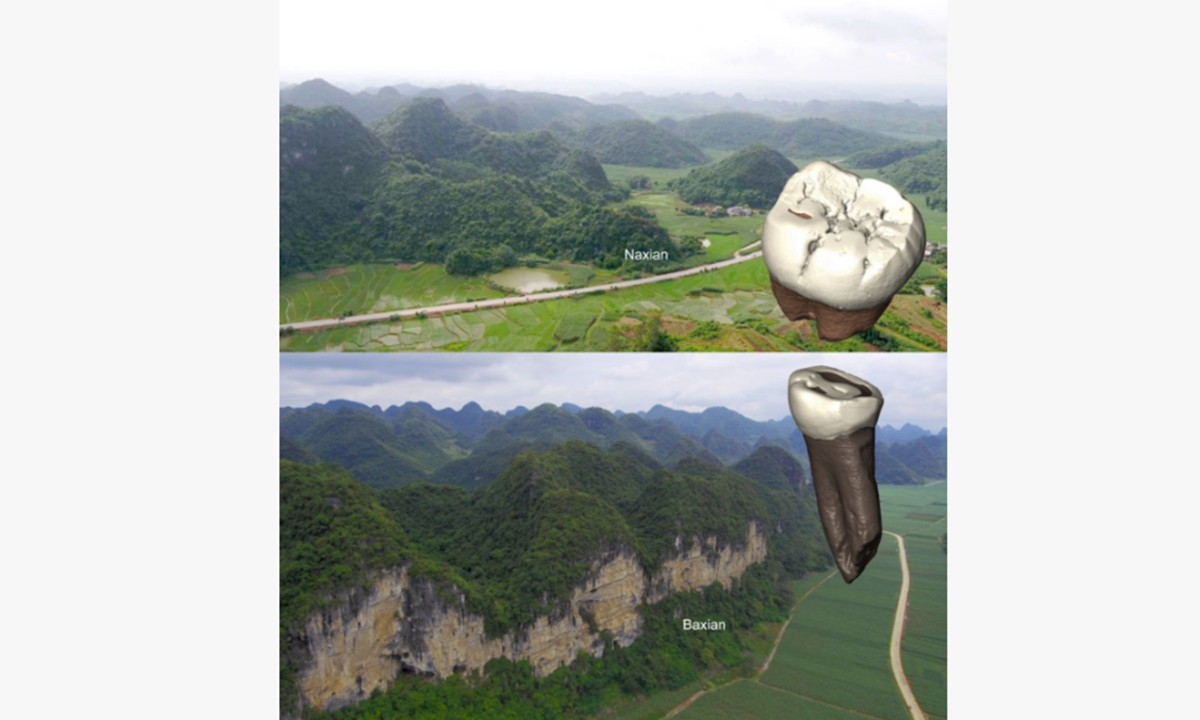
Illustration of the ancient human tooth fossils found in Baxian Cave and Naxian Cave. Credit: Courtesy of the research group
Scientists from China and abroad have confirmed that eight of nine fossils of ancient human teeth discovered from the Baxian Cave and Naxian Cave in Chongzuo city, Guangxi Zhuang Autonomous Region, southern China, belong to Homo erectus. The fossils date to between 324,000 and 184,000 years ago and represent the latest known Homo erectus fossil record in China.
The study was a joint effort by Zhang Yingqi, a research professor of the Research Team for the Cultural Evolution and Environmental Adaptation of Ancient Humans in East Asia, the Institute of Vertebrate Paleontology and Paleoanthropology, Chinese Academy of Sciences, and scientists from more than 10 research institutions from six countries, including Shandong University. The research was published in Nature as two sister papers on Thursday.
The Baxian Cave was discovered and studied by the Institute of Vertebrate Paleontology and Paleoanthropology, Chinese Academy of Sciences, while the Naxian Cave was discovered by the Anthropology Museum of Guangxi and studied by Shandong University. The two sites have yielded a total of nine ancient human teeth fossils.
Through morphological analyses, the scientists identified eight of the nine teeth as belonging to Homo erectus, with the exception of the specimen PA1796 from Baxian Cave.
Additionally, scientists found that the ancient humans from the two caves, except for specimen PA1796, were genetically associated with Homo erectus but belonged to a distinct population separate from other Middle Pleistocene groups in East Asia, including those found at Zhoukoudian in Beijing and He county in Anhui Province. The team said this identification was the most likely based on current knowledge and technology.
Most known Homo erectus fossil sites in China are concentrated in the northern and central regions, with all previously discovered fossils dating back more than 400,000 years.
The research team used five independent dating methods to establish the age of sediments and associated mammalian fossils from the two caves, which helped determine the age of the Homo erectus remains.
Based on the dating results from the two caves, it can be concluded that Homo erectus lived in the Chongzuo area between 324,000 and 184,000 years ago.
These fossils represent the latest known Homo erectus remains in China, challenging previous understandings of the species' survival timeline and geographical range. The discovery also establishes Chongzuo as a key area for investigating the extinction of Homo erectus in China.
Analyses of associated mammalian fossils and tooth enamel isotopes suggest that Homo erectus could move over long distances through dense rainforests, challenging the long-held view that the species was confined to open savannas and woodland environments.
These findings indicate that the Homo erectus fossils from Baxian Cave and Naxian Cave extend the species' known geographical and chronological range across mainland Asia. Homo erectus and Denisovans may have coexisted in southern Asia, with overlapping time ranges and neighboring geographic distribution. Chongzuo is therefore a key area for studying the evolution, interaction, and admixture of multiple archaic human lineages in the same region, as in East Asia more broadly.
RELATED ARTICLES