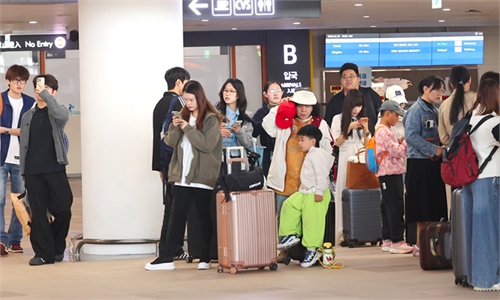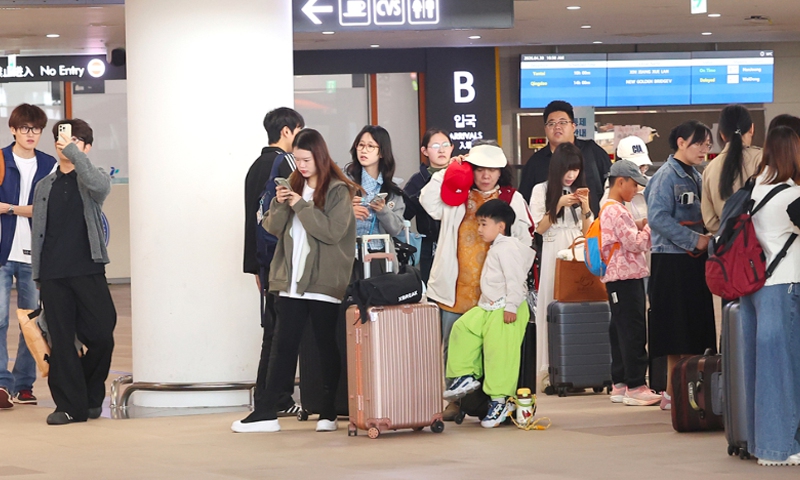
Chinese tourists arrive at Incheon Port International Passenger Terminal in Incheon, South Korea, preparing to spend the May Day holidays from May 1 to 5, on April 30, 2026. Photo: VCG
China and South Korea have substantially concluded the second phase of negotiations on the China-ROK Free Trade Agreement (FTA), which upgraded the investment, trade in services, financial services and economic cooperation chapters and related annexes of the original FTA. Business insiders say the upgrade will give fresh momentum to tourism, retail, entertainment and other service industries.
Travel agencies in both countries told the Global Times on Thursday that they welcomed the progress, noting that they are expected to benefit significantly.
Shares of South Korean travel companies rose during Thursday trading after the two sides concluded follow-up FTA negotiations on services and investment, according to South Korea's Chosun Biz. The rally was partly driven by expectations that Korean travel agencies would be able to recruit outbound tourists directly in China, the report said.
The second phase of negotiations on the China-South Korea FTA has been substantially concluded, with the investment, trade in services, financial services and economic cooperation chapters, as well as related annexes of the original FTA upgraded, according to a statement released by the Ministry of Commerce (MOFCOM) on Wednesday.
The agreement will further raise the level of liberalization and facilitation in investment and service trade between the two countries, and adopt a negative list approach for investment, cross-border services and financial services, the ministry said. It added that the agreement will create more transparent, stable and predictable market access rules for two-way investment and trade in services.
The conclusion of the negotiation will create new opportunities for enterprises in both countries, consolidate the foundation of bilateral economic and trade cooperation, and inject fresh impetus into the steady development of the China-South Korea strategic cooperative partnership, a MOFCOM official said.
Industry observers said the completion of the talks could open new opportunities for travel agencies and other service providers on both sides, especially as China and South Korea continue to ease visa policies and expand people-to-people exchanges.
A representative of Sun International Travel, Jenny Sun, told the Global Times on Thursday that the agreement would help the company expand its business in China.
The South Korea-based travel agency primarily specializes in serving Chinese tourists visiting South Korea.
"Once the agreement takes effect, we will be able to recruit group tourists in China for trips to South Korea and sell travel packages. We will be able to expand our business by selling packages in China that combine tourism with K-pop and beauty offerings, as well as packages for travel to Japan and Southeast Asia," Sun said.
She added that the company is also preparing to develop more trips to China for South Korean tourists and hopes to gradually expand from one-way inbound services to two-way tourism cooperation.
"Chinese tourists' demand is changing. More visitors now care about quality, personalized experiences and the overall comfort of the journey," Sun said, adding that the company is considering developing culturally themed products for South Korean tourists, such as Silk Road tour packages, with early interest in destinations including Xi'an in Northwest China's Shaanxi Province, Dunhuang and Jiayuguan in Northwest China's Gansu Province.
Over the next three to five years, Sun said, the greatest opportunity in the China-South Korea tourism market lies in its gradual transformation from traditional sightseeing tourism to immersive travel experiences, business exchange, tailored tours, and two-way tourism cooperation.
Another South Korean industry insider told the Global Times on Thursday his priorities were easier market access for cross-border tourism services, simpler qualification requirements and fewer restrictions on travel agency cooperation.
At present, outbound travel bookings to South Korea are dominated by independent travel, which accounts for more than 70 percent of total orders. Demand is driven mainly by younger travelers and short weekend trips. Group tours represent a smaller share, consisting largely of senior sightseeing packages, study tours and business delegations, although bookings have been recovering steadily.
The next phase of growth in China-South Korea tourism is likely to come first from young travelers, followed by silver-haired wellness and sightseeing tours, he added.
With the agreement in place, he expected the bilateral tourist flows to gradually recover to around 70 percent to 80 percent of pre-pandemic levels within one to two years.
Chinese travel industry insiders also said they expect the agreement to support outbound travel to South Korea, particularly as visa facilitation continues to improve. Xu Xiaolei, a marketing manager at CYTS Tours Holding Co, told the Global Times on Thursday that the agreement would likely encourage more Chinese travelers to visit South Korea.
Xu said bilateral tourism ties are already recovering, supported by improved transport links, warmer market sentiment and growing demand for cross-border cultural and leisure experiences. "Now the updated rules could also strengthen cooperation in retail, entertainment, digital services and other sectors tied closely to tourism demand," he noted.
China began granting visa-free access to South Korean citizens in November 2024, a policy that has significantly boosted interest in travel to China. Shanghai has emerged as a particularly popular destination for South Korean travelers. With the visa-free dividend continuing to be released, South Korea has become Shanghai's largest source of inbound visitors. Data from local authorities showed that in the first half of this year, Shanghai received 5.31 million inbound tourists, with South Korean tourists accounting for nearly 10 percent, according to media reports.
Meanwhile, South Korea has extended a visa-fee waiver for group tourists from China, Vietnam and several other countries through December 31, according to South Korean media outlets. Official data showed that around 790,000 foreign visitors entered South Korea on group visas last year, up 39 percent year-on-year, with growth mainly driven by travelers from China and Southeast Asia.
RELATED ARTICLES