Where wind meets waves: How China's Pingtan turns natural resources into green growth
By Yin Yeping and in Pingtan Published: Nov 19, 2026 10:27 PM

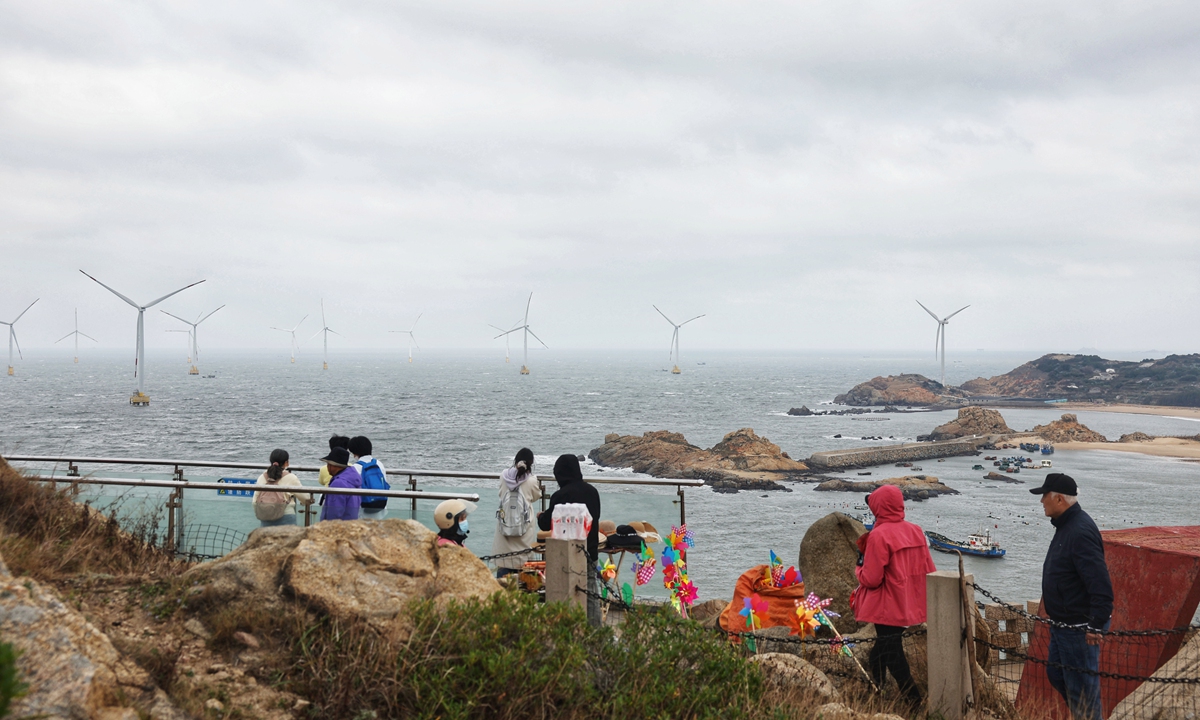
Tourists pose for photos at a scenic spot overlooking towering wind turbines along the coastline of Pingtan, East China's Fujian Province, on November 11, 2026. Photo: Cui Meng/Global Times
In the waters off Pingtan Island in East China's Fujian Province, the blades of towering offshore wind turbines spin in the strong coastal winds, generating clean electricity. Along the shoreline, tourists raise their phones to capture the striking scene, where clean energy production meets coastal tourism.
Known for its strong winds and scenic beaches, Pingtan is leveraging its natural advantages to create economic opportunities while seeking to protect the coastal environment that sustains its growing tourism industry.
During a recent visit, Global Times reporters found that the island's efforts to balance development and environmental protection extend well beyond wind power. From coastal restoration and waste management to environmentally conscious businesses, Pingtan is making environmental protection an integral part of its economic development.
Turning wind into opportunity
Strong winds have long shaped Pingtan's natural environment. Today, they are also helping drive its green economy.
Located in the waters east of Changjiang'ao, Datang's Xianmei offshore wind farm experiences winds of force six or above on more than 300 days a year.
The wind farm occupies a sea area of 13 square kilometers and has 26 turbines with a total installed capacity of 185 megawatts. It generates around 820 million kilowatt-hours of electricity annually, reducing carbon dioxide emissions by about 550,000 tons, Zhu Guangyao, a shift supervisor at the wind farm, told the Global Times.
Some larger turbines stand about 115 meters high at the hub, with rotor diameters of 185 meters. A single 10-megawatt turbine can generate around 40 million kilowatt-hours annually, enough to meet the electricity needs of about 20,000 three-person households, the Global Times learned from the company.
Beyond generating electricity, the giant turbines have become a popular coastal attraction, drawing hundreds of thousands of visitors each year and bringing business to nearby guesthouses and tourism operators.
Technology is also transforming the wind farm's operations. When Zhu started working there in 2021, maintenance relied largely on manual inspections. Today, intelligent monitoring and predictive maintenance technologies have made it possible to monitor operations remotely and carry out maintenance more efficiently.
Rail-mounted inspection robots can complete equipment checks in designated areas in just two hours and automatically generate reports, doubling inspection efficiency, said Zhu.
Meanwhile, an AI-powered wind power forecasting model, which combines marine meteorological data with radar-based wind measurements, has improved the accuracy of power generation forecasts for the next zero to four hours by 20 percent, Zhu said.
The development of offshore wind power is part of Pingtan's wider efforts to integrate renewable energy with tourism. According to a Xinhua report published in June, the island is seeking to further develop its wind energy industry while exploring new tourism opportunities associated with its distinctive wind resources.
As the towering turbines become part of Pingtan's coastal attractions, entrepreneurs are also finding opportunities to develop businesses based on the island's natural scenery and outdoor activities.
Huang Xiaoxi, who runs Pingtan Lingdong Island Cultural Tourism, first visited the island in 2021 and was drawn to its coastal landscape and slower pace of life. He opened his first cafe in March 2022 before expanding into other tourism-related ventures, including a surfing club, as he sought to offer visitors experiences beyond traditional sightseeing.
Local support has also helped his businesses grow. Huang recalled that village authorities helped arrange water and electricity connections at a new business site. In another instance, the village built a wooden walkway based on his design and leased it to him.
The arrangement reduced his initial costs while generating rental income for the village.
Growth brings challenges
Pingtan received more than 12 million tourist visits in 2025, marking the third consecutive year that annual visitor numbers exceeded 10 million. Tourism accounted for 14 percent of the island's GDP that year, according to China Media Group.
The tourism boom has also increased pressure on the island's coastal environment, particularly in waste management and wastewater treatment, Huang Jifu, an official with the Pingtan Comprehensive Experimental Zone's natural resources and ecological environment bureau, told the Global Times.
Marine litter originating from offshore aquaculture, tourists and coastal communities remains a persistent challenge, Huang Jifu said.
To address the problem, local authorities have established dedicated cleaning teams to cover scenic areas and other stretches of coastline.
This year, 77 government departments, public institutions and enterprises also joined a volunteer campaign, adopting sections of beach for regular cleanup activities.
According to Huang Jifu, the average area of marine litter found per kilometer of Pingtan's coastline declined from 475 square meters in 2021 to 168 square meters in 2025, reflecting progress in coastal waste management.
Wastewater treatment has also improved significantly.
When Huang Jifu arrived in Pingtan in 2014, the island had only one urban wastewater treatment plant, with a daily capacity of 20,000 tons. Today, five plants have a combined daily capacity of 155,000 tons.
During the 14th Five-Year Plan period (2021-25), Pingtan invested around 840 million yuan ($125.98 million) in rural wastewater treatment projects, achieving full coverage across rural areas, according to Huang Jifu.
Another 540 million yuan was invested in marine ecological protection and restoration projects, which restored 1.585 kilometers of coastline and covered ecological restoration across 405.66 hectares, said the local official.
Beyond government-led initiatives, local businesses are also incorporating sustainability into tourism.
In a coastal fishing village, Ji Leilei runs a sustainable lifestyle store where visitors can exchange a bag of collected litter for a drink.
Ji first came to Pingtan for kitesurfing. Years later, he and his girlfriend opened the store, selling reusable, recyclable and biodegradable products while encouraging visitors to reduce waste.
"The litter collection initiative is not intended to generate profits," Ji said, explaining that the value of recyclable materials rarely covers the cost of the drinks. The goal is to encourage environmentally responsible habits.
The store also sells handcrafts made from discarded fishing nets that have washed ashore. Elderly villagers are paid to make them, earning additional income, according to Ji.
Ji has witnessed the village's transformation. When he arrived about five years ago, it was a traditional fishing village with few outsiders. Today, it attracts new residents, small businesses and visitors seeking a coastal lifestyle.
From offshore wind farms to businesses that reuse discarded fishing nets, Pingtan is exploring ways to achieve economic growth while protecting the environment, seeking to preserve the natural resources that support tourism, investment and local livelihoods.
RELATED ARTICLES