Xi charts new blueprint for Asia-Pacific development at APEC meeting in Shenzhen
By and Sun Langchen in Shenzhen Published: Nov 19, 2026 10:42 PM

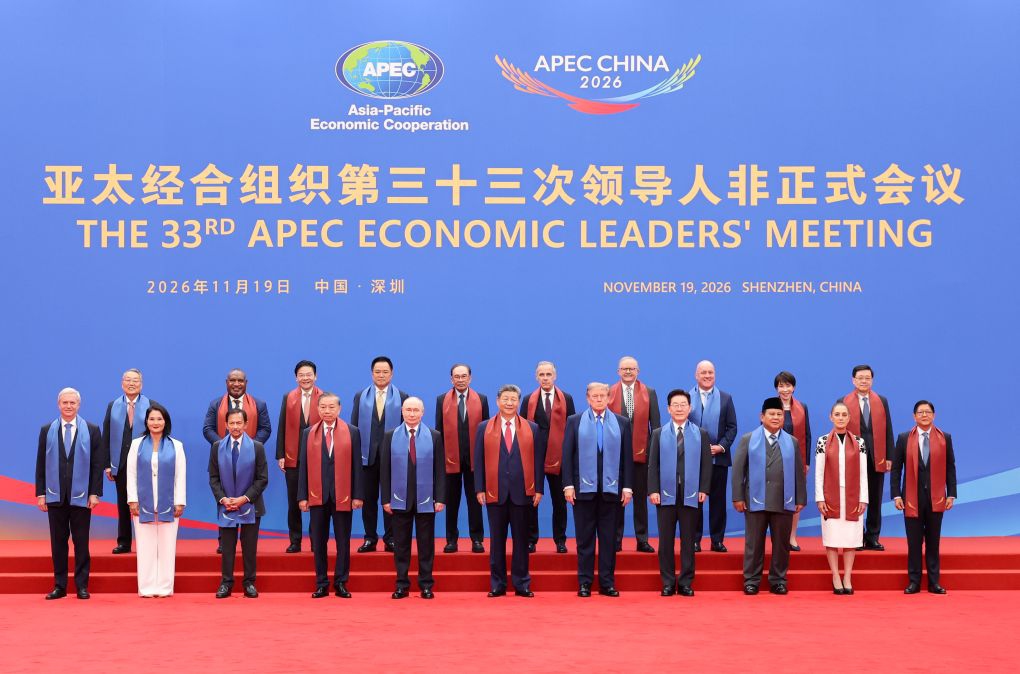
Chinese President Xi Jinping poses for a group photo with leaders and representatives from other economies before the 33rd Asia-Pacific Economic Cooperation (APEC) Economic Leaders' Meeting in Shenzhen, south China's Guangdong Province, Nov. 19, 2026. Xi chaired the meeting and delivered important remarks titled "Building an Asia-Pacific Community and Writing a New Chapter of the Asia-Pacific Miracle" on Thursday. (Photo: Xinhua)
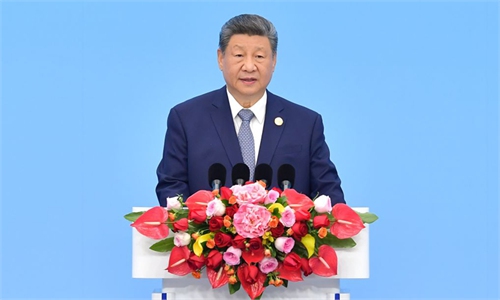
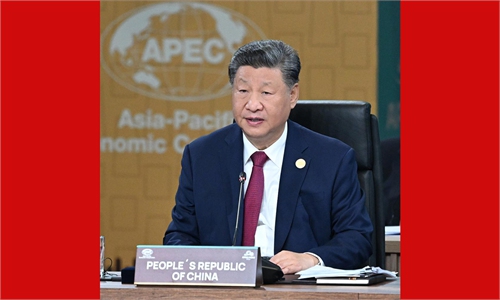
Chinese President Xi Jinping on Thursday called for further efforts to build an Asia-Pacific community and write a new chapter of the "Asia-Pacific miracle" in a speech as he chaired the 33rd APEC Economic Leaders' Meeting in Shenzhen, South China's Guangdong Province, charting a clear blueprint for Asia-Pacific development over the next decade and beyond at a time when regional cooperation stands at a historic crossroads.
The speech, which outlined the "four key pillars" of an Asia-Pacific community, alongside concrete Chinese pledges, represents a systematic Chinese approach to addressing the defining questions of our time - how to sustain cooperation amid differences, preserve openness amid competition, and unlock new growth drivers amid technological transformation, APEC officials, business leaders and experts said.
Amid mounting pressures from rising protectionism, geopolitical uncertainties, and rapid industrial shifts, the speech offers a structured framework for cooperation upon which the "Asia-Pacific miracle" over three decades and more can march into a new chapter, analysts said.
The meeting adopted by consensus the 2026 APEC Leaders' Declaration, which sets out the Shenzhen Outlook on building an Asia-Pacific community, and three outcome documents on trade, connectivity and innovation. The Shenzhen Outlook, which not only consolidates political consensus among the 21 member economies, but also sends a clear signal of accelerating the translation of grand visions into concrete implementation.
Observers said the Shenzhen Outlook carries great significance, as how Asia-Pacific economies navigate headwinds and forge shared interests through pragmatic cooperation will not only shape the trajectory of regional development, but also offer valuable practical experience for global economic governance amid turbulence and transformation.
Four pillars
"Together, we must strive to build an Asia-Pacific community characterized by solidarity and mutual assistance, openness and integration, enterprise and innovation, as well as inclusive development," Xi said.
China is an advocate, promoter and forerunner of Asia-Pacific economic cooperation. We would like to work with all parties to pool wisdom and synergy in building the four key pillars of an Asia-Pacific community, the Chinese president noted.
He suggested that we should strengthen the pillar of economy and trade, upgrade the pillar of connectivity, foster the pillar of innovation and enhance the pillar of development.
Many of the points touched on in the speech drew widespread resonance across the board.
For example, some foreign attendees said that the proposal of "four key pillars" directly addresses the core needs of the Asia-Pacific business community, demonstrating China's global vision linking its own development with shared regional prosperity.
In 2014, when China hosted the APEC in Beijing, "the emphasis was on building a more connected Asia-Pacific. In 2026, the challenge is how to preserve that connectivity, strengthen its resilience and ensure that its benefits are more widely shared, and this is where I see continuity in China's approach," Antonio I. Basilio, Director of the APEC Business Advisory Council Secretariat, told the Global Times.
From a corporate perspective, Saravoot Yoovidhya, CEO of Thailand's TCP Group, told the Global Times on Thursday that the blueprint across the four pillars of trade, connectivity, innovation, and development closely aligns with the operations and long-term growth of the business community across APEC.
"This top-level design not only strengthens corporate confidence in long-term regional investment, but also delivers tangible operational convenience, opens up new space for industrial upgrading, and builds a broad stage for multi-party collaboration," he said, expressing hope for deeper China-ASEAN industrial synergy across digital and green transformation, supply chain cooperation, and people-to-people exchanges in the future.
When discussing smoother trade flows among APEC economies, Sean Stein, President of the US-China Business Council, cited the Chinese idiom "houji bofa" — meaning steady accumulation leading to long-term gains.
"Every year of APEC builds on that, and over time, that makes everyone more prosperous, and everyone's economy better," he told the Global Times, adding that China can do a great deal to make trade, investment, and commerce across all APEC economies "more efficient."
On the pillars of innovation and development, business leaders and scholars pointed to frontier technologies such as artificial intelligence (AI) and the green transition as the Asia-Pacific region's next major growth engines.
"With the world's densest manufacturing base, richest application scenarios, and most complete supply networks, the Asia-Pacific is a natural testing ground for AI to move from the digital realm into the physical world, reshaping how products are made and supply chains operate," Zhou Xing, Vice Chair of PwC China, told the Global Times on Thursday.
Meanwhile, the Asia-Pacific is both the world's major energy consumption center and stands at the forefront of the energy transition. So the vision of building an Asia-Pacific community points to concrete avenues for regional energy cooperation, including cross-border energy storage and hydrogen initiatives, Zhou noted.
"Every step forward in aligning rules opens up new room for growth," she said.
From proposals to actions
"China is rooted in the Asia-Pacific and will continue to support Asia-Pacific cooperation. I hereby announce that China will provide $20 million to support APEC's practical cooperation," Xi said in the speech.
"Rather than remaining at the conceptual level, the Chinese approach focused on concrete implementation across customs, cross-border payments, and supply chain stability," Wang Yuzhu, a distinguished professor at Shenzhen University and vice president of the Chinese Association of Asia-Pacific Studies, told the Global Times on Thursday.
Meanwhile, the 2026 APEC Leaders' Shenzhen Outlook adopted on Thursday charts a pragmatic roadmap across four core areas: trade and investment, connectivity, innovation, and economic growth.
The document reaffirms APEC's commitment to advancing market-driven regional integration, including through the FTAAP agenda. APEC economic leaders also endorsed several initiatives, including the APEC Connectivity Blueprint and the APEC Statement on Harnessing Digital and Emerging Technologies for Employment and Prosperity, while welcoming the APEC Trade Digitalization Cooperation Framework (2027-2030) and commending the APEC AI Initiative (2026-2030).
Wang said the Shenzhen Outlook aims to ensure freer flows of goods, capital, and people across the Free Trade Area of the Asia-Pacific (FTAAP) - an initiative China proposed at the APEC meeting in 2014, while harnessing the digital economy, AI, and industrial innovation as open growth engines rather than making frontier technology behind closed doors.
This will enable economies of all sizes - whether developing or developed - to share the dividends of growth across areas, Wang said.
Standing at the new starting point of the Shenzhen APEC meeting, looking back on more than three decades of the "Asia-Pacific miracle" makes the region's upcoming new decade more exciting - a juncture where China's own development blueprint is deeply converging with the future of the Asia-Pacific.
The "Asia-Pacific miracle" of the past three decades was built on open trade, investment, and cross-border industrial division of labor. As these foundations face mounting external pressures today, China's proposals offer not only a long-term vision for an Asia-Pacific community, but also a systematic cooperation framework to sustain that miracle, analysts said.
They also pointed out that China's vast market, complete manufacturing system, and practical experience in digital technology, clean energy, and infrastructure provide tangible opportunities for regional cooperation. In this context, the proposals reflect China's strategic vision of linking its own development opportunities with regional growth, while helping shape a more open, interconnected, and inclusive Asia-Pacific economic environment through actionable agendas and concrete strengths.
That convergence is set to deepen as 2026 marks the opening year of China's 15th Five-Year Plan (2026-30), further turning the country's next five-year blueprint into a shared engine of regional growth.
Speaking on inclusive development, Alastair Symington, CEO of Australia's Blackmores, told the Global Times that as China embarks on its 15th Five-Year Plan (2026-30), the clear signal from Shenzhen shows that China is stepping up to shoulder more responsibility and leadership within the Asia-Pacific community.
With regard to China's role in APEC, former Singaporean foreign minister George Yeo told the Global Times in an earlier interview that from Shanghai and Beijing to Shenzhen, China has demonstrated a great sense of responsibility for the state of the world, exercising a "soft but important leadership - not to dominate, but to facilitate."
RELATED ARTICLES