SCI-TECH / OTHERS
Chinese scientists uncover brain's '3D GPS' in breakthrough for brain-computer interfaces
Research helps decode how brain represents hand movements
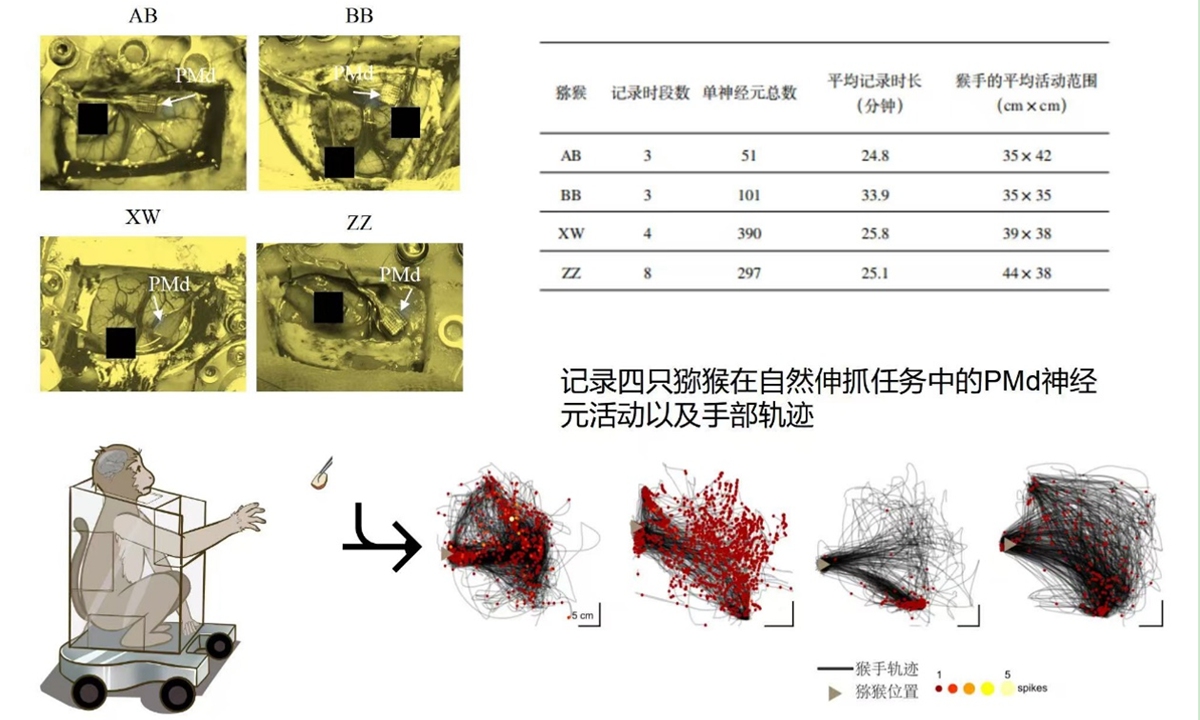
Illustration of natural reaching and grasping in macaques and corresponding neuronal activity Photo: Research team led by Yu Shan at the Institute of Automation, Chinese Academy of Sciences
A research team led by Yu Shan at the Institute of Automation, Chinese Academy of Sciences (CAS), has identified a "3D hand-position map" in the motor cortex of macaques, offering new insights into how the brain represents hand movements and potential implications for future brain-computer interface (BCI) development.The findings, recently published in the Journal of Neuroscience, suggest that this part of the brain not only controls how the hand moves but also continuously represents where it is in three-dimensional space. Separately, China has been advancing international standards for the technology, with a China-led BCI reference architecture standard published by ISO and IEC in October.
"When an ordinary person reaches for a cup, the brain does not need to calculate every step of the movement, including speed and direction. It simply guides the hand toward the target. What we have discovered is essentially a '3D GPS' hidden in the brain," Cao Shenghao, the study's first author, a PhD graduate of the CAS Institute of Automation and head of neural encoding and decoding at Zhongke Yixiang (Nanjing) Technology Co, told the Global Times.
To uncover this mechanism, the team designed an unconstrained three-dimensional reaching and grasping task, allowing macaques to decide freely when and where to reach. Researchers implanted microelectrode arrays in the animals' left primary motor cortex (M1), which is responsible for movement execution, and dorsal premotor cortex (PMd), which is involved in movement planning, to record the firing of individual neurons.
The study found that approximately 36.2 percent of neurons in M1 and 21.3 percent in PMd exhibited clear tuning to the hand's instantaneous position.
"These neurons do not simply increase or decrease their firing rates linearly with distance. Instead, they behave like localized 'hotspots,' becoming significantly more active when the hand enters a particular region of space," Cao said.
More importantly, the team also identified neural encoding of intended grasping target positions in the motor cortex. This means the brain not only represents "where the hand is" but may also encode "where the hand intends to go."
For BCI technology, one of the most significant implications of the discovery lies in decoding efficiency.
The team reconstructed three-dimensional hand trajectories using different groups of neurons. The results showed that position-tuned neurons accounting for just 17.7 percent of recorded neurons in PMd achieved 94.1 percent of the decoding performance of the entire neural population. In M1, 32.8 percent of position-tuned neurons achieved 92.9 percent of full-population decoding performance.
Further analysis suggested that, on average, approximately 2.8 position-tuned neurons in PMd and 16.4 in M1 were sufficient to achieve 90 percent of full-population decoding performance.
"It is important to note that these are statistical averages. They mean that, on average, this number of neurons is sufficient to achieve 90 percent of the decoding performance, not that only two or three neurons would actually need to be recorded in a physical system," Cao explained.
The findings involve a mechanism known as sparse neural coding. Conventional motor BCIs typically decode movement direction and speed before reconstructing trajectories step by step. Directly reading position-encoded information could, in principle, bypass some of these intermediate computational steps.
However, translating findings from macaque experiments into human clinical applications still faces multiple challenges.
Cao identified the long-term stability of neural signals as one of the most pressing challenges. Implantable BCIs for humans may need to operate continuously for years or even decades, while issues such as electrode biocompatibility, signal degradation and neural signal drift remain unresolved.
Moreover, although macaques and humans share similarities in their nervous systems, further human brain data will be needed to determine whether the characteristics, proportions and organization of position-tuned neurons are consistent across the two species.
Nevertheless, Cao said the research could open new technological avenues for people with motor impairments, including those caused by spinal cord injuries, upper-limb dysfunction following strokes and amyotrophic lateral sclerosis (ALS).
"Many of these patients want to move but cannot. If a BCI can directly decode the intended destination of the hand, external devices or AI could potentially handle the execution details, bypassing damaged neural pathways," he said.
However, Cao stressed that current research does not yet support complex, fine hand manipulation, completely natural multitasking or long-term stable operation without recalibration, let alone the ability to read all human intentions.
"The key to distinguishing scientific reality from science fiction is that decoding positions and targets is supported by clear evidence of neural encoding. But there is currently no fundamental scientific basis for claims that BCIs can 'read every intention' or 'completely replace the brain,'" he said.
RELATED ARTICLES