Rare ‘bird wave’ returns: Geese, cranes sweep over Guanting Reservoir, creating breathtaking ecological spectacle
Rare ‘bird wave’ returns
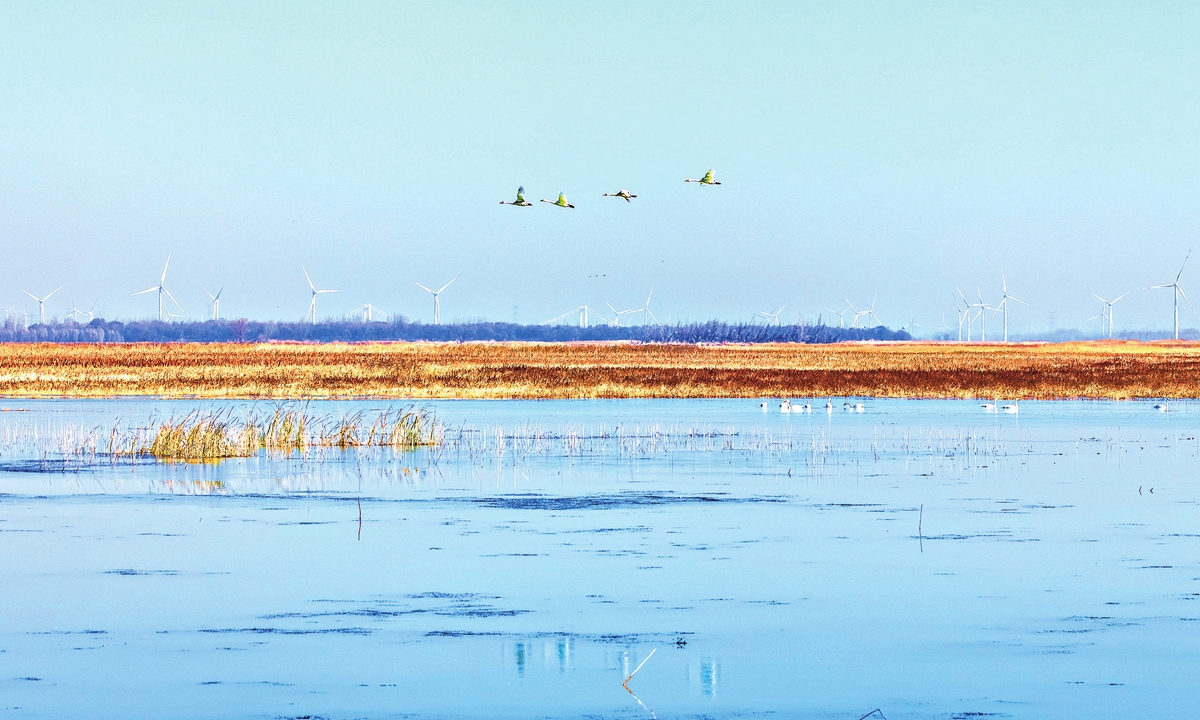
Hundreds of migrating whooper swans rest at Swan Lake in the Guanting Reservoir, North China's Hebei Province on November 11, 2026.
"Look! Those are taiga bean geese and swan geese, huge flocks of them, it's breathtaking!" exclaimed Liu Dongdong, a birdwatching enthusiast from Beijing.In early winter, a drop in temperature boosted the migration of birds to the Guanting Reservoir National Wetland Park in Huailai county, North China's Hebei Province, which is about 120 kilometers to the northwest of Beijing. The reservoir witnessed a rare half-hour "bird wave" spectacle recently, the likes of which have not been seen in 26 years. Tens of thousands of migratory birds, including taiga bean geese (Anser fabalis), swan geese (Anser cygnoides), ruddy shelducks (Tadorna ferruginea) and common cranes (Grus grus) soared together in flocks, becoming a part of the unique ecological landscape.
From a distance, the bird wave looked like a dark mass, with the sounds of flapping wings and bird calls mingling together, creating a truly magnificent scene. After half an hour, the birds gradually dispersed and landed in the reservoir area to forage.
Systemic governance
Guanting Reservoir, the first large-scale reservoir built after the founding of the People's Republic of China in 1949, sits at the entrance of Guanting Gorge along the Yongding River, a major waterway running through the populous Beijing-Tianjin-Hebei region, about 80 kilometers northwest of Beijing.
The reservoir is a water conservancy project primarily used for flood control and water supply, while also serving multiple other functions such as power generation and irrigation.
It is a crucial barrier against floods from the Yongding River threatening Beijing and one of Beijing's main surface water sources. As a core hub of the Yongding River ecological corridor, Guanting Reservoir is not only an important water source for the Beijing-Tianjin-Hebei region but also a key stopover station on the migratory bird flyway in northern China.
The number of migratory bird populations and the length of their stay are the most direct indicators of the quality of water and the state of their habitat in the reservoir area.
Once ecologically constrained, the Guanting Reservoir area now welcomes a spectacular scene of thousands of birds flocking and breeding there every year.
In particular, in recent years, the scale and duration of these "bird waves" have become increasingly larger and longer. This is a striking testament to the continuous improvement of the environment in the region.
This transformation stems from years of sustained and dedicated ecological governance.
"We have continuously promoted systematic governance, collaborative management, and precise scheduling to improve the aquatic ecological environment and strive to create a new ecological landscape in the reservoir area, featuring clear water, green banks, harmony between humans and birds, and coexistence of all things," said Xie Jianzhi, deputy director of the Beijing Guanting Reservoir Management Office.
Along the No. 8 Bridge Wetland of the Guanting Reservoir, the river meanders, with reeds, cattails, and other aquatic plants arranged in a pleasing manner, and water birds occasionally skimming the surface.
As a surface river wetland, this serves as the "first line of defense" for maintaining the quality of the water entering the reservoir. Water quality is the cornerstone of the environment of the reservoir.
The Beijing Guanting Reservoir Management Office adheres to systematic management, promotes ecological restoration, and focuses on improving water quality, connecting waterways, and purifying water bodies, and continuously advances the quality improvement and transformation of the reservoir area's water environment.
Since the implementation of the Yongding River Comprehensive Management and Ecological Restoration Project, three wetlands - Heituwa, No. 8 Bridge, and Guishui River Estuary - have been built, covering a total area of 330 hectares, Xie said.
The combined annual treatment capacity at the reservoir exceeds 150 million cubic meters, with total nitrogen and ammonia nitrogen removal rates exceeding 50 percent. This has played a significant role in improving the water quality of the Guanting Reservoir and the surrounding environment, according to Xie.
The Guanting Reservoir has met the "healthy" standard in its ecological water assessments for five consecutive years. Key water quality indicators such as nitrogen, phosphorus, chlorophyll, and dissolved oxygen are steadily improving, and the ecological carrying capacity of the water body is continuously increasing. The goal of restoring the aquatic environment and promoting sustainable ecological development has been achieved, Xie added.
Exploring the reservoir, abundant aquatic plants and teeming fish, shrimp, snails, and clams are part of the view. The increasingly improved environment has nurtured a rich aquatic community, creating a natural foraging and habitat for migratory birds.
"We have also precisely preserved the wetland shallows and waterfront transition zones through scientific water level control, creating a diverse waterscape with varying depths and a harmonious mash-up of land and water," said Xie.
This area can meet the diverse needs of different bird species, with deep-water waterfowl staying active and shallow-water wading birds foraging and resting. Every year during the migration season, tens of thousands of waterbirds gather in the reservoir area, becoming a landmark part of the ecological landscape.
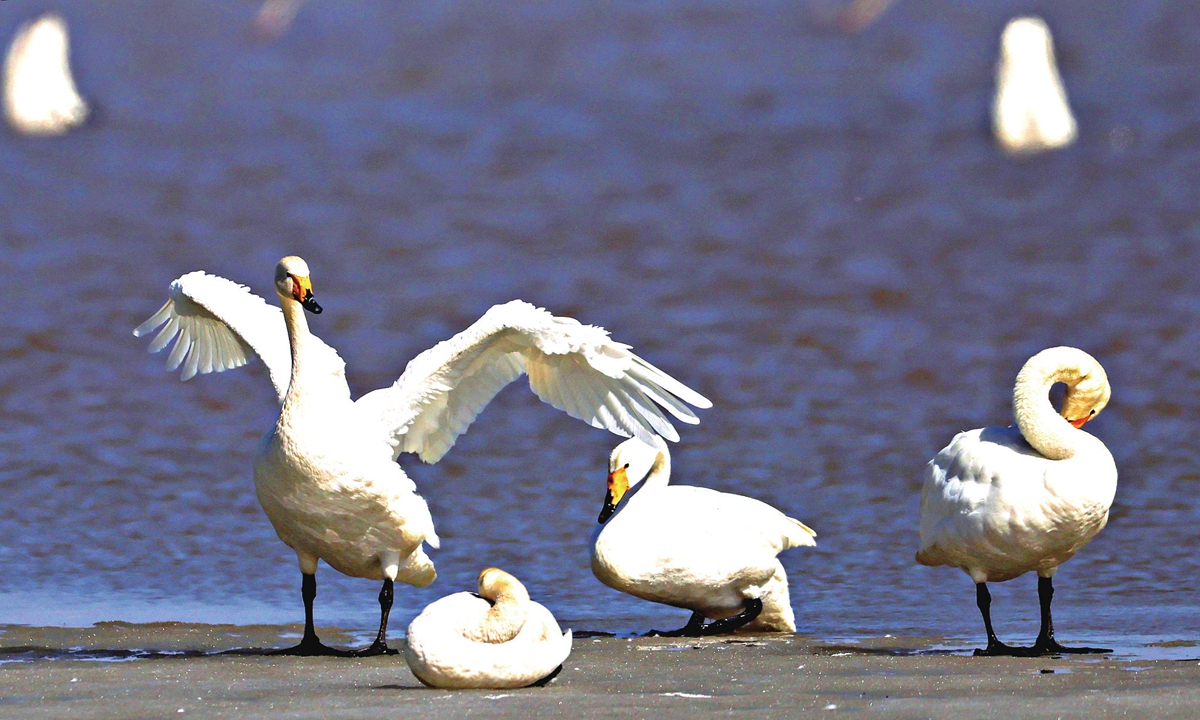
Whooper swans frolic on the shore of the Guanting Reservoir Wetland in North China's Hebei Province on March 15, 2026.
Improving mechanismsBeijing's Yanqing district, along with Zhangjiakou City and Huailai county in Hebei Province, have deepened collaborative governance and improved cross-regional protection mechanisms.
Beijing-Hebei Yihu Guanting Reservoir Liaison Station, a cross-regional procuratorial and ecological protection coordination station, was established in summer 2026 at the Beijing Guanting Reservoir Management Office.
The move effectively streamlines the entire process of tracking down the source of cross-regional ecological damage and completing restoration, constructing a governance model of integrating legal supervision, restoration and comprehensive governance across the entire region.
The Guanting Reservoir spans Beijing and Hebei, and in the past, difficulties in cross-regional law enforcement coordination and fragmented ecological governance were long-standing governance challenges.
To break through the governance dilemma of "one reservoir spanning two provinces," Beijing and Hebei have broken down administrative barriers and innovated a cross-regional ecological protection mechanism.
Wang Qi, head of the Public Affairs Section of the Beijing Guanting Reservoir Management Office, introduced that the office has collaborated with judicial, public security, and local departments in Beijing and Hebei to establish a multi-platform system.
At the same time, an ecological protection compensation mechanism upstream of the reservoir has been improved.
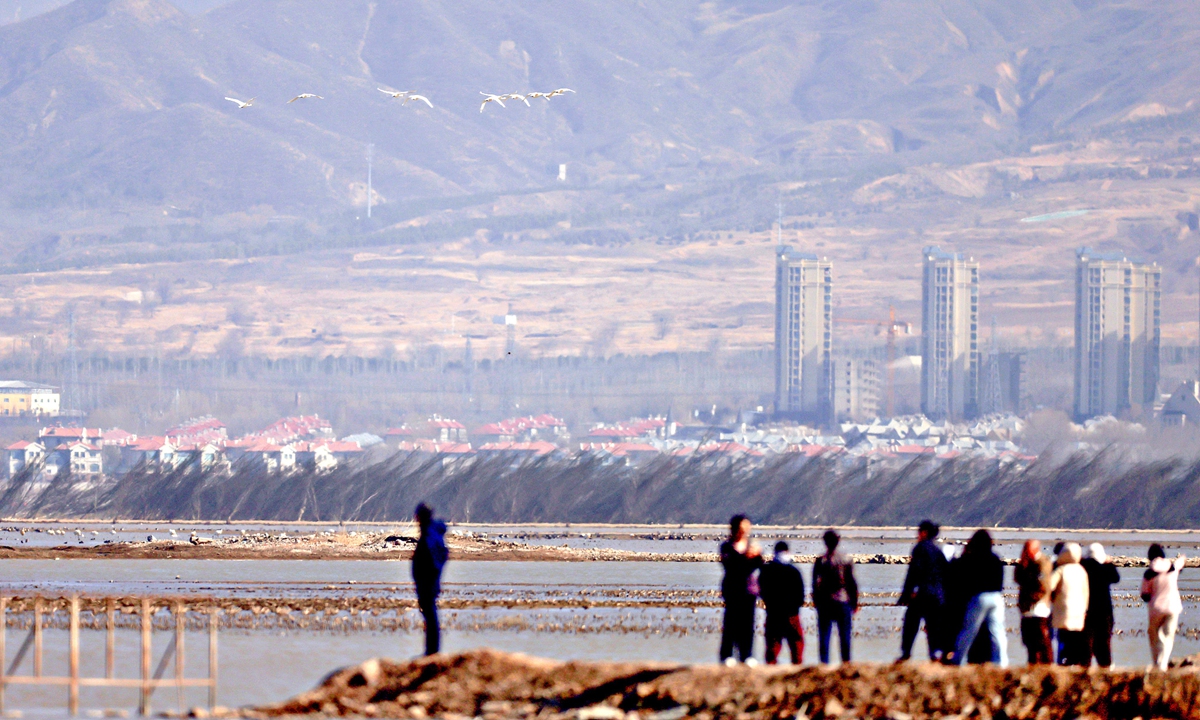
Birdwatching enthusiasts watch the whooper swans in the Guanting Reservoir, North China's Hebei Province on November 11, 2026. Photos: VCG
Joint protectionTo maximize the protection of the migratory birds' habitat, the Beijing Guanting Reservoir Management Office, in conjunction with the local government, has carried out a special campaign to clean up the shoreline.
The campaign has continuously cracked down on illegal encroachment on the water area, cleared up unauthorized construction along the shore, restored exposed shorelines, and reinforced ecological slopes, creating a contiguous ecological buffer zone to build a solid safety barrier for birds to rest and breed.
Through the participation of all citizens, a positive atmosphere for protecting the aquatic environment has been created.
"We leverage important occasions such as 'China's Bird-Loving Week' and 'World Water Day' to conduct regular science popularization campaigns in communities, schools, and villages," said Wang.
With the continuous improvement of the water environment and aquatic ecology, the populations of wild flora and fauna in the reservoir area are constantly being enriched. Migratory birds such as geese, ducks, and shorebirds are flocking to the area, making the bird population increasingly abundant.
To date, 218 species of wild birds have been identified in the reservoir area, with approximately 15,000 migratory birds being monitored, including over 2,000 common cranes, 452 swans, and the majority of the rest being geese and ducks.
More notably, the year 2026 saw a spectacular flock of black storks, a Class I protected wild animal in China, with 41 birds recorded at one time inhabiting the reservoir area.
Behind this flock of birds lies the continuous restoration of the reservoir's clear waters.
The Guanting Reservoir is accelerating comprehensive watershed management and aquatic ecological improvement, steadily progressing towards the goal of restoring the region as a source of Beijing's drinking water by 2035.
The story was compiled by the Global Times based on an article originally published on Page 8 of the People's Daily Overseas Edition on November 17.
RELATED ARTICLES