Chinese universities expand English course exemptions to recognize students' language proficiency
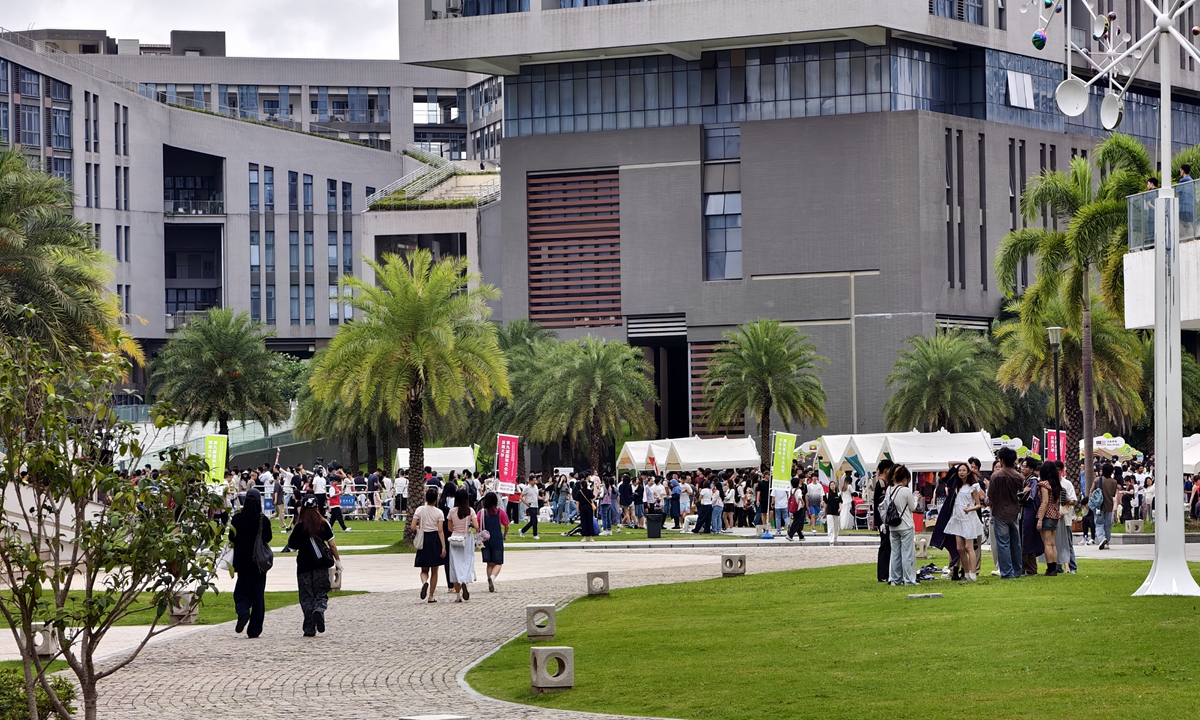
The campus of Shenzhen University in Shenzhen, South China's Guangdong Province, on May 16, 2026. Photo: VCG
Several Chinese universities are reforming English teaching by allowing students to earn course credits through language test scores and competition results, offering more flexible study options while retaining proficiency requirements. The changes have drawn public attention, with experts saying they can spare students repetitive coursework and make teaching better suited to different learning needs.
An academic affairs staff member at Jiangnan University in Wuxi, East China's Jiangsu Province, told Jiupai News on Wednesday that students could apply for exemptions using scores from the College English Test Band 4 and Band 6, known as CET-4 and CET-6, as well as IELTS and TOEFL. Students who do not meet the exemption criteria must still attend classes, the staff member said.
The clarification followed reports that the university had made college English courses elective. Other universities introducing similar arrangements include Guangzhou University and Shenzhen University in South China's Guangdong Province and the University of Shanghai for Science and Technology.
Rules published on September 20 by the official WeChat account of Jiangnan University's School of Foreign Studies set out several routes to exemptions. Alongside CET, IELTS, and TOEFL scores, students can submit results from tests of intercultural competence and international communication, or awards from English competitions.
Exemptions apply to courses in specified semesters, with course grade points determined by the results submitted. Under the rules, eligible students with an IELTS score of 7.5 or above can be exempted from college English in their third and fourth semesters and receive the maximum grade of 4.0 for each course.
The University of Shanghai for Science and Technology and Shenzhen University also issued notices in September allowing qualifying language scores to count as college English course grades. The Shanghai university lists seven English courses covered by its arrangements, including college English, academic English reading and writing, and academic English listening and speaking.
Its policy extends to other foreign languages. Students can use Japanese-Language Proficiency Test N1 results or J.TEST A-C test results for Japanese course recognition, while German qualifications include the Goethe-Zertifikat, TestDaF, and the German Language Diploma, or DSD. An N1 score of at least 170 can be recognized as a Japanese course mark of 95, while a Goethe-Zertifikat C1 qualification can be recognized as a German course mark of 95.
The changes have won support on social media but also prompted concerns that universities are reducing the importance of English, according to Chinese media reports.
The universities have made clear that exemptions are based on students' actual language proficiency, Xiong Bingqi, director of the 21st Century Education Research Institute, told the Global Times on Thursday.
Students who have demonstrated the required proficiency through CET-4, CET-6, IELTS, or TOEFL should not have to repeat courses covering material they have already mastered, Xiong said. Recognizing that ability through exemptions and credits allows them to devote more time to subjects that interest them and areas of their major requiring deeper study.
The standards remain in place, he stressed. Students whose results fall below the required thresholds must still take English classes, complete assessments, and earn the necessary credits. Such exemptions allow teaching to accommodate different starting points through flexible, competence-based arrangements, he said.
Those differences can emerge well before students enter university. Some have already developed strong English skills in middle or high school, making instruction tailored to different proficiency levels necessary, Ding Changfa, an associate professor in the Department of Economics at Xiamen University, was quoted by Chinese media outlet Yicai as saying.
Ding also pointed to the impact of artificial intelligence on how languages are used and learned, saying university English teaching needs to adapt to these changes.
As universities seek to train people with skills spanning different disciplines, their teaching should evolve accordingly, Ding said. For English courses, differentiated instruction can help shift the emphasis from language knowledge toward the ability to use English in professional settings, bringing learning closer to the needs of economic and social development.
RELATED ARTICLES