'Once you come, you are a Shenzhener': How China's tech hub is making newcomers feel at home
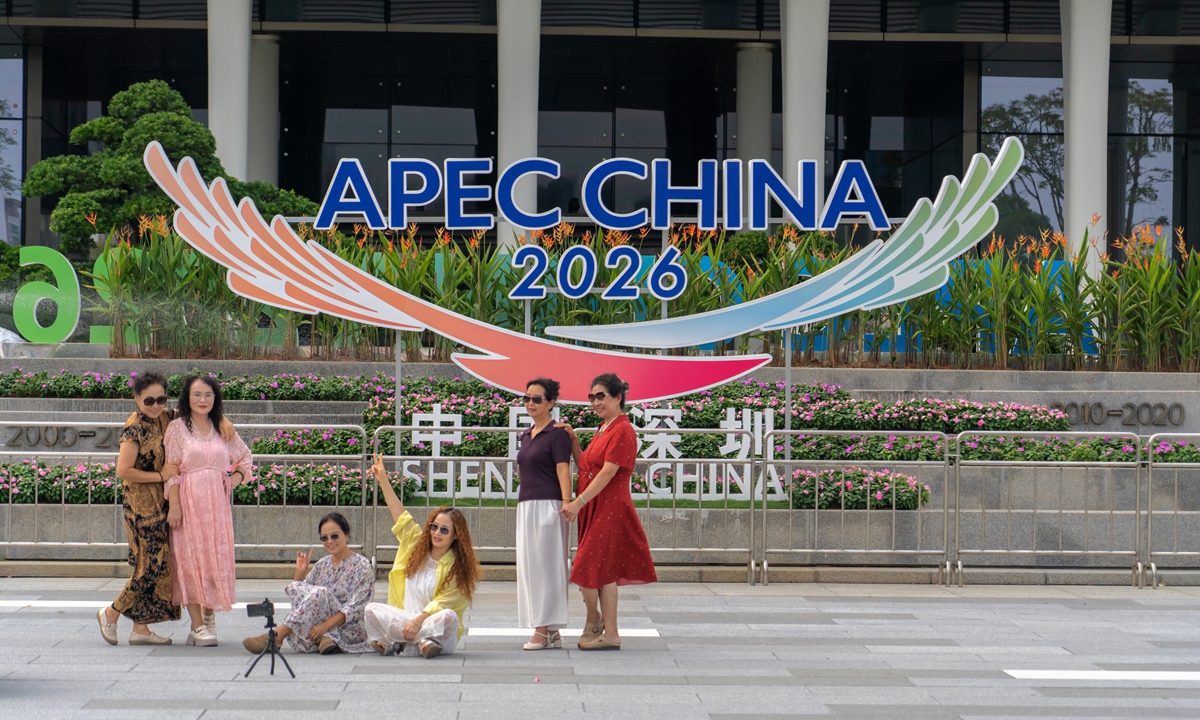
Residents and tourists take photos at an APEC-themed installation outside the Qianhai International Conference Center in Shenzhen, South China's Guangdong Province, on October 28, 2026. Photo: VCG
As the spotlight of the 33rd APEC Economic Leaders' Meeting turns to Shenzhen in South China's Guangdong Province, one phrase captures the character of the city: "Once you come, you are a Shenzhener."
More than four decades ago, Shenzhen was a border area surrounded by farmland and mangroves, facing the Hong Kong Special Administrative Region across the water. Today, it has grown into a metropolis with more skyscrapers than New York City and more than three times as many as Chicago.
Innovation is visible everywhere. Autonomous electric cabs glide through the streets, and drones deliver hot meals and iced coffee. In coffee shops, young entrepreneurs discuss business ideas in a city where the average age of residents is just 32.5.
Yet what makes Shenzhen truly compelling is not simply its impressive development figures or breakneck pace. It is the sense of belonging the city offers to people who come from elsewhere.
For Shalita Murdock, an American business communication specialist who has lived in Shenzhen for 10 years, this feeling is closely connected to the convenience of everyday life and the city's openness.
Sharing her experiences in Futian district, where some of the major APEC events are being held, she compared daily services in China and the US. Online shopping platforms such as Taobao offer a wide range of products, while return policies and doorstep pickup services make online shopping more convenient and less risky. A manicure in Shenzhen costs around 198 yuan ($30), far below the roughly $80 she would pay in California. Such affordable services have even attracted customers from neighboring Hong Kong.
But what touched her most was not a technological innovation. It was a photo wall at a small bar in her community.
Covered with snapshots of the lives of foreign residents in Shenzhen, the wall captures birthday celebrations, live music performances, Thanksgiving dinners, chess games and Spring Festival gatherings. On a nearby map, pins mark residents' places of origin, from Europe and Africa to South America and the US West Coast. Even those who have not submitted photographs can mark their hometowns.
"These images not only capture happy moments, but also tell the stories of community members and showcase the vitality and cultural integration of the community," Murdock said.
Such a sense of belonging is not exclusive to international residents. It is also reflected in the experiences of people who have moved to Shenzhen from other parts of China.
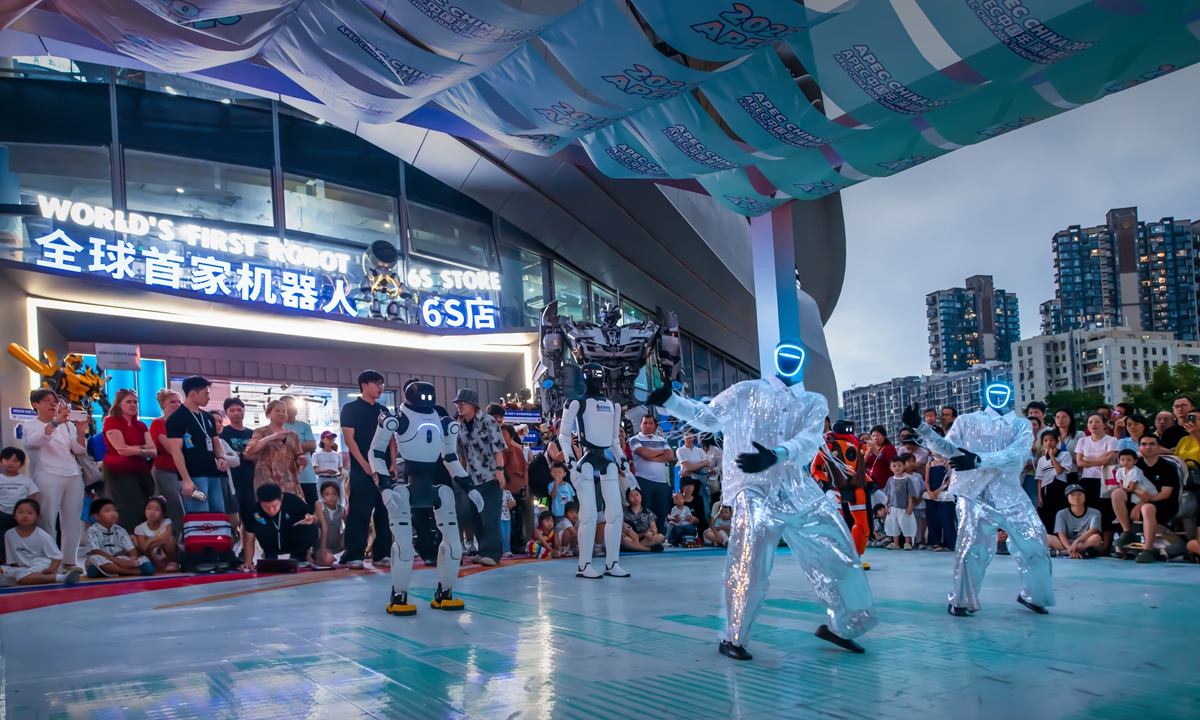
Humanoid robots perform outside the world's first robot 6S store in Bantian, Longgang district, Shenzhen, South China's Guangdong Province, on November 8, 2026, attracting crowds of local residents and tourists. Photo: VCG
Chen, a local taxi driver originally from Central China's Hunan Province, told the Global Times how Shenzhen had given his family the opportunity to put down roots. After moving to the city more than a decade ago, he obtained a residence permit and used a rental housing certificate to apply for his child's admission to school through the city's points-based admission system.
His child went to school in Shenzhen from primary school through high school. During the child's primary school years, the family also received education subsidies of 3,500 yuan per semester, totaling 7,000 yuan a year.
"I'm truly grateful to the Shenzhen municipal government. The city has given my family a real sense of belonging and a place to put down roots," Chen said.
For Jay, a Russian comedian who has lived in China for 13 years, feeling at home in Shenzhen also means knowing that problems can be addressed quickly, allowing him to focus on his work.
"I would highlight efficiency, and especially in my type of work, because when you're dealing with shows there's stuff getting lost, getting broken down, it just happened yesterday. But within 15 minutes, everything was checked and cleared. We started on time," he told the Global Times.
For American social media influencer Jax and his family, Shenzhen has also challenged many of their preconceived ideas about China. Drone deliveries and mobile vending machines that drive right up to customers were among the innovations that surprised them the most.
"What we were taught as kids about China as a whole is completely opposite to what our in-person experience has been - the safety, how clean it is," Jax said.
For newcomers like Jax, such everyday encounters can turn curiosity into familiarity, making an unfamiliar city feel comfortable and welcoming. More broadly, Shenzhen's openness is reflected in the opportunities it offers people from different backgrounds to pursue their ambitions, build connections and make the city their own.
Shenzhen's appeal has also caught the attention of international visitors and social media users. During a visit to the city, Spanish political scholar Santiago Armesilla wrote on social media that he wished Spain had a city as prosperous as Shenzhen.
"I want this for the entire Spanish- and Portuguese-speaking world. I want this for my Spain," he wrote on X on October 29.
From farmland to skyscrapers, Shenzhen has written a remarkable story of rapid development. But its deeper appeal lies in how it enables people from different backgrounds to take part in its growth and share its opportunities.
Here, belonging is not an identity imposed on newcomers. It grows naturally from everyday convenience, safety, opportunity and human warmth.
Shenzhen is still moving forward. And those who choose to join its journey, wherever they come from, are helping write the story of a city that is more than a place to live and work - it is a place they can call home.
RELATED ARTICLES