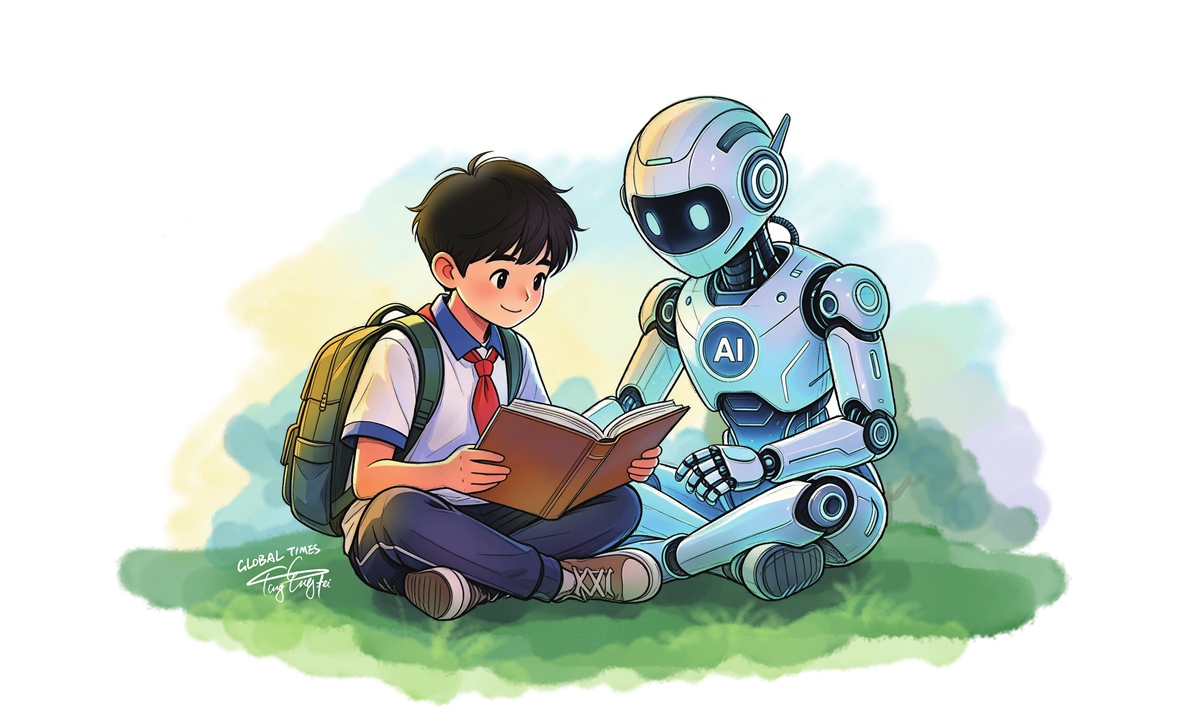
"AI is a helper, not a substitute for thinking." Illustration: Tang Tengfei/GT
Foreign media outlets have picked up on something happening in Chinese schools. China intends for nearly 200 million primary and secondary students to be broadly AI-literate by 2030. Close to half of its provincial-level governments have already issued relevant plans, such as a minimum of 30 class hours a year, dedicated AI demonstration schools, and so on.
When overseas readers encounter a 13-year-old who has built more than 200 apps with AI, who thinks about what he is doing and can explain a business idea to investors on his own, the reaction is often unguarded: "These Chinese kids are going to change the world we live in."
The picture is undeniably heartening. Why can a society take up a disruptive new technology this smoothly, and how does it bring that technology genuinely into everyday life?
Technology never colonizes daily life on its own. It arrives from the top down and has to be met halfway. It also grows from the bottom up, like a sapling, and the surrounding soil has to be able to hold it.
Adolescents who are willing to tinker are the quickest to pick up a new tool, and they are also the ones who will inherit the rules and the order that eventually govern it — and rewrite them. What they understand about this technology now will, over time, harden into the common sense of a generation, and that common sense will in turn determine where AI sits in a society and what shape it takes.
AI literacy is an education question aimed at the future. The point is not to train students to operate tools passively, but to let them learn judgment, selection and control through use and interaction, and to get them thinking about the kind of human-machine relationship they actually want to live in.
One reason "AI in schools" has moved quickly is that schools in China remain among the most trusted public institutions. If a new technology is to go from being available to being used well, the classroom is a high-priority channel.
Everywhere else, AI mostly appears as a consumer product or a way to pass the time. Inside a curriculum, a project-based assignment or a competition, it is given a purpose. That distinction matters, because what determines where a technology goes is not the technology, but the people using it — and the institutions and values of the society they belong to. Moving early on AI education is a way of putting the long term inside the present.
But acceptance is not integration. Integration means a stable, balanced and sustainable educational ecosystem, and on that front a great many questions remain open. Many educators worry, reasonably, that AI will weaken students' capacity for independent thought. If a machine can produce an answer in seconds, where exactly does education stand?
My answer is that it does not stand in the model. It stands in what we are trying to grow in a person. What makes a human irreplaceable is not the volume of knowledge stored in the head. It is the ability to formulate a question, the judgment to test whether information is true, the resilience to keep working through a problem that is not resolved easily, and the capacity for empathy, collaboration and sheer perception of the world.
AI can support those things. It cannot hold them on the user's behalf. Putting AI into schools is a technological change, but it is forcing education to recalibrate what it is for: from knowing to judging, from remembering to asking, from skills to character, and from understanding to inventing.
"AI is a helper, not a substitute for thinking." That line comes from the 13-year-old mentioned earlier, and it captures a healthy instinct now forming among young people: humans set the direction, machines do the work. Boundaries of that kind are not built through lectures. They are built slowly, through repeated practice and through getting things wrong. This is also where a society's maturity toward new technology shows itself — neither worshipping it nor fearing and walling it off. Once the idea settles, the position and the relationship settle with it.
The current push on "AI plus education" reflects a consistent approach to new things: the conviction that real knowledge comes from practice, and an interest in what all this implies for the technological civilization of the future.
It should not loosen the baseline safeguards. Student data protection, protection of attention, the drawing of clear human-machine boundaries — the rules around these need to be specified and made legible at the same pace.
China's younger generation is bound to have a place in the process of changing the world. How they change it will depend, to a large degree, on what kind of world we hand them now. Popularizing a technology is not difficult for a society. Maturing a technological civilization takes much longer.
Putting AI into schools is not only about producing a generation that can use it. It is about cultivating, across the whole of society, the habit of living alongside new technology over the long term. That mature way of coexisting with machines is the part others cannot easily copy — and the most valuable thing a society can accumulate for the long run.
The author is a professor of Chinese language and literature at Peking University.
RELATED ARTICLES