Chinese scientists lower ceramic film making temperature by over 1,000 C, to facilitate better, longer-lasting clean energy
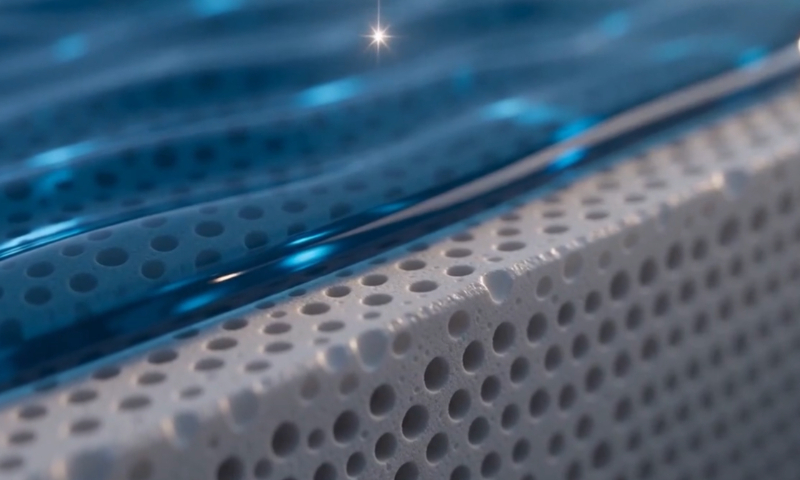
A concept photo of making ultra-thin ceramic film Photo: Dalian Institute of Chemical Physics of the Chinese Academy of Sciences
Chinese researchers have developed a new method to manufacture ultra-thin ceramic films used in clean-energy devices such as fuel cells, hydrogen production equipment and solid-state energy systems. The new method works at just 600 C - more than 1,000 C lower than the traditional process.
The films are critical components in next-generation energy technologies. Because the new technique uses far less heat, it reduces damage to the material, improves device reliability and lifespan, and opens the door to combining ceramics with other heat-sensitive materials that previously could not be processed together, the Science and Technology Daily reported on Monday, citing the research team.
The breakthrough was achieved by a team led by Yang Weishen and Zhu Xuefeng at the Dalian Institute of Chemical Physics of the Chinese Academy of Sciences. They developed a "liquid-phase growth" (LPG) method that allows the ceramic film to form naturally in a liquid environment, similar to how seashells and bones grow in nature, rather than forcing ceramic powder particles together under extreme heat.
Traditional methods require temperatures high enough to melt or sinter materials with melting points near 2,700 C. That intense heat often causes chemical elements to evaporate, creates uneven composition, and triggers unwanted reactions between the film and its supporting base - all of which can shorten the life of fuel cells and other devices, the research team said.
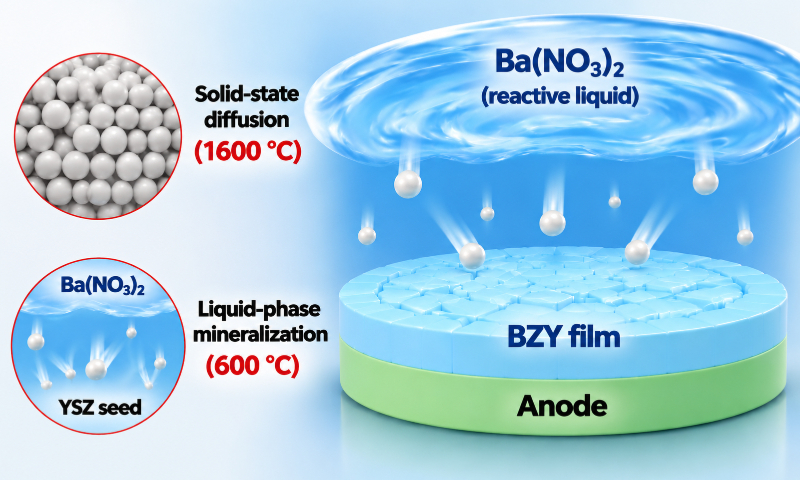
A graphic of producing uniform yttrium-doped barium zirconate (BZY) films. Photo: Dalian Institute of Chemical Physics of the Chinese Academy of Sciences
With the new approach, the team successfully made dense and uniform films of a key proton-conducting ceramic at only 600 C. They later refined the process to produce thicker films that are larger at 800 C and succeeded also on metal surfaces, laying the foundation for large-scale real-world manufacturing.The technique has already been extended to other types of ceramics and can create multi-layer films with different compositions in a single step. Laboratory tests in fuel cells confirmed that the films work effectively.
"This result will have a positive impact on hydrogen energy, advanced electronic devices and solid-state energy technologies," said Zhu, adding that the lower temperatures not only protect materials but also give engineers greater freedom to design more complex and efficient clean-energy devices.
Global Times
RELATED ARTICLES