Photo: Screenshot from Sina Weibo
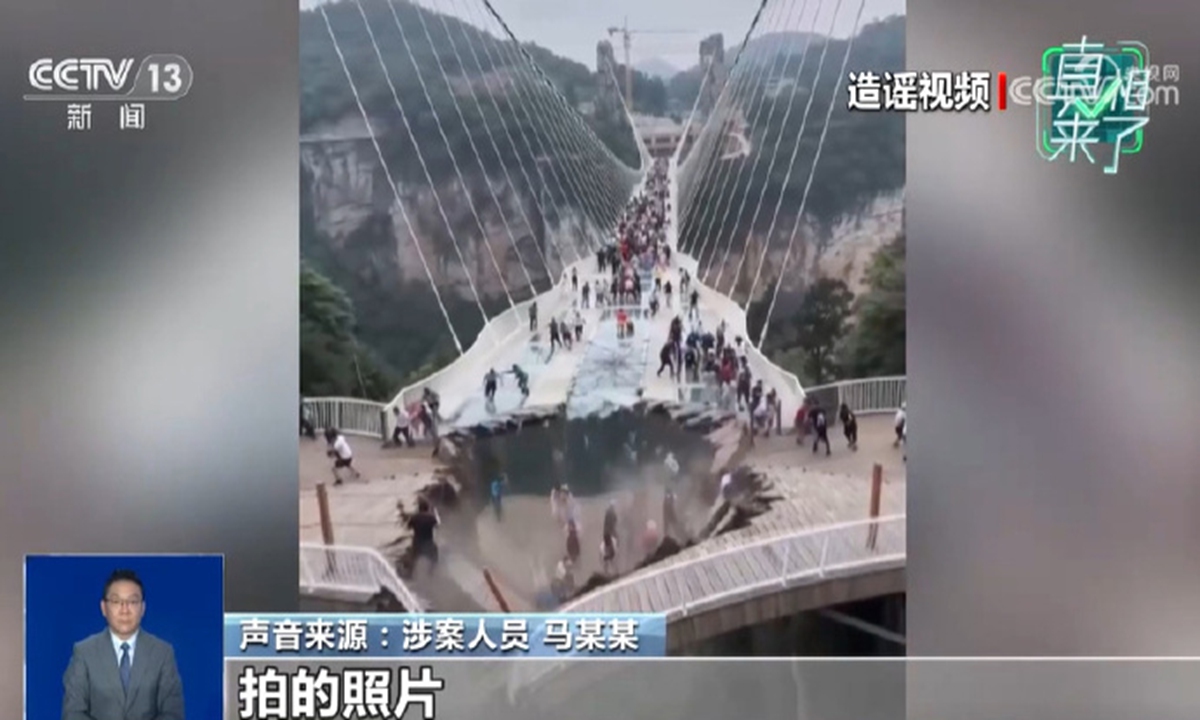
The cybersecurity bureau of China's Ministry of Public Security (MPS) on Tuesday released 10 typical cases involving the fabrication and spread of AI-generated online rumors in 2026, including a fake video showing the Zhangjiajie Grand Canyon glass-bottom bridge suddenly collapsing. The cases were released as part of the authorities' ongoing efforts to crack down on online rumor-related offenses as part of the "Clean Internet 2026" campaign.
One of the cases involved an internet user surnamed Ma who used AI tools to fabricate a video showing the glass-bottom bridge at Zhangjiajie Grand Canyon in Central China's Hunan Province collapsing, in an attempt to attract attention, gain followers and drive online traffic. The video falsely depicted the bridge breaking apart and people scattering and fleeing in panic. Ma accompanied the video with the caption "There's no need to go out for fun unless you have to. It's safer to stay at home." The video sparked public panic and disrupted public order. Local public security authorities have taken criminal compulsory measures against Ma in accordance with the law.
In another case, an internet user surnamed Han used AI tools to create and post fake images and videos of himself wearing a police uniform, against a backdrop of police insignia and vehicles, in an attempt to attract attention, gain followers and drive online traffic. The content misled internet users, disrupted public order, and had a negative social impact. Local public security authorities have taken criminal compulsory measures against Han in accordance with the law.
A netizen surnamed Shu used AI tools to generate a fake video depicting a production line for toxic, artificially produced rice in Central China's Hubei Province, in an attempt to attract attention. The video spread fabricated food-safety rumors, causing public panic and disrupting public order. Local police have imposed administrative penalties on Shu.
Another case involved an internet user surnamed Sun who used AI tools to fabricate false information about a case in which authorities had seized smuggled rare earths worth 4.6 billion yuan ($690 million) in Lianyungang, East China's Jiangsu Province, in an attempt to attract online traffic. The false information spread across multiple online platforms, misleading the public and disrupting public order. Local police have imposed administrative penalties on Sun in accordance with the law.
An internet user surnamed Wang used AI to fabricate screenshots of social media posts impersonating an entertainer in an attempt to express personal dissatisfaction. The fake posts, written in the entertainer's voice, expressed discontent and falsely claimed that a performance had been called off. The content had a negative impact and disrupted public order. Local police have imposed administrative penalties on Wang.
In another case, a netizen surnamed Xing used AI to use a public figure's likeness in livestream sales on an online platform without authorization, in an attempt to attract online traffic. The unauthorized use misled internet viewers and caused serious adverse impacts. Local police have imposed administrative penalties on Xing.
Global Times