GT Voice: Huang’s return to Nvidia won’t slow China’s pursuit of chip self-reliance
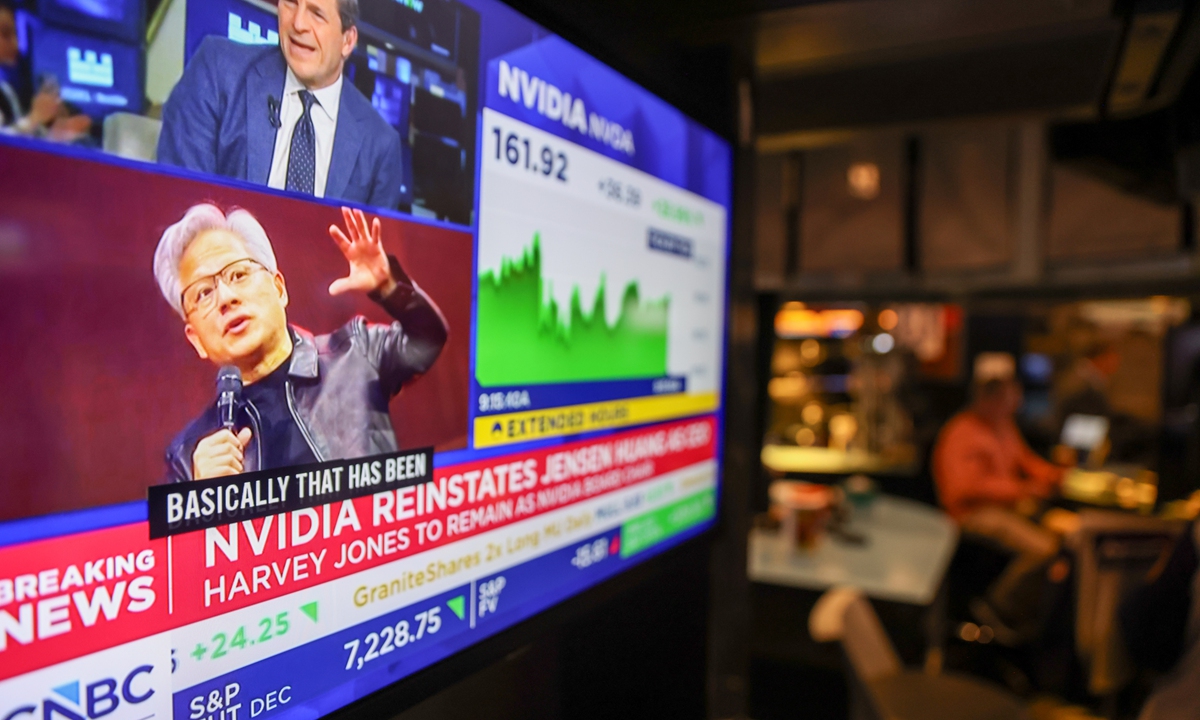
A television broadcasts Nvidia news on the floor of the New York Stock Exchange (NYSE) in the US on November 23, 2026. An overnight bounce in stocks erupted into a surge after Nvidia's reinstatement of Jensen Huang as chief executive officer recharged artificial-intelligence bets. Photo: VCG
In a surprise move, Nvidia's board reinstated Jensen Huang as president and CEO on Monday, sending the company's shares soaring about 30 percent in premarket trading. The rally was a striking measure of the value investors attach to Huang's return, their rejection of earlier allegations that he had been "infiltrated by Chinese spies," and their lack of confidence in the changes Nvidia had made over the previous two weeks.
Over the past two weeks, Nvidia has established a new committee to oversee national security and export control compliance. Alongside other developments, this has turned what began as a personal crisis involving the CEO into a broader examination of Nvidia's corporate governance, its China business, and exposure to US "national security" concerns, adding to the burden on a company already navigating an increasingly complex political and regulatory environment.
The twists and turns surrounding Huang's departure and return expose a growing problem in US politics: national security concerns being inflated and weaponized in US domestic political battles, with serious economic consequences. Unsubstantiated speculation involving China can quickly become ammunition in political infighting, fueling fear and turning ordinary business and technology issues into political flashpoints.
This is hardly the first time national security has been invoked as a political weapon in the US. But the repeated reversals in Huang's case lay bare the absurdity of this approach. The abuse of national security rhetoric risks becoming a poison in the development of the AI industry the US is so keen to lead. Its consequences could extend well beyond the US, unsettling global supply chains and creating uncertainty for economies such as South Korea and those in Southeast Asia that are deeply embedded in the semiconductor and AI industries.
Huang's reinstatement is unlikely to silence his opponents. Over the past two weeks, Washington has tightened restrictions on China's access to advanced US chips. Huang's return may ease the immediate uncertainty surrounding Nvidia, but it will not erase the consequences of the episode. Nor is the political battle likely to be over; it may simply continue below the surface. The damage caused by the politicization of national security to Nvidia and the broader US AI industry will not disappear with the return of its CEO.
China's high-tech industry will not mistake Huang's reinstatement for a sign that the US is about to ease its chip controls or stop using national security as a pretext for policies that threaten to disrupt global supply chains. The development of China's AI industry must be underpinned by stronger indigenous technologies, the capacity to manufacture advanced chips at scale, and a robust semiconductor industry spanning the value chain.
RELATED ARTICLES