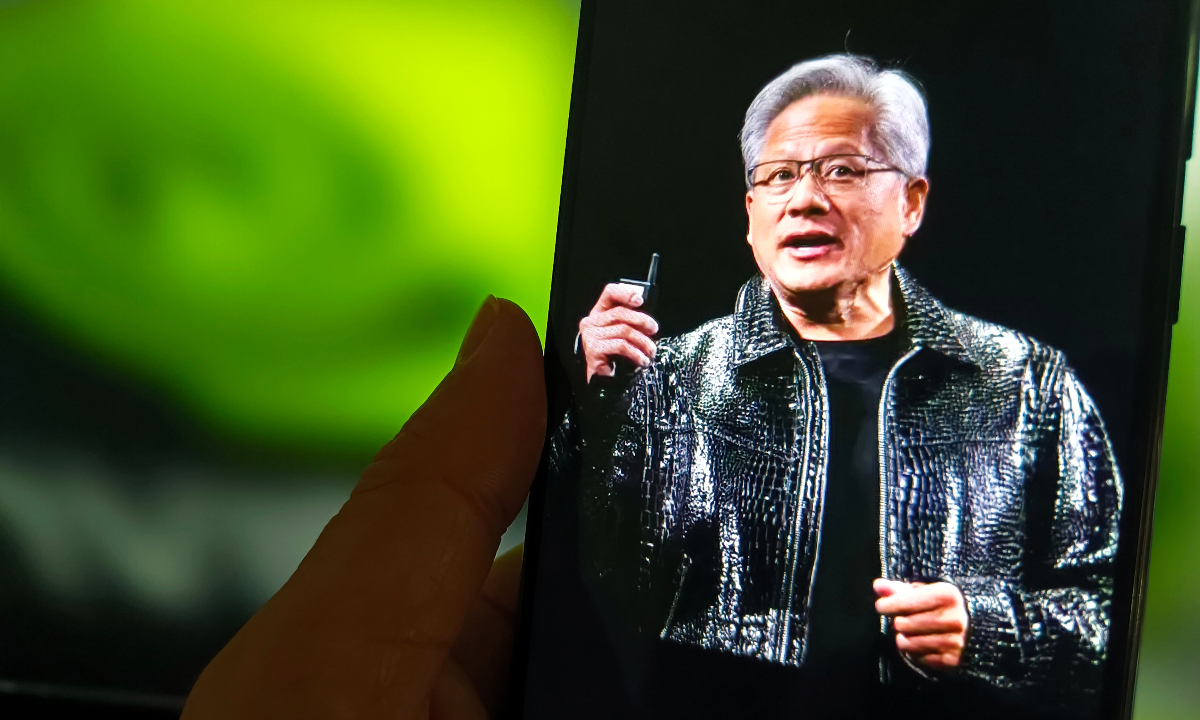
Jensen Huang. Photo: VCG
Eleven days ago, almost no one would have imagined Jensen Huang walking away from Nvidia. Eleven days later, he was back - in a way few could have predicted - reclaiming his place at the very center of the company's power structure.
In the space of just eleven days, certain American media outlets and politicians turned the episode into a Hollywood-style spectacle, complete with gossip, conspiracy theories, and political maneuvering.
And then? Huang is back, "posing no national security risk." "Is it a threat to have him? No, it's a threat to lose him," the US President said, defending the return.
Some Western media outlets spent weeks digging up dirt on him, branding him a "spy," and portraying him as a deeply troubled figure — both personally and professionally. They may be having a hard time explaining what happened next. There he was: Jensen Huang, strolling back into Nvidia headquarters in a dark blue jacket, greeted by cheering employees, a forest of raised phones, and thunderous applause.
The Financial Times struck a sour note, casting Huang's return as "a triumph of money over morals."
But is that really what happened? Huang's fate was never simply a matter of personal conduct. His future became a pawn in a much bigger game - one involving elections, political infighting, semiconductors, and geopolitics. He made his way back because, after all the political maneuvering and calculations, one thing became clear: The so-called spy allegations, entirely fabricated out of thin air, are nothing more than a political witch hunt; Nvidia and US AI industry still need him.
While certain politicians in Washington scramble to carve up the AI compute pie, Silicon Valley's engineers have sent a very different message through their applause: Politics may create enemies, but technological competition is ultimately won through real-world capabilities.
You don't win the AI race through political witch hunts or a never-ending expansion of export controls. You win by keeping the people who know how to build, innovate, and deliver. Those invoking "national security" may have plenty to say about GPUs. But the people who actually design and build them know what it takes to stay ahead in the AI race.
The Huang episode has also given global markets a fresh and sobering perspective on the relationship between business and government in the US, the country's business climate, and how corporate power really works.
In America, the fate of tech companies is never determined by market forces and technological prowess alone. It is deeply intertwined with politics, making even the biggest companies vulnerable to partisan battles, geopolitical rivalries, and political maneuvering.
Even for a company as powerful as Nvidia, who really gets to decide something as basic as whether the CEO stays or leaves? After this episode, companies and investors around the world may need to rethink what they thought they knew about doing business in the US, how corporations and government interact, and what corporate independence actually means.
Huang is back, but the storm is far from over. More hearings and investigations are on the way and the winds of McCarthyism are still blowing. This farce has shown just how unpredictable and politicized the US business environment has become, and it has given China a clear reminder. Every restriction, political intervention, and so-called national security review Washington has imposed on China's tech industry only reinforces the same lesson: China has no choice but to accelerate its drive for technological self-reliance and build a fully integrated, independent semiconductor supply chain.
What is China's takeaway from Jensen Huang's saga?
A clearer view of the absurd relationship between American politics and technology - or, more simply, another episode of the American political soap opera.
RELATED ARTICLES