First batch of 300 container flatcars handed over in Dalian for TAZARA revitalization project in Africa
By Published: Nov 24, 2026 05:00 PM

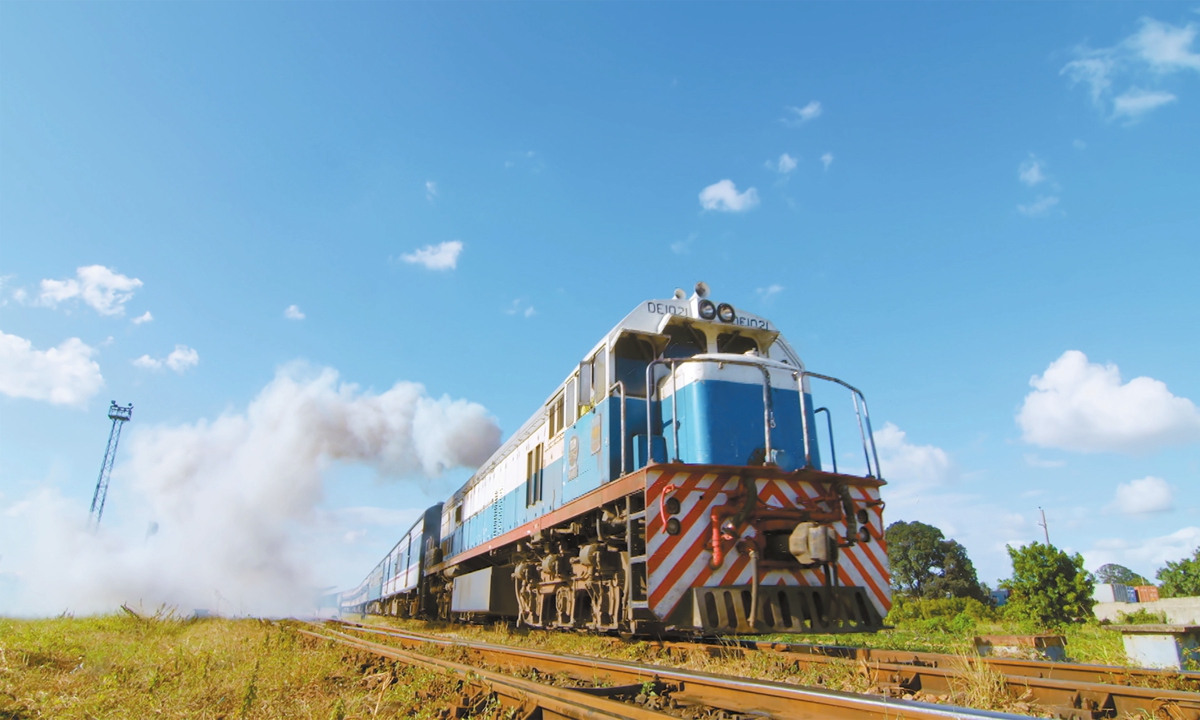
A train travels along the TAZARA Railway on November 19, 2025. Photo: Courtesy of CCECC
The first batch of 300 railway container flatcars needed by the Tanzania-Zambia Railway (TAZARA) revitalization project was handed over to the TAZARA Revitalization Project Company in Dalian, Northeast China’s Liaoning Province, on Tuesday, ready to sail across the ocean soon. It marked a landmark milestone as the iconic railway project under the Belt and Road Initiative (BRI) enters a substantive implementation phase.
The smooth delivery of the new equipment will effectively address the project’s hardware bottlenecks in transport capacity, laying a solid material foundation for restoring TAZARA’s freight capacity and advancing an integrated “mine-railway-port” operating system, according to a statement the China Civil Engineering Construction Corporation (CCECC)—the Chinese contractor leading the railway’s revitalization, sent to the Global Times on Tuesday.
Freight wagons serve as the core equipment guarantee for railway cargo operations. Under the project plan, a total of 760 container flatcars are being procured for the entire TAZARA line. The 300 units handed over on Tuesday will be prioritized for shipment so they can arrive early at the port for commissioning, helping accelerate the schedule and lay a solid hardware foundation for the line’s full launch and regular operations.
Designed to transport diverse cargo including containers and engineering materials, the new flatcars feature a lightweight, modular design that combines low tare weight with high payload capacity and structural reliability. Balancing operational stability with ease of maintenance, the vehicles have reached world-leading levels in both transport performance and lightweight indicators.
On November 20, 2025, a groundbreaking ceremony for the TAZARA revitalization project was held in Lusaka, Zambia. The TAZARA stretches 1,860.5 kilometers from Dar es Salaam in Tanzania in the east to New KapiriMposhi in Zambia in the west. The railway was jointly built by China, Tanzania and Zambia. It began construction in 1970 and was completed and handed over in 1976. This year marks the 50th anniversary of its opening to traffic.
Long regarded as a cross-border logistics lifeline in East Africa, TAZARA has been constrained by aging equipment and chronic capacity bottlenecks. Against the backdrop, the revitalization project adopts a 31-year concession public-private partnership (PPP) model to build an integrated “mine-railway-port” operating system. The initiative aims to steer the decades-old railway toward market-oriented and sustainable operations.
With the 760 flatcars forming the core capacity backbone of this system, the TAZARA revitalization project is accelerating from blueprint to reality. Once the revitalization work is completed, the railway is expected to “fully unleash its freight potential, bolster East African connectivity and regional prosperity, and write a new chapter in China-Africa mutually beneficial cooperation, CCECC said.”
With regards to the revitalization project, the Chinese side plans to spend three years rehabilitating tracks, bridges, stations, and roadbeds along the entire TAZARA line.
And once the rehabilitation is completed, the railway’s annual freight capacity is expected to surge from the current 200,000 tons to 2.4 million tons, with freight transit time along the entire line projected to be cut by two-thirds, while transport costs are expected to be 30 to 40 percent lower than road transport, according to media reports.
RELATED ARTICLES