Breaking the 100 million mark: China’s best answer to technological throat-choking
Huawei Photo: VCG
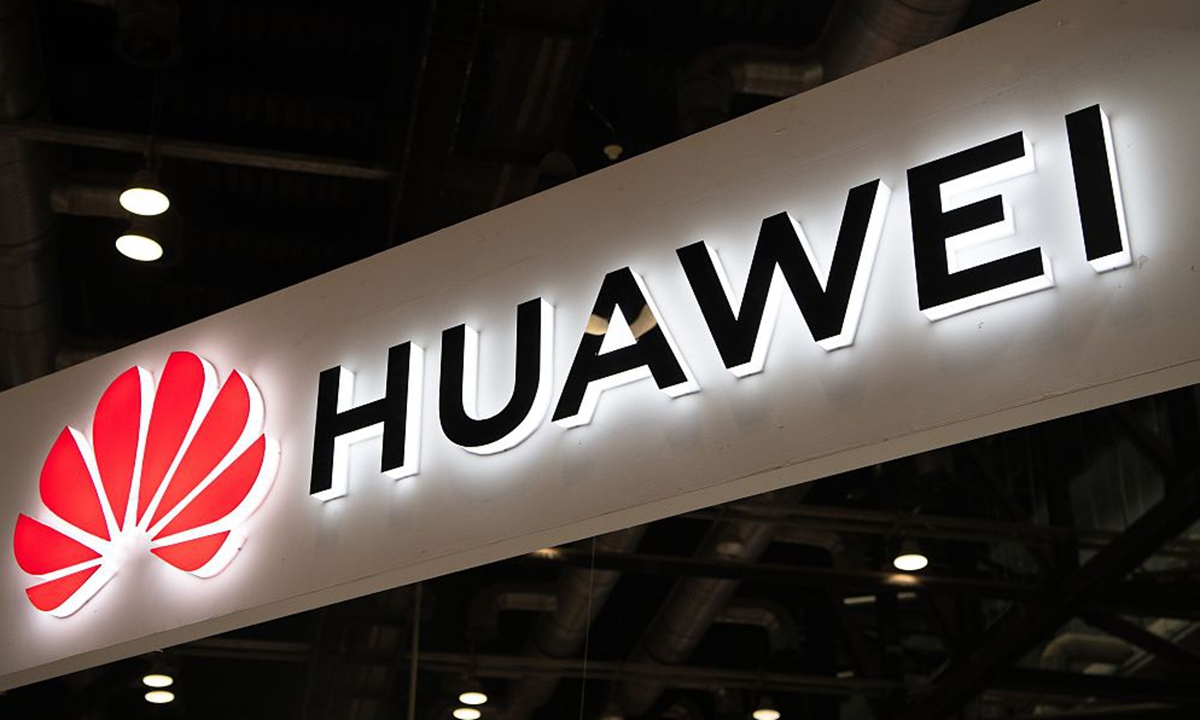
At a press conference on November 24, Huawei announced that the number of devices running HarmonyOS 5, 6 and 7, including smartphones, tablets and computers, had surpassed 100 million. This milestone puts to rest the notion that "HarmonyOS could never succeed." As is widely known, Huawei's decision to develop HarmonyOS was driven both by its long-term corporate strategy and, to a considerable extent, by US sanctions. At a time when the market was almost entirely dominated by Android and Apple's iOS, developing another operating system from scratch was widely seen as a near-impossible gamble, with many convinced that it simply "stood no chance." Yet, with the number of devices running Huawei's independently developed native architecture surpassing 100 million since the launch of HarmonyOS 5, the homegrown operating system has crossed the critical threshold of survival from zero to one and begun to enter a virtuous cycle of self-reinforcing growth.
In May 2019, the US Department of Commerce added Huawei to its Entity List. Google subsequently announced that it would suspend some business cooperation with Huawei. For a time, the world was talking about Huawei's "survival crisis." But Huawei responded with HarmonyOS. Few had imagined that, even when Android and Apple's iOS were at the height of their dominance, Huawei had the foresight to ask itself: "What if one day we could no longer use Android or Windows 8?" As early as 2012, Huawei had established a laboratory, one of whose original purposes was to develop a backup system that could be used if the company were ever cut off from supplies. Yu Chengdong, Huawei's executive director, later revealed that HarmonyOS was originally scheduled for release in the autumn of 2020, but US sanctions dramatically accelerated the process.
HarmonyOS is a microcosm of a much bigger story in China. It reflects not only the arduous journey of a company reinventing itself under extreme pressure, but also the remarkable resilience of Chinese enterprises in forging new paths through independent innovation. As of mid-2026, approximately 1,106 Chinese entities were on the US Department of Commerce's Entity List, making China the country with the largest number of listed entities for several consecutive years. By comparison, during the 14th Five-Year Plan period (2021-25), China's national-level manufacturing innovation centers achieved breakthroughs in nearly 700 key generic technologies. Of the 35 representative technologies identified as facing critical bottlenecks by Science and Technology Daily in 2018, at least 21 have since made substantive breakthroughs. An assessment by an Australian research institute of 74 advanced technologies found that China held the lead over the US in 66 of them. "1,106 vs 700" offers a vivid illustration of how external pressure has, in turn, spurred China's drive for independent innovation. More importantly, it reflects the Chinese people's refusal to be intimidated by adversity or yield to pressure, their determination to confront difficulties head-on, and their resolve to forge new paths for development through tenacious struggle.
Today, from the full integration of high-end Kirin chips across design and manufacturing to the Ascend chips breaking through foreign technological restrictions; from the domestic mass production of core hot-section components of aircraft engines to the C919 large passenger aircraft entering regular commercial service, China is turning its once-formidable list of technological throat choking, one by one, into areas of industrial strength. These leaps from nothing to something, and from catching up to taking the lead, are the most vivid proof of the vitality of Chinese modernization. They also give us greater confidence and resolve to weather turbulent times and reaffirm our belief that Chinese modernization will continue to achieve new victories through sustained breakthroughs.
RELATED ARTICLES