US politicians push stricter chip curbs on China amid Jensen Huang's return
By Published: Nov 24, 2026 06:45 PM

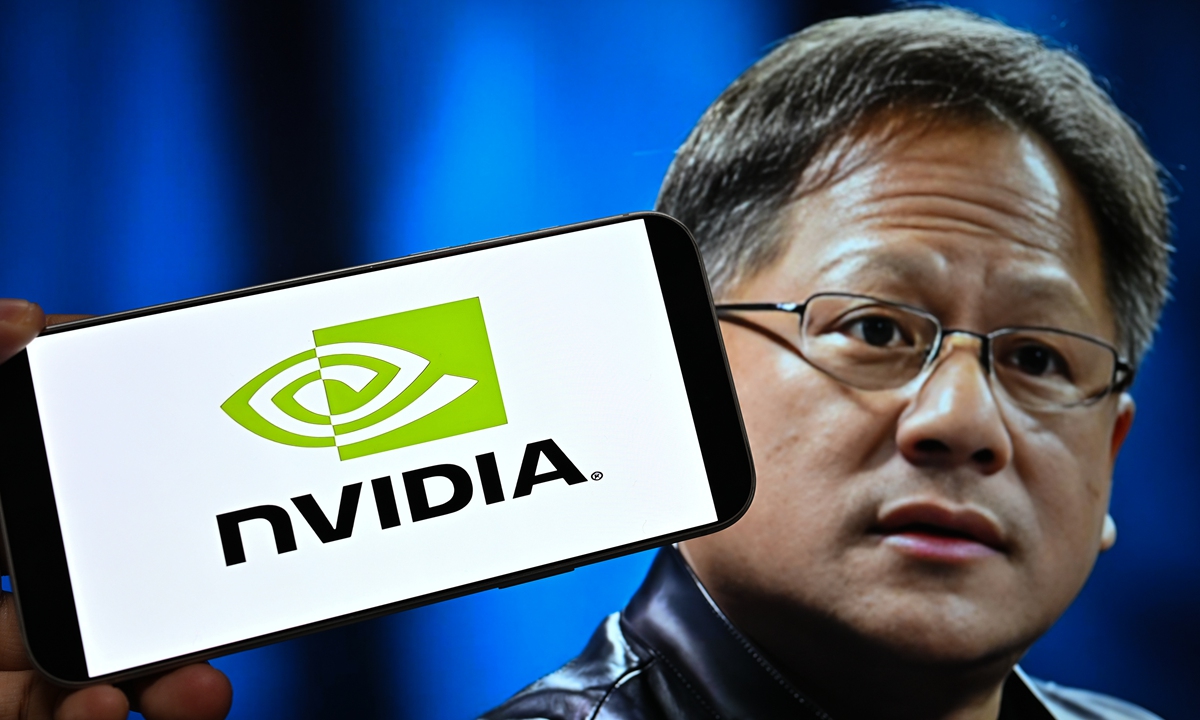
Jensen Huang Photo: VCG
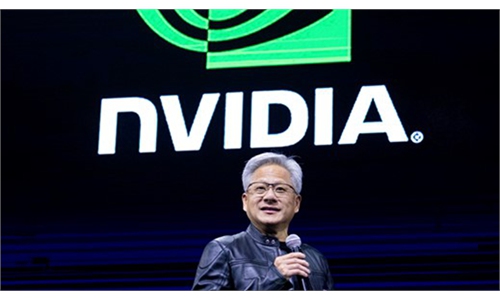
Jensen Huang's reinstatement as Nvidia CEO sent ripples through global stock markets as investors regained confidence in the artificial intelligence (AI) narrative, but it also triggered a strong backlash among some US lawmakers, many of whom seized the latest turn of events as a fresh opportunity to advance their anti-China agendas.
Amid Huang's dramatic reversal of fortunes and the rollercoaster performance of Nvidia's stock price, Chinese analysts said the real driver behind the unfolding Nvidia drama is US politicians' continued attempt to contain China's development. The so-called national security concerns and corporate governance issues are nothing but excuses - "political chips" that can be deployed or discarded as needed to push anti-China agenda.
They warned that any moves aimed at containing China's tech development are doomed to fail, and that the outright politicization of trade and economic matters will further damage predictability in the US business environment and erode its long-term competitiveness.
Ripple effect
"I want to thank all of you. I am terribly sorry for putting you through all of this… I've made some very terrible mistakes… I am going to work on coming back," Huang told a room full of Nvidia employees, according to video clips circulating on Chinese internet platforms on Tuesday.
Facing a cheering crowd, Huang bowed with his hand on his heart.
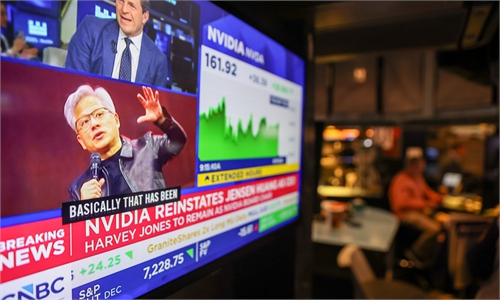
Nvidia announced on Monday that Huang has been reinstated as president, CEO and a member of the board, effective immediately. The company's stock price surged nearly 31.5 percent on Monday.
US President Donald Trump said on Monday after the corporate statement that Nvidia's board of directors had made the correct decision to reinstate Huang, according to a post on Truth Social.
"The Country needs Jensen's leadership at Nvidia in order to ensure the Success and Prosperity of not only the Company, but the American Economy. The US Government has no reason to believe that Jensen's return to Nvidia poses any risk to National Security."
Ironically, this came just 11 days after Huang stepped down as CEO on November 12, amid fierce criticism from certain US politicians and media outlets.
Huang's return was also closely watched by Chinese public. "Huang did not wear his signature leather jacket on this day," one Chinese netizen noticed. However, more people commented that the abrupt about-face regarding Huang's role amounted to stock price manipulation that caused many investors to suffer heavy losses. "It is like child's play," one netizen wrote on Sina Weibo.
Huang's previous resignation amid intense scrutiny surrounding his affair with a Singapore-based business executive, who some US media reports and officials alleged had links to Chinese intelligence. Some US officials also sought to link Nvidia's leadership crisis to Washington's chip export restrictions on China. The Chinese Foreign Ministry has dismissed the "Chinese spy" allegation as "purely unsubstantiated and directed at smearing China."
When asked about Jensen Huang's return to Nvidia, China's Foreign Ministry spokesperson Guo Jiakun said at a regular press briefing on Tuesday that "We have no comment on this."
Huang's dramatic reversal of fortunes came after a 23 percent plunge in Nvidia shares last week. By then, the company had lost nearly half its market value since its October 6 peak. Nvidia's 31 percent surge on Monday helped lift the Nasdaq by 6 percent, and the S&P 500 by 5 percent, per Reuters.
Chinese analysts said the drama surrounding the Nvidia CEO could be part of Washington's efforts to cope with a plunge in US stocks, for which Nvidia's success story is a vital pillar. It has laid bare the deepening politicization of trade and economic matters in the US and its impact on corporate governance.
"Such frequent shifts are indeed telling. First, Washington invokes national security as a pretext to suppress a specific company. Then, it appears to adjust its stance because of stock market or broader financial considerations. For businesses, this creates profound uncertainty," Zhou Mi, a senior researcher at the Chinese Academy of International Trade and Economic Cooperation, told the Global Times on Tuesday.
"What can be granted today can just as easily be taken away tomorrow - and that is what any company would fear most. National security has been reduced to a pretext, a handy tool for direct intervention in corporate affairs. This will have a deeply detrimental impact on the development of the US business environment," Zhou said.
"One has to wonder whether Nvidia's governance is now decided not inside its boardroom but in the White House - Washington weighed in, the board listened, and Huang was reinstated," Shen Yi, director of the International Research Institute of Global Cyberspace Governance at Fudan University, told the Global Times on Tuesday.
"Whatever the legal formalities, the episode suggests the US business environment and the unwritten rules of politics-business relations are being redefined," Shen said.
Political storm
The cheering on Wall Street and at Nvidia's headquarters was matched by fury on Capitol Hill, according to media reports.
According to Reuters, US lawmakers from both parties sharply criticized Nvidia's decision to reinstate Huang, with several arguing that Congress should tighten restrictions on China's access to advanced Nvidia AI chips and scrutinize the circumstances surrounding Huang's return.
A number of US politicians also used this turn of events to give a further push to their anti-China agenda.
Senate Intelligence Committee Chairman Tom Cotton on Monday called on Congress to pass the Chip Security Act, a bill seeking to address legally exported advanced chips later being diverted to China, per Reuters.
Senate Democratic leader Chuck Schumer claimed the reinstatement showed it was critical to pass legislation toughening restrictions on US chip exports to China.
Democratic lawmakers last week opened a probe into what influence Nvidia was able to wield over the Commerce Department's investigation. Some asked Huang to testify before Congress.
The US Commerce Department on Monday added Singapore-based Megaspeed, the cloud company at the center of the Nvidia scandal, to its trade blacklist, following criticism from lawmakers and administration officials.
Megaspeed, an Nvidia partner under investigation by US authorities since 2024 over whether it diverted AI chips to China, will now need Commerce Department approval to obtain US exports, which is likely to be denied, according to Reuters.
"In the face of tightening US export controls, Chinese companies have options for responding to changes in US policy, including adopting domestic solutions in areas where homegrown chips can already meet their needs," said Xiang Ligang, director-general of the Zhongguancun Modern Information Consumer Application Industry Technology Alliance. "Once customers can run their models reliably on chips from other suppliers, Nvidia's competitive advantage built through its CUDA software platform will be weakened."
"Huang's dismissal and subsequent reinstatement had little to do with him personally; they were not the result of his own capabilities or actions. He was merely a pawn in American political maneuvering, and the fundamental problems facing Nvidia remain unresolved," Xiang told the Global Times.
"Will this struggle end here? Clearly not; this political sparring is set to continue. Things are unlikely to get any easier for Jensen Huang and Nvidia. This grand political drama has not come to an end," Xiang said.
RELATED ARTICLES