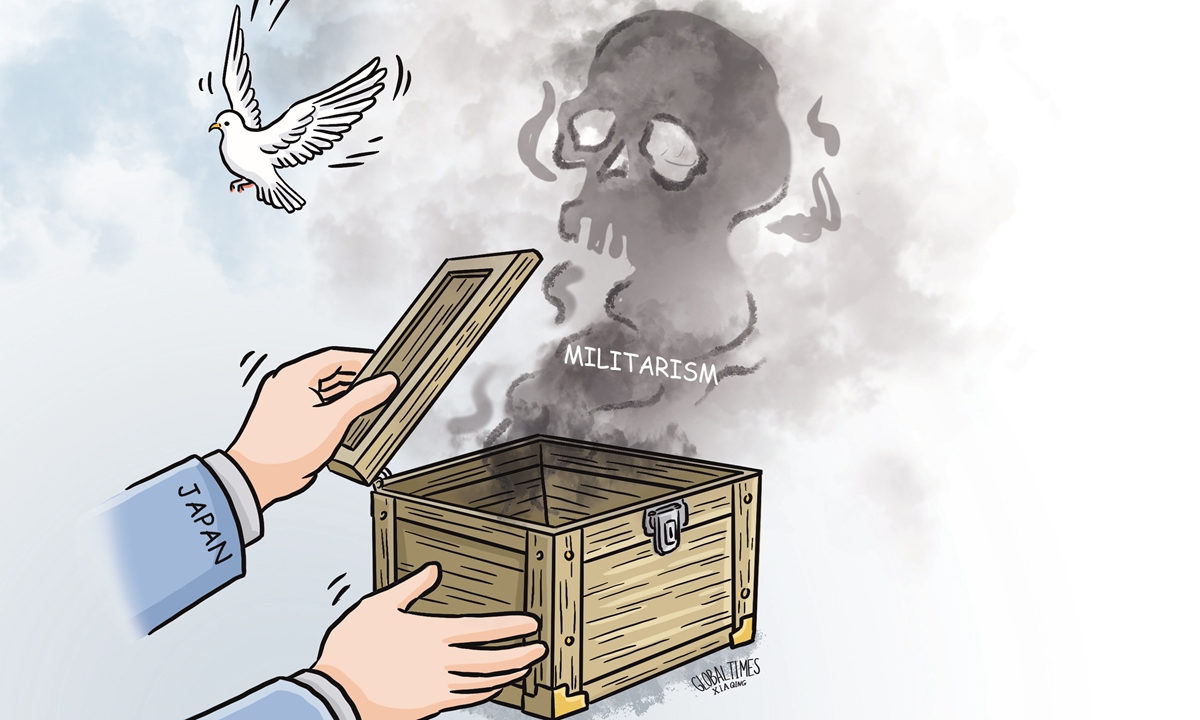
Japanese militarism Illustration: Xia Qing/GT
In the summer of 2003, at a construction site in Qiqihar city, Northeast China's Heilongjiang Province, a group of workers was excavating earth as they had done countless times before. Little did they suspect that the metal drums emerging from under the soil were laden with mustard gas - chemical agents abandoned by Japan during its invasion of China. The instant those drums were cut open for scrap, the poison burst forth. In total, 44 people were stricken and one did not survive. The youngest victim was just 8 years old. Those who survived would endure a lifetime of recurring skin lesions and relentless damage to their internal organs.
More than half a century has passed since the Chinese People's War of Resistance Against Japanese Aggression (1931-1945) ended, yet the chemical weapons buried beneath Chinese soil continue to exact a toll on the health and lives of Chinese citizens.
Any country that deliberately uses chemical weapons commits a barbaric violation of the fundamental principles of human civilization. Chemical weapons are by no means ordinary instruments of warfare. By their very nature, they are designed to inflict excruciating and often irreversible suf-fering, leaving behind physical injuries and environmental contamination that can per-sist for decades.
The Geneva Protocol signed in 1925 explicitly prohibits the use of asphyxiating, poisonous or other similar gases in warfare. However, Japan, as a signatory, went on to develop, stockpile and extensively deploy chemical agents such as mustard gas, lewisite and diphenylcyanoarsine during its war of aggression against China, causing casualties among more than 200,000 Chinese military personnel and civilians. These were not conventional acts of war, but meticulously planned and systematically carried out crimes against humanity.
Even more appalling, following Japan's defeat and surrender in 1945, it secretly buried or discarded large quantities of chemical weapons in mountain forests, rivers, lakes and marshlands in an attempt to conceal its crimes. These toxic munitions were concentrated primarily in Northeast China, particularly in the Haerbaling area of Jilin Province, where an estimated 330,000 chemical shells remain buried, while others were scattered across several other provinces. This was not the result of a hurried retreat or insufficient time for proper disposal. It was a deliberate act of abandonment.
These deadly remnants buried deep beneath the earth continue to surface unexpectedly during construction projects and agricultural land development, posing a serious threat to the lives and property of the Chinese people. According to Chinese official statistics, more than 2,000 people have been killed or injured by abandoned chemical weapons (ACWs) since the end of the war.
Under the Chemical Weapons Convention, which entered into force in 1997, and the Memorandum of Understanding on the Destruction of Japanese ACWs in China signed by China and Japan in 1999, Japan bears full responsibility for destroying these ACWs and is obligated to provide all necessary funding, technology, facilities, experts and other resources. However, over the past nearly three decades, Japan has repeatedly failed to honor its own deadlines for destroying these weapons.
Japan initially pledged to complete the destruction process by 2007, but subsequently postponed the deadline, first to 2012, then to 2016 and 2022, and now to 2027, citing a range of excuses from corrosion of munitions, technical difficulties, budgetary constraints, to missing wartime archives, uncertainty over burial locations, and even climate and environmental problems. Japan's repeated procrastination only lays bare its lack of political will to atone for its war crimes and the sinister nature of Japanese militarism.
These ACWs remain a ticking time bomb on Chinese soil. The longer their disposal is delayed, the more severe the threat they pose to the lives and health of the Chinese people and the regional ecological environment, as the risk of munitions rupturing and toxic agents leaking on a large scale increases with each passing day. If Japan is genuinely committed to eliminating this historical scourge, it must back up its words with concrete action instead of paying lip service. Any passive delay, evasion or buck-passing amounts to gambling with the lives and safety of the Chinese people and evading historical responsibility.
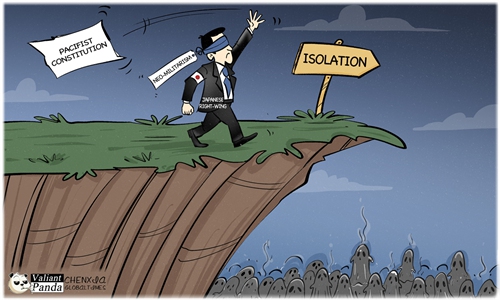
More than 80 years have passed since the end of World War II, yet Japan has still not fully disposed of the chemical weapons it abandoned in China. While dragging its feet on its international legal obligations, Japan has been increasingly brazen in glorifying its aggression, downplaying its historical crimes and remilitarizing itself. Such evasion abroad and revisionism at home are not separate flaws but two faces of the same drive to revive Japanese militarism. Until these munitions are fully destroyed, Japan can never convincingly claim to have reckoned with the toxic legacy of militarism.
The author is a commentator on international affairs, writing regularly for Xinhua News, Global Times, China Daily and CGTN. He can be reached at xinping604@gmail.com.
RELATED ARTICLES