ARTS / ART
Designer Luo Yujie explains how a remote Chinese village library has won global recognition
Designer explains how a remote Chinese village library has won global recognition
By and Li Xundian Published: Nov 24, 2026 09:14 PM

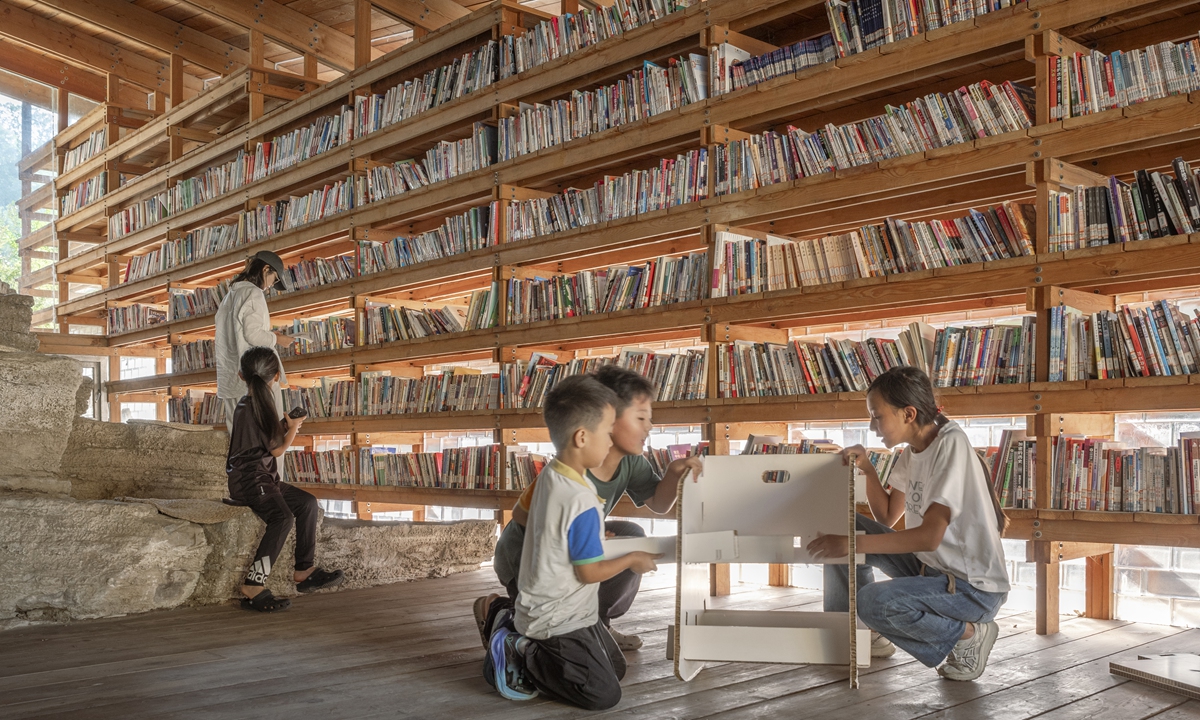
Children explore at the Zheshui Natural Library in Jincheng City, Shanxi Province. Photo: Courtesy of Luo Yujie
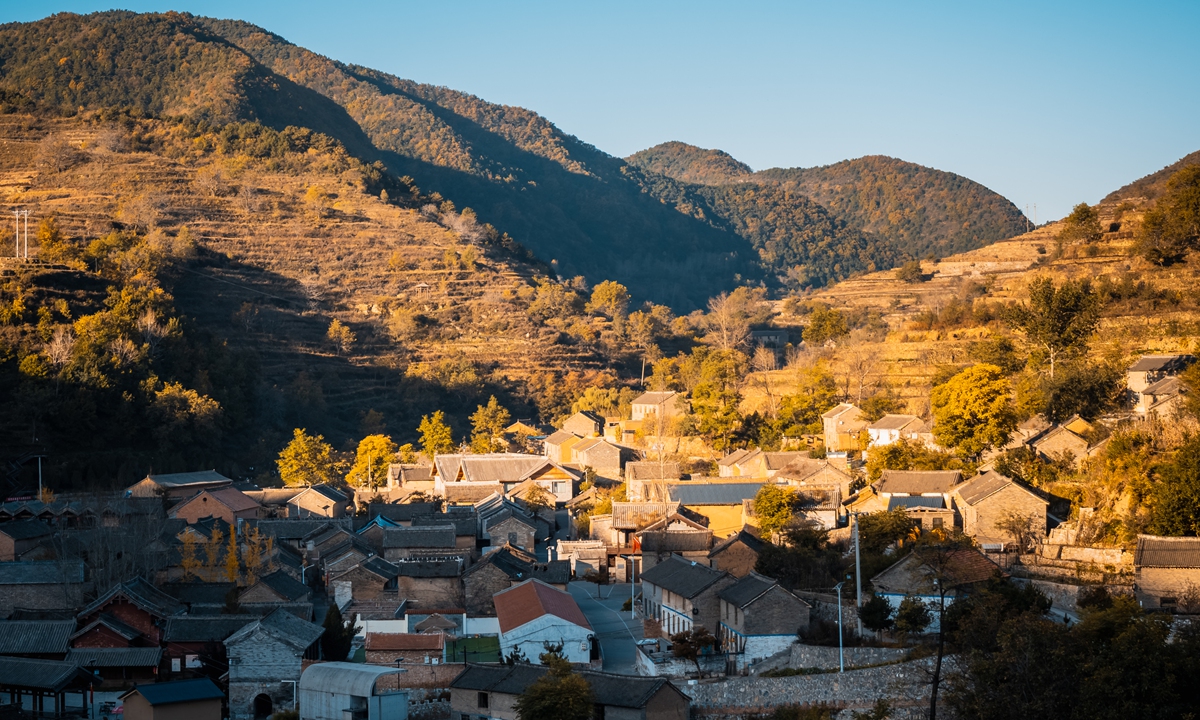
The view of the Zheshui Village in Jincheng City, Shanxi Province Photo: VCG
Along a winding stretch of the Taihang No. 1 Tourist Highway, in the rugged borderlands between the provinces of Shanxi and Henan, a small wooden structure sits quietly against a natural rock face. Its roof slopes gently. Sunlight filters through glass. Inside, roughly 2,500 books line shelves that double as structural supports. Soft woven mats rest on the smoothed stone floor, inviting villagers and visitors to sit and relax. A single tree rises through an intentional opening in the roof.This is the Zheshui Natural Library — known locally as the "Shale Library" because the layered rock behind it resembles stacked pages. At the 2026 Iconic Awards in Munich, the project and its client, the Zheshui Village Committee in Lingchuan county, Jincheng City, Shanxi Province, received the "Architects' Client of the Year" award, the first time a Chinese rural community has received the honor.
Luo Yujie, its designer, does not treat the prize as a goal. What he returns to, whenever he explains the library, is a single discipline. "We had to remain restrained," he said in an interview with the Global Times. "Minimal intervention is both practical and philosophical. It is also an Eastern idea: to work with what already exists." Flat land is scarce in these mountains and construction budgets drawn from provincial tourism funds are finite. Restraint, for him, was as much a budget decision as a worldview. It is also, as the Munich jurors would later make clear, what made the building worth noticing at all.
In harmony with the land
Luo, who teaches at the Central Academy of Fine Arts in Beijing, approached the site with a deliberately limited palette of ambitions. The team chose not to blast or extensively excavate the rock. Materials were kept light enough that local residents could handle them by hand. No large machinery arrived. No outside construction crews were hired. The wooden load-bearing wall that holds the books is also the primary structural element; it can be leaned against or sat upon. Luo likens it to the meirenkao, or "beauty's rest," a traditional railing that is at once a seat, a structural brace, and a place to gather.
The tree that pierces the roof is the clearest statement of the design ethos. "Half is made by people, half is given by nature," Luo said. "That balance is what the ancients meant by harmony between heaven and humanity. We simply tried not to break it."
It takes a village
The project was driven from the start by the village committee. When the chosen site overlapped a resident's courtyard, the conversation was direct. Luo explained the plan to the man: a library for children. The village's officials followed up. The man agreed and shifted his yard without drama. Older residents cleared soil from the rock face. Labor stayed local; money from the provincial construction budget remained in the community.
Luo has long argued that this kind of participation changes the relationship between people and a place. "If local people build something with their own hands for their own use, they care for it differently," he said. The finished library is now linked to the county library system, allowing books to circulate in and out of the venue. The village, which traces its history back some 800 years, receives more than 500,000 visitors a year. Residents have found work in tourism without leaving their hometown.
Only a handful of children still live in Zheshui full time. Luo said that the original motivation behind the project was simply to give those children a place that felt both beautiful and serious. Knowledge, he notes, altered the course of his own life. A well-made room for reading, in his view, is a quiet form of argument for possibility.
Resonating abroad
Western jurors, Luo said, responded to the human scale and the social narrative of the project. China's rapid urbanization over the past decades has left many rural areas diminished, as he sees it. A small library that treats a remote village as worthy of careful design reads to them as an act of attention rather than charity or branding. Its power lies in the opposite direction: anti-spectacle, anti-commercial, rooted in place.
Luo is careful about how Chinese architectural tradition should be carried forward. He rejects the production of faux-antique structures that merely reproduce traditional brackets and raised-beam systems as stage sets. "If the Chinese building tradition was a living person who had existed for thousands of years, it would not simply rebuild the Forbidden City or a Suzhou garden," he said. "It would become something else, but the underlying ideas — material thrift, climatic intelligence, structural honesty — would still guide it." Those ideas, he argues, have renewed relevance in an age concerned with carbon, waste, and energy.
His own work draws more from prolonged observation of traditional villages than from imported theory. The result is neither pure revival nor pure modernism. It is an attempt to keep a cultural conversation continuous while answering contemporary needs.
The Munich award is not, in Luo's telling, primarily about Western validation. It is evidence that a way of building grounded in Chinese rural practice can speak across borders without translation into spectacle. "We did not set out to seek recognition," he said. "We trusted the value of studying and implementing ideas on our own terms. The local character and the continuity of ideas turned out to be understandable elsewhere."
RELATED ARTICLES