China stresses co-op with Solomon Islands not subject to third-party influence following reported security pact uncertainty
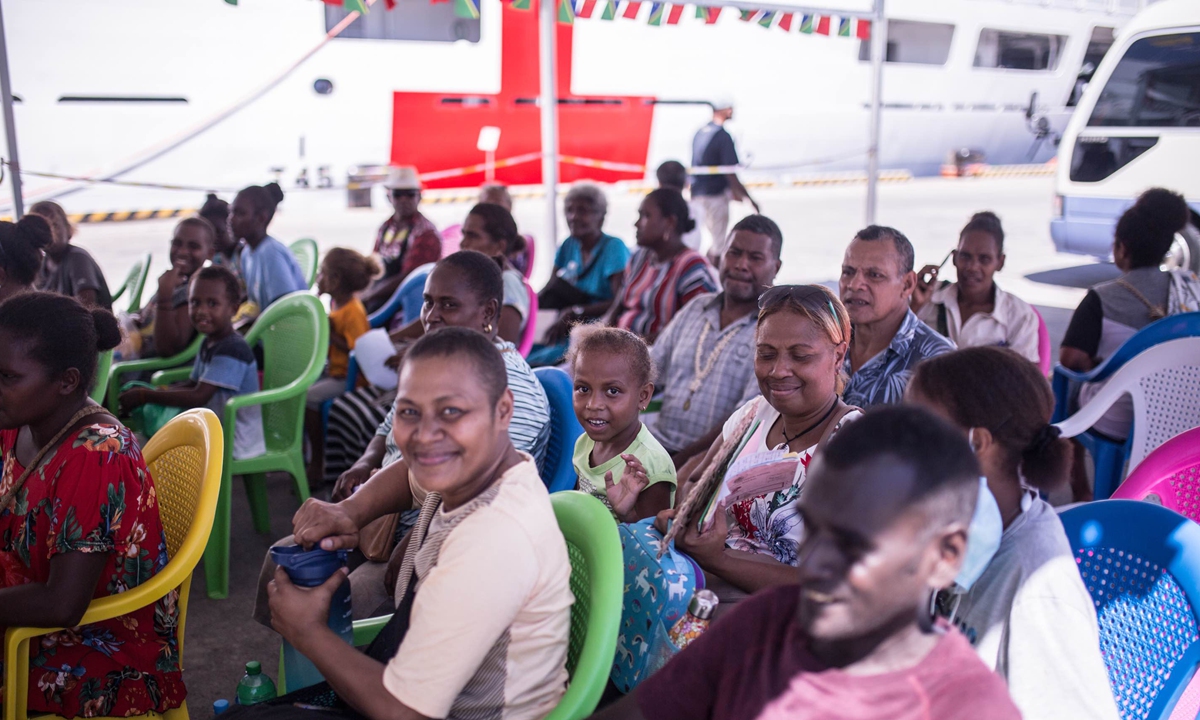
People wait to get onboard of the Chinese People's Liberation Army (PLA) Navy's Ark Peace hospital ship at Honiara port on August 20, 2023. Photo: Shan Jie/GT
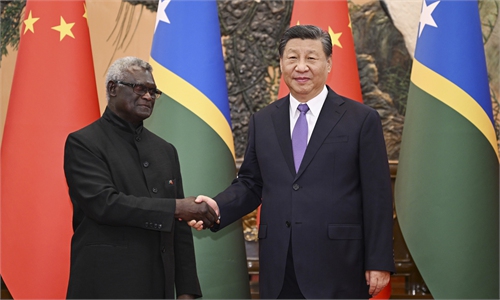
China has always developed its relations with the Solomon Islands on the basis of mutual respect and equality, Chinese Foreign Ministry spokesperson Guo Jiakun said on Tuesday, in response to media reports that the Pacific island nation had decided to terminate its security cooperation agreement with China when it expires next April.
China's cooperation with Pacific island countries, including the Solomon Islands, is not driven by geopolitical rivalry, does not involve bloc confrontation, is not directed against any third party, and is not subject to influence from any third party, Guo added.
The remarks came after Australian newspaper The Sydney Morning Herald reported on Tuesday that the Solomon Islands had decided to terminate the security agreement. The report, citing anonymous sources in the Solomon Islands, linked the decision to the country's plans to establish a new security arrangement with Australia.
It is important to note that China's response does not amount to a formal confirmation of the reported decision, Chen Hong, director of the Institute of Country and Region Studies at the School of Foreign Languages, East China Normal University, told the Global Times on Tuesday.
"Even if the report proves true, an adjustment to security cooperation between China and the Solomon Islands would not necessarily signal an overall shift in their bilateral relations, because the relationship between the two countries is not built on a single security agreement," Chen said.
The expert noted that the Solomon Islands' change of government in May had been accompanied by some shifts in its approach toward China. However, China has consistently maintained that genuinely sustainable international cooperation should not be premised on restricting cooperation with third parties, but should instead be centered on the development needs of Pacific island countries themselves, and that true cooperation should expand choices, not restrict them.
The debate over the agreement has prompted some criticism within the Solomon Islands. Former prime minister and opposition leader Manasseh Sogavare warned the government against scrapping the arrangement without carefully assessing the consequences for the country's national interests.
He said the 2022 framework agreement on security cooperation with China and subsequent police cooperation arrangements should be assessed based on the practical benefits they have delivered, noting that the Solomon Islands cannot afford to lose sight of its national priorities while trying to accommodate the expectations of others, according to Solomon Islands-based newspaper The Island Sun.
Sogavare also underscored that any new arrangements must protect the Solomon Islands' sovereignty and preserve its ability to maintain relationships with other development and security partners.
Noting that China's position on cooperation with Pacific island countries has remained consistent, Chen added that China-Solomon Islands cooperation has long extended beyond security to cover infrastructure, healthcare, education and training, trade and economic ties, and agricultural development.
These areas of cooperation are closely connected to the Solomon Islands' economic and social development needs, and their value would not disappear because of a change to one security agreement, Chen said.
The expert cautioned against attempts to make Pacific island countries' security choices part of geopolitical competition. If Australia seeks to use exclusive security arrangements to further constrain the diplomatic options available to Pacific island countries, this could prompt greater concern among those countries about protecting their strategic autonomy, Chen said.
The international community should work together to help Pacific island countries achieve sustainable development, uphold the principle of putting the islands' independent development first, and embrace openness and inclusiveness, and relevant cooperation should not target any third party, Guo said at press conference.
RELATED ARTICLES