International space cooperation opens a new chapter today: Global Times editorial
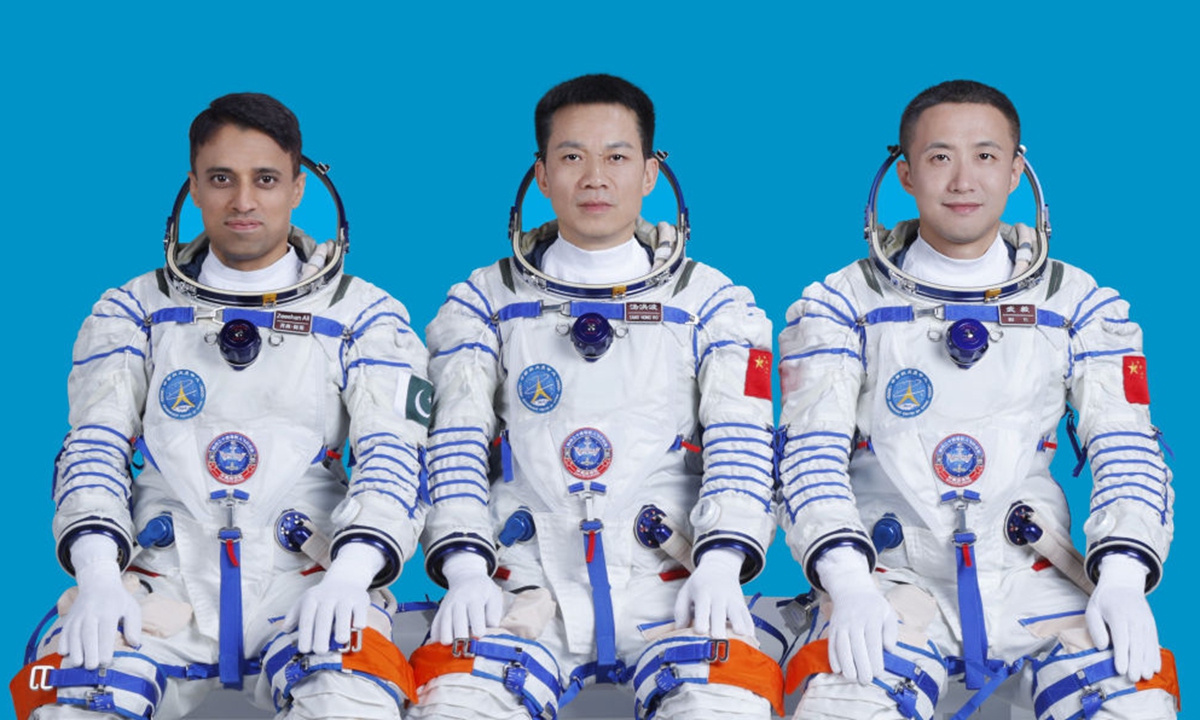
China Manned Space Agency (CMSA) on November 24, 2026, unveiled the Shenzhou-24 crew: spacecraft pilot Tang Hongbo (center), flight engineer Wu Yi (right), and payload specialist Muhammad Zeeshan Ali (left).
Over the past few decades, the ISS - built and operated primarily by countries including the US and Russia - has been the only "human laboratory" in space, leaving countries of the Global South with virtually no opportunity to even set foot on its threshold. The "Wolf Amendment" enacted by the US also explicitly excluded China from cooperation. Having been denied a "ticket" to the ISS back then, China launched its own space station through self-reliance - and has reserved "seats" for other nations as well.China's Shenzhou-24 crewed spaceship is scheduled to be launched from the Jiuquan Satellite Launch Center on the morning of November 25, Beijing time. What has drawn significant international attention is the inclusion of the first "non-Chinese face" among the crew for this mission. Muhammad Zeeshan Ali, a Pakistani astronaut, will travel to the Tiangong space station alongside Chinese astronauts to complete the first joint flight between Chinese and foreign astronauts in the history of China's manned space program. He will also carry out joint China-Pakistan space science experiments.
Pakistani media have widely reported on the event, with terms such as a "historic flight" and "the hopes of 250 million Pakistanis" in headlines. Chinese netizens have welcomed the guest with poetic remarks: "Under the starry sky, we greet friends from all quarters; aboard Tiangong, we gather guests from across the globe." A path of cooperation, jointly forged by China and other countries of the Global South, is slowly unfolding in the vast expanse of space.
Seven months ago, Ali stepped into the Astronaut Center of China. In his own words, he carries the hopes of 250 million Pakistanis. As is well known, human spaceflight sets extremely high thresholds in terms of industrial infrastructure, scientific research capabilities, and financial investment - thresholds that the vast majority of Global South countries find difficult to overcome on their own.
The Outer Space Treaty, which entered into force in 1967, explicitly stipulates that the exploration and use of outer space shall be carried out "for the benefit and in the interests of all countries," irrespective of their degree of economic or scientific development, "without discrimination of any kind." However, over the past few decades, the International Space Station (ISS) - built and operated primarily by countries including the US and Russia - has been the only "human laboratory" in space, leaving countries of the Global South with virtually no opportunity to even set foot on its threshold.
Pakistan's first entry into Tiangong is the natural outcome of 36 years of space cooperation between the two countries. As early as 1990, Pakistan's first scientific experimental satellite, Badr-1, was launched aboard a Chinese rocket. Since then, cooperation between the two sides has gradually expanded to fields such as communications, remote sensing, and satellite navigation.
In 2024, a Pakistani CubeSat accompanied the Chang'e-6 mission to the Moon, marking the country's first lunar exploration. Now, Pakistan is on the verge of realizing its dream of human spaceflight, and its lunar rover project has been included in the list of international cooperation initiatives for the Chang'e-8 mission.
The deepening of China-Pakistan space cooperation serves as a vivid illustration of how collaboration among the Global South is expanding into the frontiers of science and technology. Global South countries not only seek to improve people's livelihoods and advance industrialization but also have the right and the dream to reach the heights of scientific and technological innovation.
Looking back on the evolution of China's human spaceflight program, this commitment to openness stands out as all the more precious. China was unable to participate in the construction of the ISS due to external political factors; the "Wolf Amendment" enacted by the US explicitly excluded China from cooperation. Having once stood in the rain ourselves, we are all the more eager to hold an umbrella for others.
Before construction began on the Tiangong space station, China extended an invitation for cooperation to the world without any conditions. China, in collaboration with the United Nations Office for Outer Space Affairs, selected the first batch of international scientific research projects, involving 23 research institutions from 17 countries. On this mission, Ali will also serve as a payload specialist, carrying out substantive scientific research tasks. Having been denied a "ticket" to the ISS back then, China launched its own space station through self-reliance - and has reserved "seats" for other nations as well.
For China's Tiangong space station, this also marks a new beginning, with more countries, particularly those in the Global South, joining hands to build a wider circle of partners. Beyond crewed spaceflight, China has officially presented the United Nations with the first lunar samples collected from the far side of the Moon by the Chang'e-6 mission. The BeiDou Navigation Satellite System provides navigation services to more than 140 countries and regions, while the China-Brazil Earth Resources Satellite program helps protect the Amazon rainforest.
China has also signed more than 200 space cooperation agreements with over 50 countries and international organizations. The old era of major powers vying for supremacy in space, which characterized the last century, has come to an end, and a historic new chapter in international space cooperation is unfolding.
Outer space has now become a new frontier for human economic and social development. Its exploration and utilization, as well as the formulation of relevant rules, have a direct bearing on the long-term interests of all countries. On October 23, the Chinese side released China's Position on Strengthening Outer Space Governance, explicitly calling for safeguarding the right of all States to have equitable access to outer space and to explore and use it without discrimination, while increasing the representation and voice of developing countries.
If the vast majority of Global South countries remain absent from space exploration for an extended period, the power to determine the future allocation of outer space resources and formulate industry rules may once again become firmly concentrated in the hands of a handful of countries. As humanity expands its horizons for survival and development into space, it should not replicate the North-South divide seen on Earth, nor should it allow this new frontier to become the exclusive domain of a few countries seeking to monopolize its benefits.
"To see a thousand miles farther, ascend another storey." This line from an ancient Chinese poem was a particular favorite of Ali during his training in China. In the past, people tended to measure progress in space exploration by how far spacecraft could travel and how long astronauts could stay in orbit. Perhaps another yardstick should be added: how many countries have been able to participate in humanity's journey into space, and how many people's dreams have been realized along the way. Outer space is not an exclusive arena for competition among a handful of countries. Every nation with a dream has the right to reach for the stars.
RELATED ARTICLES