space mission Illustration: Xia Qing/GT
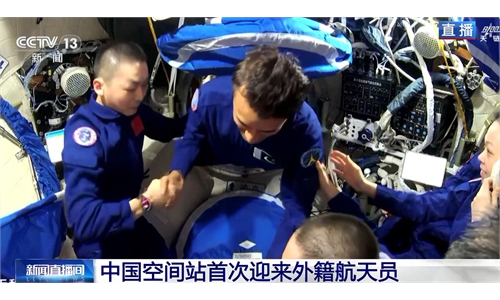
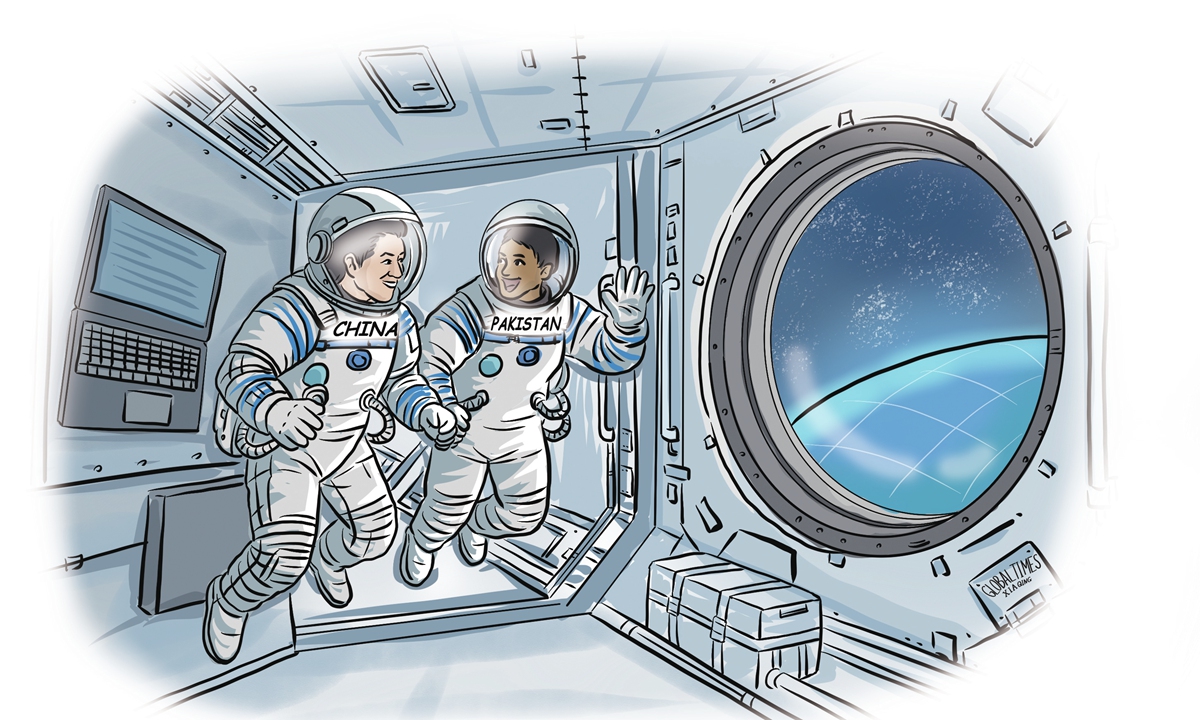
Pakistani astronaut Muhammad Zeeshan Ali, the first foreign astronaut to board China's Tiangong space station, lifted off on China's Shenzhou-24 crewed spacecraft on Wednesday. As a payload specialist, he will participate in the crew's daily operations, stay in space for roughly one week and return to Earth when the mission ends.
This landmark China-Pakistan space mission means much more than a historic first. It testifies to the enduring special friendship between the two countries, helps shape international norms for space cooperation, pioneers a new model for collaborative exploration and enables substantive participation by Global South nations.
First, it fully demonstrates the special friendship between China and Pakistan as all-weather strategic cooperative partners. On the 75th anniversary of bilateral diplomatic ties, China gave Pakistan this historic first opportunity, and cooperation at the frontier of cutting-edge technology has lifted the year's celebrations to a new level. Across Pakistan, crowds have taken to the streets with fireworks and firecrackers - a vivid display of the two nations' unbreakable friendship. It underscores that China-Pakistan relations are among the most representative and stable strategic partnerships in the world today.
Pakistani Prime Minister Muhammad Shahbaz Sharif stated that this space mission would "add a new dimension to the brotherly relations between Pakistan and China." Ali also remarked that it carries "the hopes of 250 million Pakistanis," and that China-Pakistan friendship is vaster than the outer space.
Second, it has effectively promoted the transition of international space cooperation from theoretical norms to practical collaboration. The boundaries of rights in human spaceflight have long been demarcated by technological capacity. Though international treaties enshrine shared benefits, the absence of enforceable rules has blocked substantive participation by Global South countries. This China-Pakistan joint spaceflight moves space cooperation beyond paper declarations, delivering visible, replicable cooperative models.
Although the 1967 Outer Space Treaty prescribes that the exploration and use of outer space "shall be carried out for the benefit and in the interests of all countries," this provision has yet to be accompanied by a clear enforcement mechanism. The 2020 Artemis Accords, by contrast, leave rule-setting for lunar and celestial resource activities largely to space front-runners. Since 2016, China has opened its space station to the world via the UN framework, turning that written principle into real operational procedures. This marks China's push to reorient space cooperation from an "eligibility-first" gatekeeping model to a "project-first" framework, challenging the exclusive, identity-driven Western "space club."
Third, it consolidates a new access paradigm that prioritizes project merit over membership status. Existing international space cooperation has long centered on membership, where resources are distributed according to membership standing and funding contributions. The Chinese space station, in contrast, uses project quality - rather than membership status - as the access criterion. Applicants don't need to possess space launch capabilities, only cover their R&D costs. For countries in the Global South, this means that the threshold for participation will be lowered from "possessing launch capabilities" to "possessing scientific research capabilities."
This China-Pakistan joint astronaut mission signals that global space cooperation is shifting its criteria from political identity to scientific value. With participation costs becoming more predictable, space research can be better integrated into national science agendas. This expands the pool for space-related public goods, a departure from the era when space exploration was the preserve of a few major powers. Small- and medium-sized countries can now gain equitable access to human spaceflight.
Fourth, it advances Global South nations from symbolic to substantive participation in space cooperation. This China-Pakistan joint mission marks a shift in the participation of Global South from a symbolic level to one of knowledge production. Ali will conduct hands-on space science work, overseeing the deployment and on-orbit operation of experimental samples and modules, including direct operation of the "green micro-factory" experiment. This tangible involvement will deliver solid scientific outputs for Pakistan.
Long shut out of the inner circle of human spaceflight collaboration, Pakistan is participating substantively for the first time. This gives Global South countries real-world grounds to weigh in on space rule-setting. It signals their evolution from passive rule-takers to stakeholders with first-hand human spaceflight experience. In turn, it will bring the weight of the Global South into global space governance, amplifying its voice in shaping international space rules.
The author is the director of the Pakistan Study Center and associate research fellow at the China Center for South Asian Studies, Sichuan University. opinion@globaltimes.com.cn
RELATED ARTICLES