SCI-TECH / OTHERS
China’s ‘star compute’ project completes AI model training tests in orbit
By and Li Hang Published: Nov 25, 2026 10:36 PM

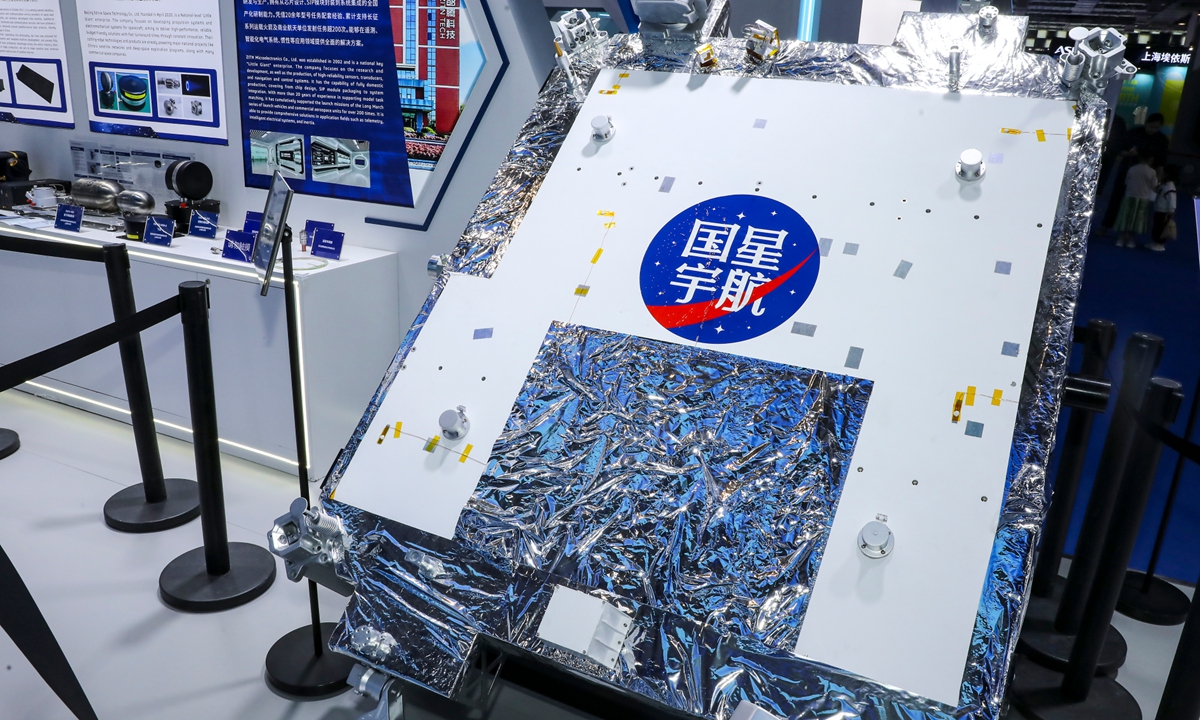
Photo: VCG
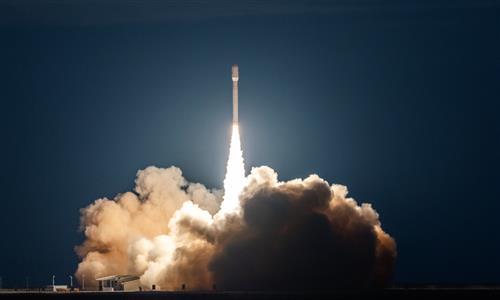
The China Academy of Information and Communications Technology (CAICT) recently released the results of third-party in-orbit capability tests of the second group of satellites making up China's "star compute" project. The second group was successfully launched from the Jiuquan Satellite Launch Center on October 14, bringing the constellation's total computing capacity to nearly 50 POPS (peta operations per second) and making it the world's largest space-based computing constellation currently in orbit, according to Chinese space AI company ADA Space, the project's developer.The tests demonstrated the satellites' ability to perform high-performance computing and train large language models while in orbit. One of the satellites, named Libra, has a nominal computing capacity of 32 petaflops (PFLOPS) at FP8 precision and has completed in-orbit training and inference tests involving Alibaba's Qwen3-32B large language model, according to the test results.
A key achievement was the satellite's ability to conduct continuous full training during an orbital pass. The Libra satellite trained an AI model for 45 minutes and 33 seconds, during which the model's error rate steadily decreased, indicating that it was learning effectively.
The entire model training loop - forward propagation, backward propagation, gradient calculation and weight updates - was completed during the orbit, according to the test.
By comparison, according to publicly available reports, the continuous operating time of Google's in-orbit tensor processing unit (TPU) prototype sits at around 15 minutes per run due to heat dissipation limits, meaning the Chinese satellite can operate over a far longer time.
The tests also demonstrated progress in thermal management for high-power computing payloads. Guoxing Aerospace's 10-kilowatt-class liquid-cooling fluid loop system and extra-large deployable radiative cooling wings operated normally in orbit. Together, they meet the thermal-control requirements for the continuous operation of computing payloads in the 10-kilowatt range, helping ensure the long-term stable operation of high-performance computing satellites.
Space-based computing refers to deploying computing infrastructure in orbit and connecting satellites into networks to provide seamless global coverage. Compared with ground-based data centers, its main advantages lie in real-time data processing and wider coverage. The development of space-based computing is being driven by several factors, including surging demand for AI computing power, advances in reusable rocket technology, and constraints on ground-based data center construction, particularly in terms of energy supply and available space, according to China's state broadcaster CCTV.
Computing satellites can be connected through laser communications to data collection satellites to form a network that provides global coverage and processes data directly in orbit. This could reduce the time needed for applications such as disaster warnings and resource monitoring from several hours to seconds, a capability that is difficult to achieve through ground-based computing alone, Xie Lina, deputy director of the Cloud Computing and Big Data Research Institute under the CAICT, was quoted as saying in the CCTV report.
"The future of the human information industry will inevitably be an integrated space-air-ground system. A large volume of data will be processed in space, where abundant solar energy can be harnessed to provide greater power and higher efficiency," Xiang Ligang, director-general of the Zhongguancun Modern Information Consumer Application Industry Technology Alliance, told the Global Times.
By deploying computing capabilities in orbit, monitor satellites can be managed directly from space, while many computational tasks can also be completed there, Xiang said.
"This approach can significantly improve efficiency and reduce costs. It also offers a certain degree of security, as it minimizes the need for large-scale data transmission," he noted.
The "star compute" plan is an ambitious project by the company to build AI space infrastructure composed of 2,800 computing satellites.
Under the plan, the "star compute" network will consist of 2,400 inference computing satellites and 400 training computing satellites, deployed in dawn-dusk orbits, sun-synchronous orbits and low-inclination orbits at altitudes between 500 and 1,000 kilometers.
Through satellite-to-ground and inter-satellite laser communication networking, it will ultimately form a global training and inference computing network, capable of delivering inference power at the hundred-thousand-petaflop level and training power at the million-petaflop level.
The first group of satellites for this plan was successfully launched in May 2025.
RELATED ARTICLES